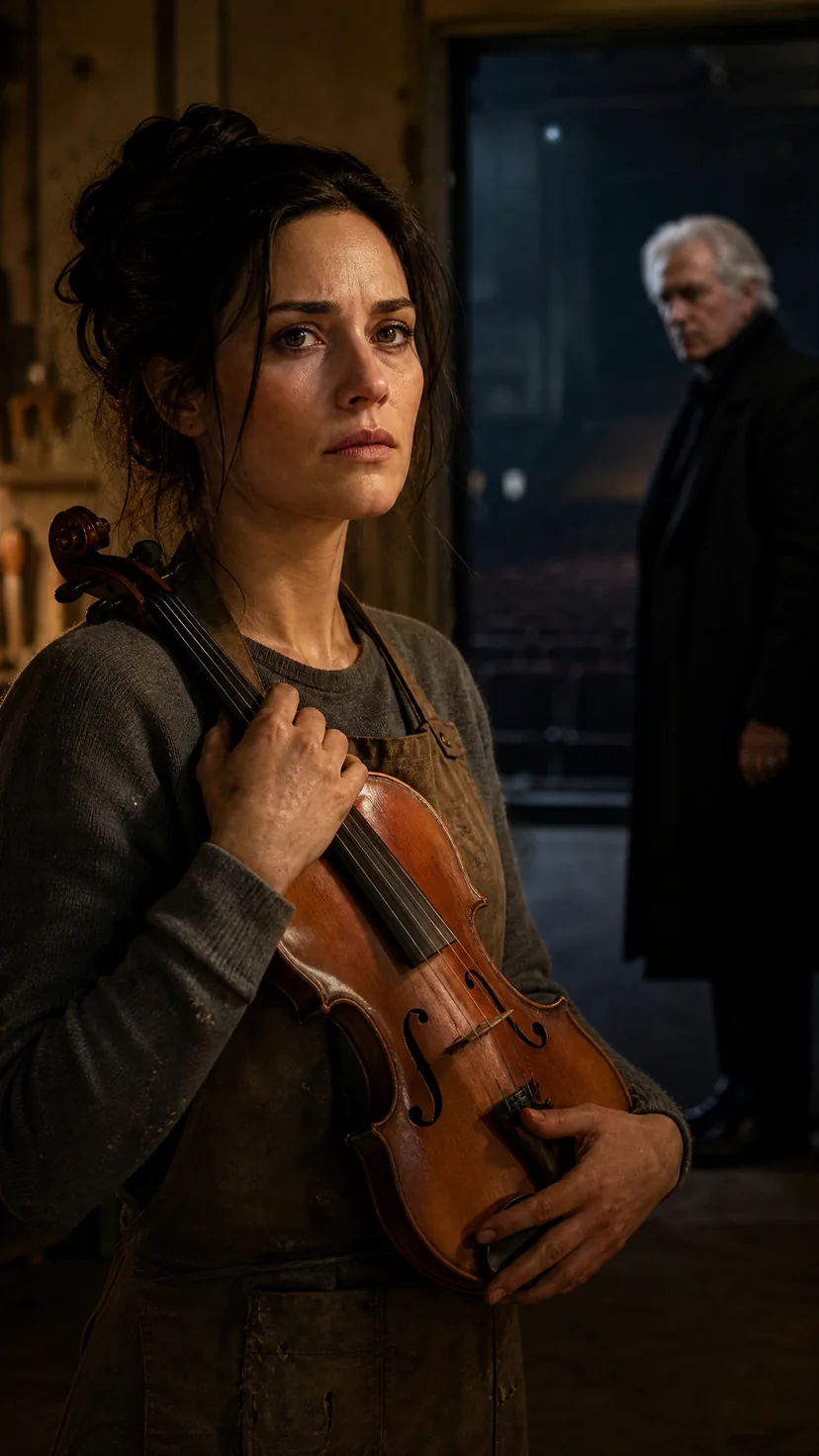
My pianist cancelled before breakfast, and by the time I knew it, Rosa Sandor had already told Priya she would play.
I hadn't asked my mother for anything in fifteen years, and now I had to walk into Harrowgate Hall beside her or lose my slot. How had she known the pianist was gone before I did?
Priya put us in warm-up room B, because the rule was by number. She said it kindly and quoted it twice, and I understood she was telling me she was sorry.
The room smelled of rosin and radiator dust. Rosa sat at the upright with her coat on, penciling something into the Mozart. "You rush the entrance to forty-six."
"Nobody asked you."
"Priya did." She didn't look up. "You'd have said no on the phone."
"Yes."
"Then I saved us the phone bill." She turned a page. "Your grandfather paid for every one of your lessons. I'm not letting a stranger on a borrowed piano spend them."
"He's dead, Mama."
"So is the money. Tune."
"Don't talk to me about money."
"I'm talking about forty-six." Her hands stayed flat on the lid. "Tune."
I tuned my A to her piano, which was a quarter tone flat, and told myself that was why my hands were cold. Henrietta's violin lay on my knee, and the maple under my thumb was the only honest thing in the room.
The door opened without a knock. Ada stood there in her laundromat polo, holding a school loaner by the neck, a scarred student fiddle with a chin rest held on by a rubber band.
"He took it at seven." She said it fast, to the floor. "Grandma let him in, she thought it was a setup check. He said a student who goes behind his back isn't his. Then he took the violin. Out of my hands."
"Ada."
"Go on, say it. I'm an idiot, I lent him my whole life for a Sunday." She tried a laugh and it broke. "This thing buzzes on the G. It buzzes on everything. I'm on at thirty. Well?"
I looked at the loaner. I looked at Rosa, who had stopped writing. A fiddle like that would sink her in the first four bars, and I knew exactly what the first four bars cost, because I'd paid it once with a better instrument.
"Take this one," I said, and held out Henrietta's violin.
"It's yours."
"It's lent to me, which is worse." My arm didn't want to move. "I go thirty-first. You go first and you give it back warm."
"You'll have nothing to warm up on."
"I'll have whatever you leave in it." I put it in her hands and felt my own go empty. "Your elbow's still too high."
Rosa closed the score. "I play for both," she said, to nobody, and for once there was no verdict in it.
The wing door was painted plywood that shivered with every low note from the hall. I stood behind it with my palm flat on it and listened to Ada go through the exposition.
She played it lower at the elbow, and she played it better, and I didn't know which of those was worse for me. Bar 46 came and she went straight through it, the way you cross a stair that has stopped being a stair.
When she came off, her face was wet and she held out Henrietta's violin with both hands. The chin rest was warm and damp from her jaw, and I put my own jaw on it without wiping it.
I walked out into the hall in front of a screen and a panel I could not see. Rosa's first chord was a mile off true, and I came in anyway.
I reached bar 46. I didn't stop. I went through it with her wrong, a steady piano under me, and my left hand, which had waited fifteen years to be asked, answered. The varnish smell of the borrowed violin was in my nose the whole way, and I never once looked for the chair.
Priya pinned the list at half past four. She read it to us in the lobby first, because that's what she does.
"Finalists, Saturday the twenty-fourth. Arden. Whitcombe. Sandor."
Ada made a noise and sat on the floor in her polo, in the middle of the Harrowgate lobby. I stood very still, because I had never once been in this lobby when the news was good.
"Congratulations, ladies." Anton Arden had come up behind us, twenty-six and tidy, with a smile that wanted something. "Brilliant, both of you. I should tell you, I switched to Lasko this week. He's worked miracles on my shifting."
"Has he," I said. I checked his hand for a ring to turn. He wore none.
"He says the final is going to be a wonderful story." He glanced at Ada, then at me. "He did say hello, Miriam."
He went. Ada, on the floor, said in a small voice, "He's going to come for us." I took the violin from her and set it in its case, and then I walked her out to the bus and came back for my mother.
Rosa was alone at the foot of the stairs, buttoning her coat over her good blouse. She had spent the day at a piano for two girls who weren't hers.
"Thank you," I said. "For playing."
She stopped buttoning. "Don't."
"I mean it. You didn't have to."
My mother looked past me at the double doors, where the lobby light fell on the exact tile I had never been able to cross in my head. "I saw him walk out of this hall with your case while you were still upstairs. All I sold him was my name."