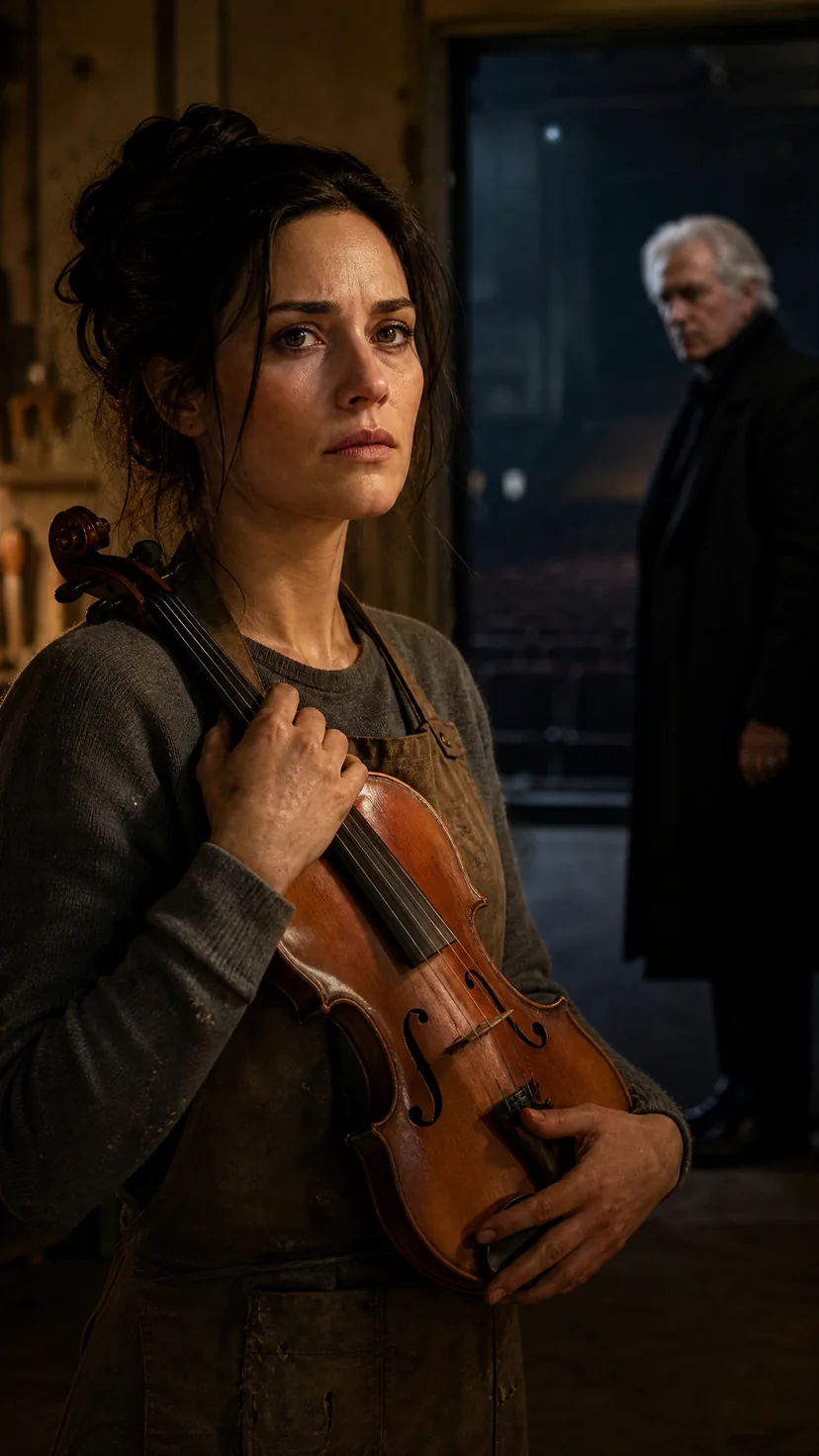
On Thursday morning the Harrowgate gave my final to the man who had ended my first one.
Priya phoned at ten past nine to say Greta Brandt had pneumonia, and that I should sit down. I stayed standing. My mother was at the counter with a foil pan of rice, and for five days I had not asked her for the rest of what she'd said in that lobby.
"The committee named a guest chair this morning," Priya said, low, the way she quotes a rule she'd like broken. "Off the record. Viktor Lasko. He's abstaining on Anton Arden, because Anton is his declared student. But he told them, and I'm quoting, that he'd already promised the seat to his student."
"Anton," I said.
"I didn't say that. I said what he said."
I put the phone face down. The shop smelled of shellac and hot foil. Rosa watched me over the rice.
"Lasko's chairing the final," I said.
"Then eat before you shout."
"You said all you sold him was your name. Why did he need it, Mama, if he already had the violin?"
She smoothed a glove flat against the counter, finger by finger. "A name is cheap. The rice is not."
"Mama."
She looked at the bench, at the clamps lined up like teeth, at the three months of rent notices I kept under the glue pot as if paper could be hidden from paper. "Your grandfather never asked what a thing cost until it was gone," she said. "I am not starting now."
Then she was at the door, and the bell rang behind her, and the foil was still warm under my hand. As finalists we had each been given a practice room at the hall for the week. I had booked mine for Ada's lesson at five. Now I had a reason to be there at four.
The side door of Harrowgate Hall had a brass knob so cold it stung my palm. I had planned on Priya's door and a firm voice. I had not planned on my knees. Inside, the house lights were down to half, and the velvet smelled of dust and old coats.
Priya wasn't in her office. Tremayne wasn't in his. I went through to the stalls to see if anyone at all was left in the building, and there in the front row, alone, with one arm along the seat back, sat Viktor Lasko.
"Miriam," he said, without turning around. "You walk like your grandfather."
I came down the aisle and stopped two rows behind him. "You're chairing the final."
"Greta asked me herself."
"From a hospital bed."
"She is a very persuasive woman."
His left hand lay on the armrest. With his thumb he turned the ring on his little finger, one slow quarter turn, and I thought: she's in a hospital bed, and he is still lying about her.
"Step down," I said. "Today. Or I tell Tremayne you've rigged it for Anton."
"I'm abstaining on Anton."
"You told them the seat was promised."
"Priya reads minutes aloud. She's always been generous." He turned the ring back.
I came down one more row. Now it was close enough to read. The face of the ring was flat and oval, the size of a fingernail, gold worn soft except for a tiny nick at the upper rim.
I took out my phone. I didn't have to look for the picture. I had looked at it every night since the fifth of October, under the bench lamp, with the sound off.
"I photograph everything that comes in damaged," I said. "Before I touch it."
I held the screen out next to his hand. The oval in the varnish was the same oval. The puckered edge was the same, and the nick at the top was the same, a flaw as small as a hair, pressed into the lacquer right over the soundpost.
He looked at the phone. He did not look at me. His face stayed perfectly calm, and the ring went around once, all the way.
"You pressed the top in," I said. "You killed the post first, and then you leaned on it. You told her not to bring it to me, and you knew I'd see it."
Nothing. He studied my phone as if it were a score he had been handed late. A seat creaked somewhere in the dark upstairs, and a long way off a cleaner's cart rattled.
"You choked it again on the Sunday, so Ada would sound like a girl on a borrowed fiddle. You dropped her so Anton could walk in alone." My voice was too loud for an empty hall and I let it be. "And my mother saw you carry my case out of this hall fifteen years ago, while I was still upstairs."
For the first time he moved. He stood, slowly, as a man stands who has been told the train is late, and picked up the black case that had been sitting beside him on the seat. He set it on the front row and thumbed the two latches.
The lid came up. A little rosin dust lifted off the velvet and hung in the stage light.
The violin lay in blue velvet with its scroll toward me. I knew the retouch before I knew anything else: my own varnish, three inches along the treble side, still a half shade too bright, because it needed another month to settle. It had been in Ada's hands that Friday. It had been in his since Saturday.
I did not decide to take it. My hands decided, and then they had the weight of it, and the weight was exactly right. For fifteen years they had been empty. I had stopped noticing.
"Ada plays that," I said.
"Play the final on it." He closed my left hand around the neck with his own, the ring cold against my knuckle, and he did not let go at once. "I meant you, Miriam. I always meant you."
Behind us the door at the top of the aisle opened. Ada stood in the light with her rubber-banded loaner under her arm, and she had seen him put the violin in my hands.