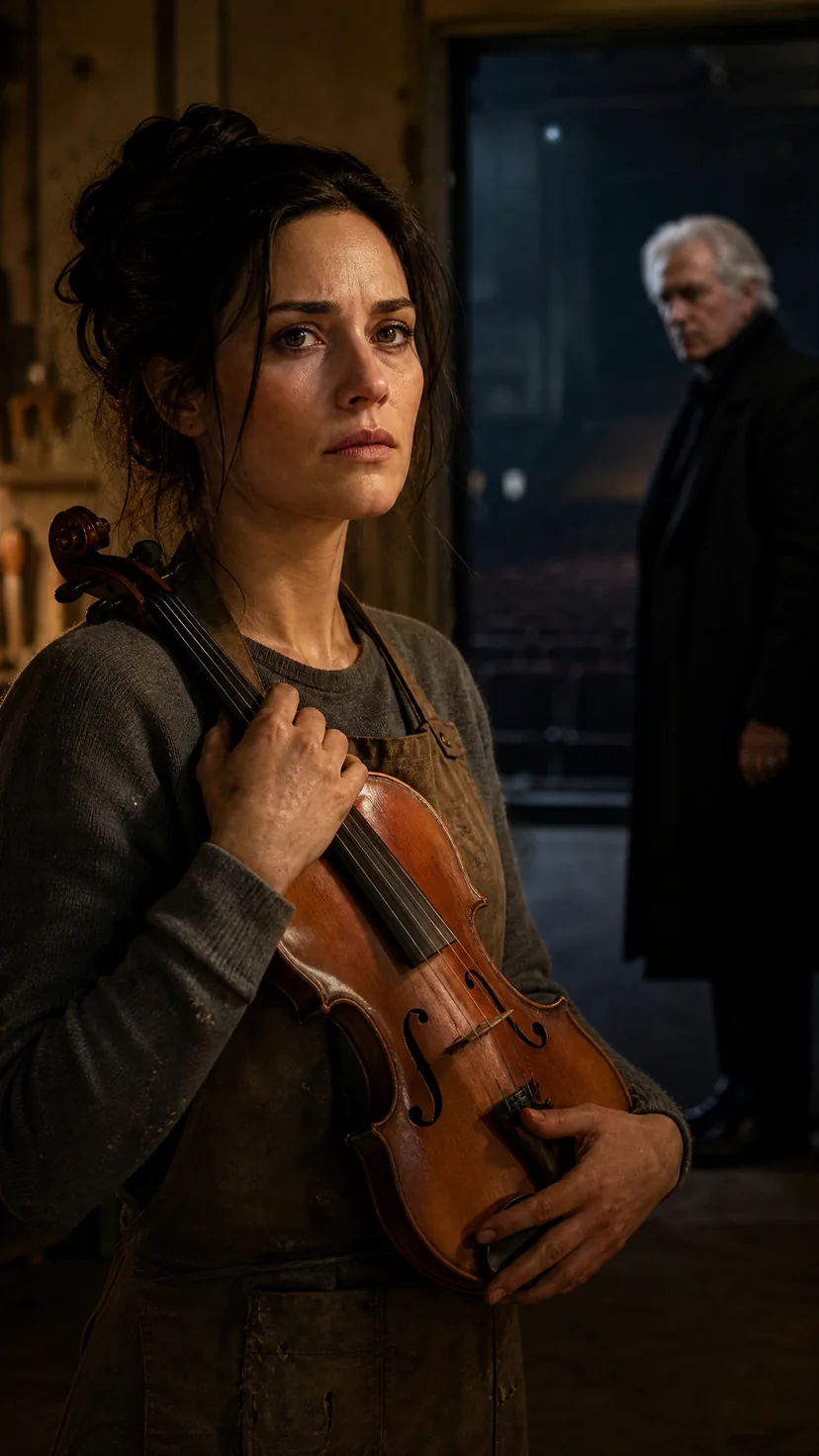
Viktor Lasko phoned the shop line at ten past eight Monday morning, and he was kind about it. Nobody had said my name that gently since my grandfather's funeral. Why would a man who wanted me gone sound so sorry?
"Miriam. I'm calling as a friend."
"You've never been one." The hide glue pot ticked on the bench beside me. The shop smelled of it, warm and animal.
"Withdraw," he said. "Today, while it can still be called nerves. You were never built for this, and I'd hate to see you proved it in front of Brandt's panel."
"Your lawyer spelled Tolland with one L."
"The letter can be corrected." A pause, and in it I could almost hear the ring turning. "So can an afternoon. Think of the girl, Miriam. A student shouldn't be carried into a guild complaint by her repairer."
He hung up first. I stood holding the receiver until the dial tone started to whine, and I told myself it was only a phone call.
Ada came in through the back lane at a quarter past four, with the violin wrapped in a Suds & Spin laundry bag like a shirt she was ashamed of. "Don't say anything. I'm already awful."
"Put it down."
"Mr. Lasko had it Sunday. For a setup check, he said, because of the, you know. The letter." She didn't look at me. "He gave it back at six. It sounds like a duck in a bucket."
I tuned the E string and bowed an open fifth. The sound came out gray and squeezed, with nothing under it. I took off the strings, slackened the bridge and looked at the feet through the penlight.
They'd been sanded. The bottom curves were rubbed flat, bright and fresh, so the bridge sat on the top like a table on a rug. Through the f-hole the dental mirror found the soundpost pushed hard toward the bass side, a quarter inch past where I'd set it Friday.
A post doesn't walk a quarter inch on its own. Somebody walked it there, where it would choke a violin and make a lawyer's letter true.
I photographed everything for the job log: the feet, the post's scratch on the top, the bright dust still caught in the grain. Sanded wood is a signature, if you know how to read it.
"Who was in the studio Sunday?" I said.
"Just him." Ada hugged her elbows. "Why?"
"Sit." I got the soundpost setter. "Nothing."
It took me forty minutes, nudging the post back, listening for it, nudging again. The spruce dust smelled like a pencil. When I strung it up I handed Ada the violin without a word.
She played the opening of the Mozart, and the room filled up as if somebody had opened a window. Her bow arm was still wrong. The sound was not.
Halfway through the second phrase she stopped, because she was crying, and she wiped her face with the laundry bag. "That's disgusting. Ignore me. I leak."
"Elbow," I said.
"I will pay you to stop saying that."
"You already have."
I left her tuning and went up the back stairs, because I'd heard every note of that Mozart through my own ceiling, and I wanted to know how.
Joel's door was open. He was folding a music stand, in his concert blacks, and he looked up with his whole face. "Is that her? Is that the sound? Did you hear it from up here?"
"I heard it from my bench." I pointed at the floor. "Where the board over my workbench lifts."
"Does it?"
"It's lifted a quarter inch, and there's a towel under it. Joel."
He put the stand down very carefully. "Draft," he said.
"Who sent in my application?"
His mouth opened as if to joke, and then he didn't. "I did."
"Why?"
"Because you'd never have. I thought, somebody has to put your name in a hat." He rubbed the back of his neck. "That's all it was. You're not mad. Are you mad? You look mad."
"I look like a person who found a hole in her ceiling." I waited, and he held my eye and told me nothing else, and I let him. A deflection is a crack too. You can feel where it's been glued.
"Excuse me." Ada stood at the top of the stairs with the violin in both hands. "I'm sorry. I heard shouting. I mean talking. I'm sorry." She looked from him to me and straightened her shoulders. "Can you teach me? Not the fixing. The Mozart. Properly."
"You have a teacher."
"I have a landlord." She tried to laugh. "He lends me the violin. If I study with anyone else he drops me, he's done it before, ask anyone. Then the violin goes back to him, and I'm a laundromat girl with a fourth place at youth orchestra. And he gets to say I was never any good."
"Then you can't," I said.
"I can't not." She held the case against her chest like a shield. "Saturday I was awful and I was fine because of what you said in the lobby. I need more of that. Please."
Joel said, very quietly, "Nobody comes up the back stairs after nine. I've got a stand, a metronome and a flat nobody visits."
"No," I said, and then I thought of Lasko's kindness on the phone, his one L, his hand on a girl's violin.
"Tuesday," I said. "Nine o'clock. If he asks, you've never been up these stairs."
She nodded so hard her hair fell out of its clip, and I watched a seventeen-year-old hand me everything she had.
Joel turned the metronome on to hide his face. It ticked once, twice, and I understood that I had just agreed to hide Lasko's student in the one flat in Port Ellery where the floor already knew how I sounded.