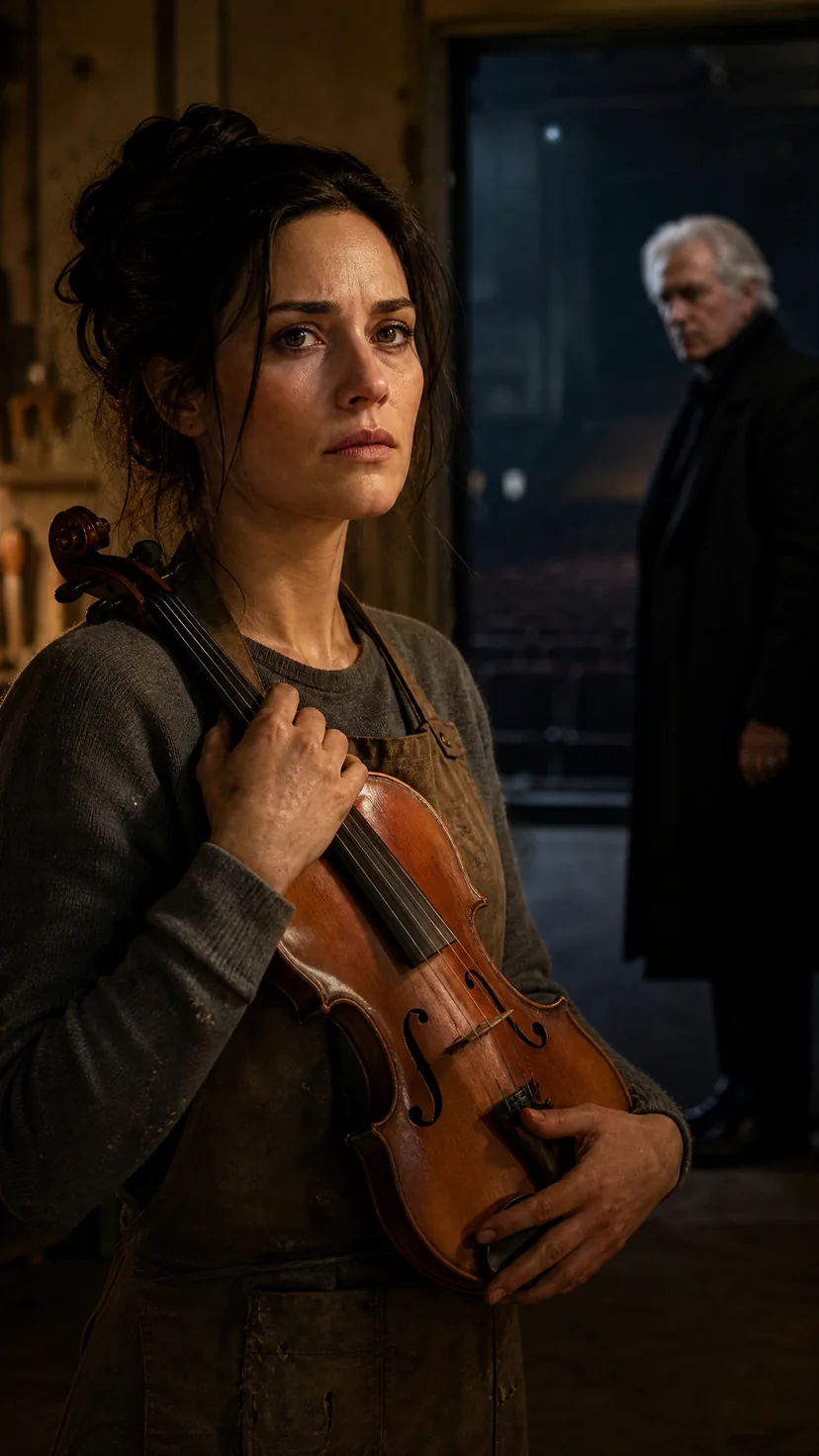
"Sandor," a man said, to the wall, to the room. "Isn't she the one who walked out?"
Eleven candidates stopped tuning. My bow thumb locked around the frog, and I had been in the warm-up room for four minutes.
Nobody answered him. Nobody had to. Who had kept that story warm for fifteen years, and why was it still so easy to tell?
I turned my back. Henrietta's violin smelled of clean rosin and nothing else, and my hands didn't know it. A violin you haven't broken in is a stranger's coat.
Across the room, at an upright piano with a cracked music desk, Rosa was running a boy through his Brahms. My mother had not looked up when I came in. She had a gift for it.
I crossed the carpet. "You said you didn't take auditions anymore."
"Forty dollars an hour." She played the boy's four bars again, harder. "Accompanists eat."
"Mama."
"Your A is flat." She still didn't look. Then her left hand came off the keys and sat on her knee, and she said to the music desk, "I waited in this lobby once. It has terrible chairs."
I waited for the rest. Rosa put her hand back on the keys.
"Tune," she said.
I tuned. I had no idea where to put a lobby and a bad chair.
Candidates stood in the corridor outside the hall during other people's turns. The rule was no shoes on the boards, carpet runner only, so the panel hearing us behind the screen couldn't tell a man from a woman from a girl in her work sneakers.
Number thirty began at nine twenty-eight. I put my palm on the hall door. The oak was smooth and faintly damp, like a held breath.
I knew the first note before she played it. The open G had a grain I'd chased for two days with a setter and a lamp, and now it came through the wood with nothing between us but a quarter inch of oak. Ada didn't hold back. I had half expected she might, after what she'd asked me, but she opened the Mozart like a window in a fire.
At bar 46 she took the shift without looking. A stair she had climbed all her life.
Behind me, somebody exhaled. I realized it was me.
"Candidate thirty-one."
Priya Nandakumar had a clipboard and a lanyard and the kind of voice that tells you where the exits are. She walked me to the door. "Rule six," she said. "One restart per excerpt, from the top of the phrase. Panels hear restarts as information." She glanced at the clipboard, not at me. "Most of them take it as courage."
"And the rest?"
"Take it as a restart," Priya said, and opened the door.
A black cloth screen stood in the middle of the stage, with a chair on my side and fourteen empty seats on the other. Somebody behind it coughed. I put my feet on the carpet and my bow on the string.
The exposition went like a drive on a road I knew. Bars one through forty-five, clean.
Then bar 46, and the shift.
My hand knew where to go. It simply didn't go. Fifteen years of the same bar, played in the dark, in the sink, in the cab of a van, and now the finger hung above the string like a dropped plumb line. The note I wanted sat six inches away and nothing in me would send my hand to it.
The sound that came out was a squeak. A bad one, a cat on a fence.
I stopped. Behind the cloth a pencil scratched.
I could have walked out again. I saw how short the walk to the door was.
"Restarting," I said, to the cloth, "from bar 40."
The pencil stopped.
I played bar 40. I played 41, 44, 45. At 46, I did not look at my hand, and my hand went, and the note rang out of Henrietta's violin in the right place and the cloth said nothing at all. I played to the end of the passage.
My hands were shaking when I came out. They went on for some time.
The results went up on the lobby corkboard at eleven fifteen: a printed list, thirty-one numbers long. I did not look for mine. I looked at the first column and found thirty, and then, because the eye can't help it, the line below.
Thirty and thirty-one. Both advancing. Semifinal, Saturday the seventeenth.
"Well?" Ada said behind my shoulder. She was in her Suds & Spin polo. I'd forgotten she had to work tonight. She looked at the list and put her hand over her mouth. "Both. It passed two. He said it wouldn't."
"Who said?"
"Mr. Lasko. I mean. Everybody says it." Her eyes were wet and she was grinning, and she punched my arm with the violin case. "You were awful at forty-six. You were also fine. You're so weird."
"Your elbow's still too high."
"I will pay you to stop saying that," she said, and I laughed once, loudly, in a lobby full of people who'd heard what I'd walked out of.
Then she stopped, because Lasko was crossing the marble toward us in a gray coat, with both hands out.
"Ada. Wonderful." He took her free hand in both of his, and the gold ring slid on his little finger as he turned it. "Opening G like that on that violin. I'm proud of you."
He looked at me over her head. Flat oval face. A man congratulating a stranger's daughter.
"Miriam. A restart. What a brave thing to do in front of that room." He released Ada and took an envelope from inside his coat. Cream paper. A law firm's name in raised letters. "A courtesy. Before it goes anywhere else."
I opened it on the marble, where my mother's terrible chairs still sat along the wall.
The first line was my name and the shop's address. The second said my repair had ruined the tone of a violin in his keeping. The third had a number: nine thousand dollars. After that, the word guild.
Ada said, "What is it?" Nobody answered her.
Lasko turned his ring a full circle, and smiled.
"Withdraw this afternoon, Miriam," he said, "and I'll forget I ever signed it."