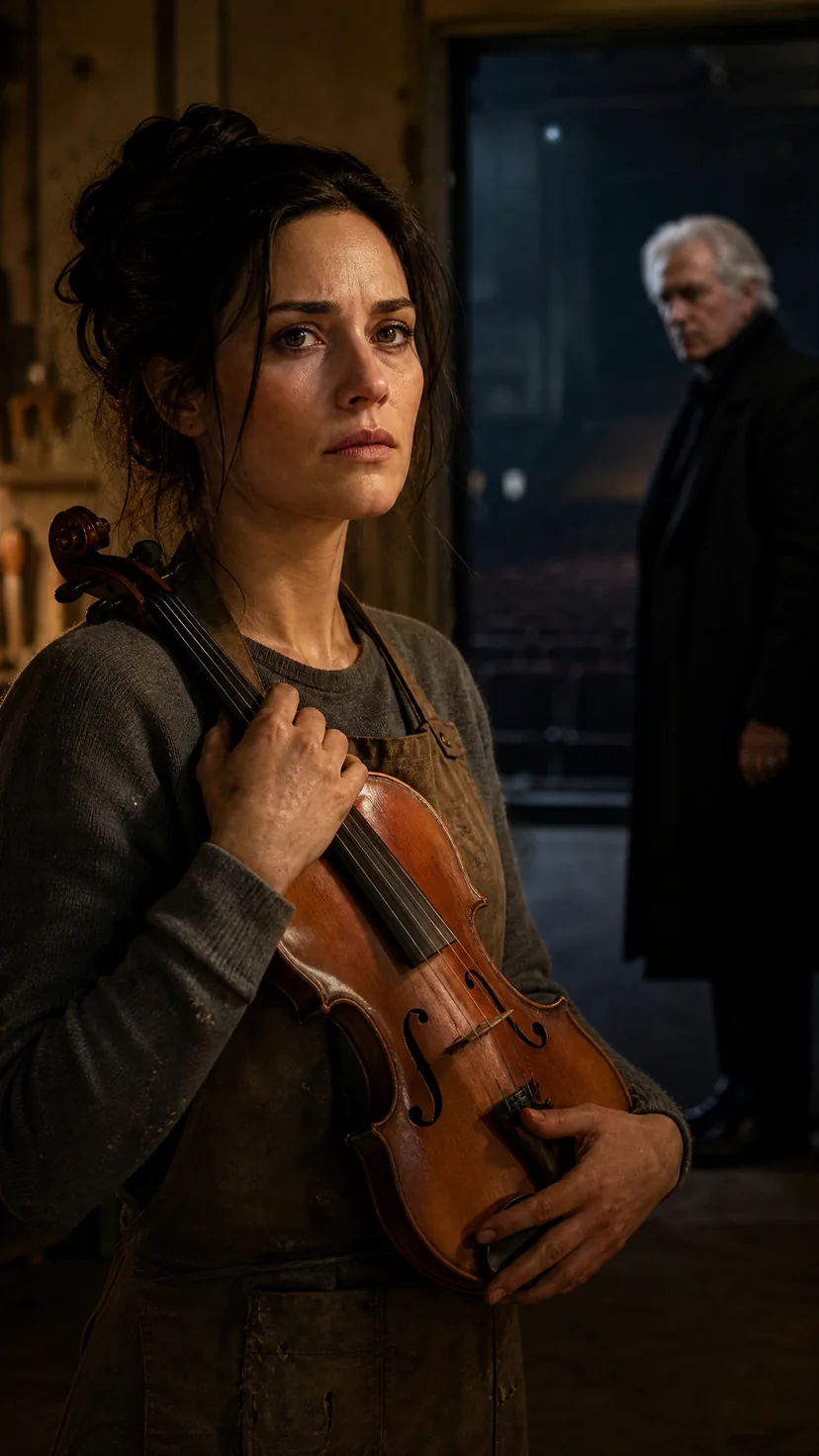
The woman in my doorway said "Miriam" as if she'd said it yesterday. The hank of horsehair I was combing slid out of my fingers and spread across the bench, two hours of knots gone. She had a bow case in her right hand, and I could not think who had told her where I was, or why she'd bothered to look.
"Henrietta Dorn," she said, and laughed, though nothing had been funny. "I'm sorry. You'd have to be a ghost to forget me."
I hadn't. She was thirty-four, camel coat, lipstick the color of a stop sign. Her left hand stayed in her pocket the whole time, like something she'd been told to keep out of the weather.
"It needs rehairing," she said, and put the case on the counter. The bow inside was good old pernambuco with the hair gone grey and slack. Rosin dust came off it like flour, and the room filled with that smell, a barn with the heat on.
"Tomorrow noon," I said.
"Lovely." She didn't leave.
I took the card out of my coat and laid it on the counter between us, lily up. I had slept with it under the pillow, which I will deny. "Did this come from you?"
She looked at it for longer than it takes to read ten words. "It came from the office. Everyone got told the same thing, you know. They told the panel you'd been taken ill." She smiled at the lily. "We all believed it."
"Who's we?"
"Oh, everyone. The panel, the other finalists, me. I was nineteen. You were eighteen." She laughed again, in the wrong place, a little too high.
I let the silence stand until she looked up. Then I said, "I wasn't ill."
"Well. Nobody checked." Her good hand found the strap of her bag. "You'll need an instrument for Saturday. Mine's in the car. It's a good one, and it's sitting in a case, which is a sad thing to do to a fiddle."
"I have a shop full of violins."
"With dead G strings." She said it kindly. "I can tell from here."
I took down the best of the wall, a Czech workshop violin with a one-piece back and a bridge I had cut myself. I tuned it, and Henrietta stood by the window with her pocket against the glass.
I played the opening of the Mozart. The first eight bars came, thin but true. At bar 46 my left hand went somewhere I had not sent it, and the note fell off the string like a plate off a shelf.
I tried it again and it did the same. Henrietta said nothing at all, and her kindness was the worst of it.
"It's the violin," I said.
"Of course it is." She went out. The bell rang, and cold air came in with the smell of exhaust. She came back with a case held against her chest, and it was warm, because she'd left the heater on for it. "Take it. Don't say thank you. I won't know where to look."
I took it. I didn't open it. At the door she turned, bright and brittle, one hand on the doorframe, where the paint had worn through to wood.
"He told me you'd never come back. He said he'd made sure."
"Who did?"
She was already gone, and the bell was swinging.
By six on Friday the Halvorsen cello was long gone and the top of the violin was back on. I had set the post at five-forty, and the seam showed only if you knew to hunt for it. The shop smelled of hide glue and warm varnish, and my thumb had a blister from the spatula.
Ada came through the door at three minutes to the hour, out of breath. "I sprinted the last block," she said. "Don't comment."
"I wasn't going to."
"Well?"
I handed her the violin. She turned it in the lamp light, looked for the crack, and couldn't find it, and her mouth went into a straight line. She tucked it under her chin and began.
It was the Mozart again, because it's always the Mozart. This time the violin did what it had done in my hands at sixteen. It opened. The sound went up past the bench lamp and out into the dark corners of the shop, and the Halvorsen's empty stand rang with it.
Her elbow was still too high. It didn't matter. At bar 46 she took the shift I could not take on Thursday, and she took it without looking, the way you step over a stair you've climbed all your life.
I understood it the way I understand string gauge, as a measurement and nothing more. She would be better than I ever was.
She stopped. "Well?"
"The elbow," I said.
"That's all?" She laughed and then stopped, and set the violin carefully on the counter. "Mr. Lasko lends it to me, you know. It's his. If I don't advance tomorrow, he takes it back."
"Then advance."
I heard how it sounded and didn't take it back.
"I'm thirty. You're thirty-one." She was looking at the pocket of her polo, the one that said SUDS & SPIN. "They'll hear us one after the other, same piece, same panel, and a panel doesn't pass two in a row. Mr. Lasko says it remembers the second one, or the better one. He wouldn't say which."
"Ada."
"I know. I asked you to withdraw and you said it's a bus. So I'm asking something smaller." She picked at her thumbnail, the bitten one. "I came to you because you were good. I know how that sounds." Her voice cracked and she pushed it flat. "I have a grandmother and a bus pass and that violin. You have a shop."
The bench lamp hummed. Behind her the street was dark already, and a bus went by without stopping.
"So tomorrow," she said, "don't be good."