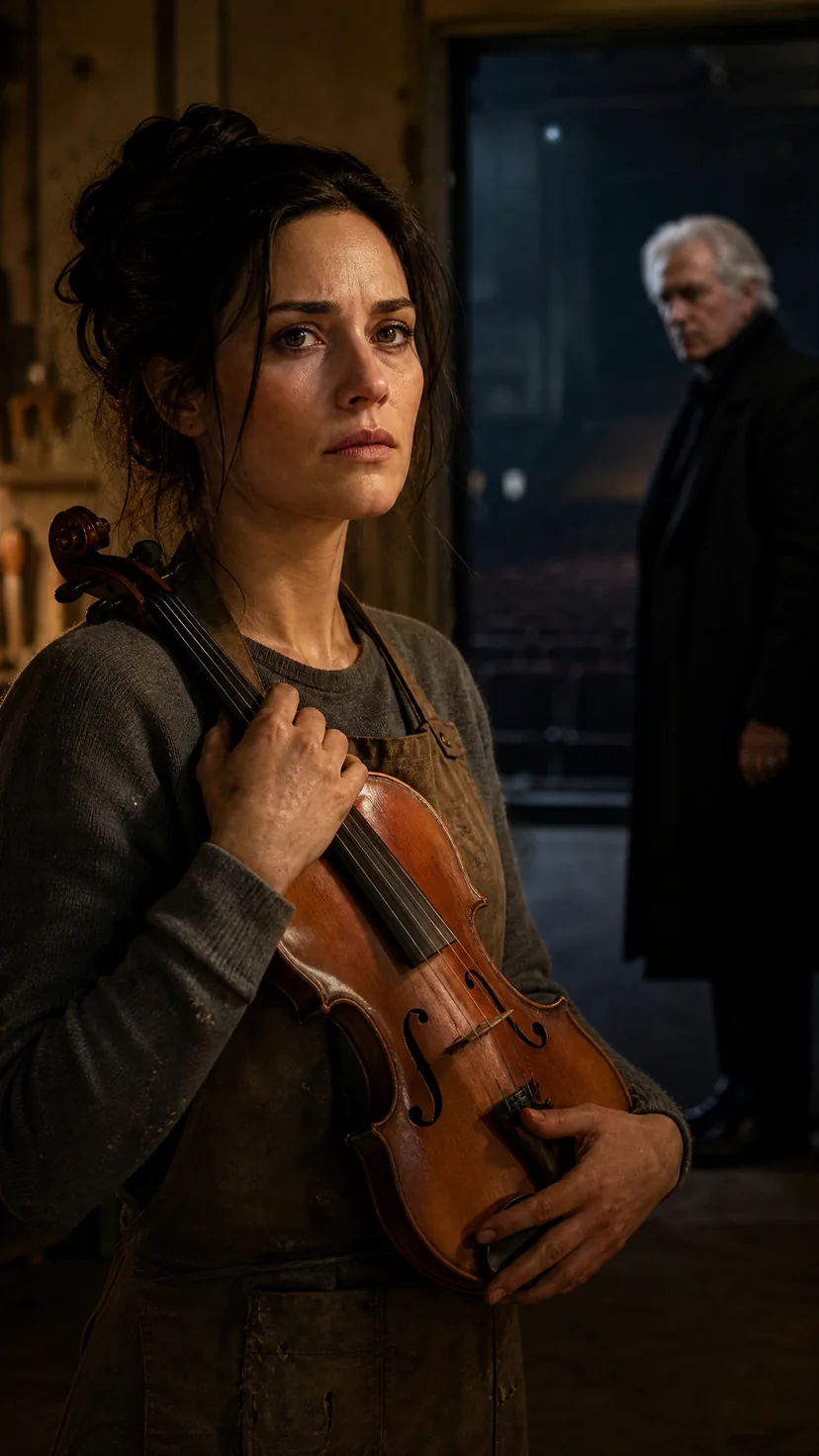
The file was called VARGA_E_excerpt, and it was me. One in the morning, in June, in my own shop with the door locked and the blinds down: the Bach, slow, on a shop fiddle with a dead G string. I had never let anyone hear that, so who had?
Priya's email had come in at seven. Per procedure, applicants may review their submitted materials before the withdrawal deadline. Under it, in a smaller font, she had added: I'm so sorry. I assumed you knew.
I played it twice at the bench with the lamp humming over my hands. I told myself it was one night. A person is allowed one night.
On the third pass I stopped listening to the fiddle and listened under it. The sound was thin and came from slightly above, as if the microphone had been lying face-down on a ceiling. At 2:14 something creaked, one long note of old pine taking a man's weight.
I looked up. The loose board over my workbench had been loose since my grandfather's time. Joel lived on the other side of it.
He opened his door with a piece of toast in his mouth. His flat smelled of rosin and something burnt. "Questions," he said around the toast. "Is this a hostage situation? You look like one."
"Who recorded me in June?"
"In June I was doing weddings. Do you know how many weddings a viola can survive? Forty." He swallowed. "I don't own a recorder, Mira."
"I didn't say recorder."
"You said recorded. Same thing. Are you hungry?" He was already turning toward the kitchen.
Over our heads the building ticked as the radiator woke up. I walked across his floor to the spot above my bench and put my weight on it. The board gave one long pine note, the same one, to the half step.
"Pipes," Joel said, behind me. "Old buildings. Pipes, Mira." He didn't come any closer, and he didn't look at the floor. He was turning the toast over and over in his fingers, as though it might give him a better answer.
I left. On the stairs I realized I had never told him it was the Bach.
My mother lived in the flat over the dry cleaner's, with an old upright she had never once let anyone set a cup on. It smelled of lemon oil. She was marking a student's scale book in red pencil when I came in, and she didn't stop.
"Tell me about the bill of sale," I said.
"No."
"Nine thousand dollars. Lasko had it in a piano bench. Why did he have it?"
"Because I signed it." Rosa turned a page. "How far behind are you?"
"Mama."
"Fifty-four hundred. Joel told me." She opened the kitchen drawer for her checkbook. "I'll write it."
"I don't want it."
"You want a great many things you don't want." She found the checkbook and shut the drawer on her own thumb, and the drawer jumped and spilled. Pencils, rubber bands, a tuning fork, and a cream envelope that slid across the linoleum and stopped against my shoe.
Rosa's hand shot out. I got there first. The paper was soft and thin, and the corner had a crest I had known since I was eight.
"Put that back."
"What is it?"
"Old paper." She had the face she used on bad pupils. "Your grandfather's heart, or a violin you left on a chair. I did the sum. I'd do it again."
"Did you see him take it?"
"Eat something," my mother said. She wrote the check. I let her tear it out, and I did not take it, and I put the envelope in my coat pocket while she watched me do it and said nothing at all.
At 11:40 that night I was alone with Ada's violin, the top off, clamps on the seam, the hide glue pot ticking on its hot plate. The withdrawal form sat open on my laptop. The cursor blinked in the box that said Confirm.
Someone was knocking on the glass with a whole fist. It was Ada. She was still in the laundromat polo, and when I let her in she brought a cloud of dryer sheets and cold air.
"Withdraw," she said. "Please. I'm out of breath again, I'm sorry, I'm an idiot, it's a talent."
"Who sent you?"
"Nobody sent me." She looked at the violin on the bench, ribs showing, and quickly away. "Mr. Lasko says if you're there it's a circus. He says they'll remember the freeze and not me." Her voice went up and she dragged it down. "Everyone's going to be looking at you, and I'll be a girl who played after the shaky lady."
"You think I'll freeze."
"I think you're good for eight bars." She didn't say it unkindly. "Please. I have one shot at this. You have a shop."
I looked at her hands, the nails bitten, the left fingertips grooved. I had once had hands like that, and nobody had come to my door at midnight to ask me for anything.
"Go home," I said. "Somebody will be waiting up."
"That's a no."
"It's a bus."
She went out without looking back. The bell rang again, and the glue pot ticked, and on the laptop the clock turned over to 12:00. The box greyed out. The form said closed.
I took the envelope out of my coat and slit it with the spatula I use for lifting tops.
It was a card with a lily on the front, printed in ink that had gone the color of tea. Inside, in a secretary's round hand: Get well soon, Miriam. The Harrowgate Philharmonic. It was dated the Monday after the final, two days after I walked out, and I had not been sick a day that autumn.