The woman with my face did not stop when I said her name.
She finished the seam first, the heat gun moving along white plastic, and the whole pole barn smelled of hot polymer and cold lake. I stood in the doorway with thirty-one years of being an only child hanging off me like wet clothes. She had the scar. Left side, thin, the same line from lip toward nostril. I had spent my life believing it was mine alone.
"Ellie," I said. "Why does nobody in my family say you exist?"
She clicked the gun off. Then she looked at me, and it was like being photographed by someone who didn't care about my good side.
I'd gotten there by nine that morning. The fridge note said E.H. in neat upright ballpoint, and the ledger line on my phone said Caretaker, E. Haugen, Nyquist Harbor, monthly since 2006. I drove back to the gas station with the album under my arm. Hollis Dahl looked at page thirty-two without a word, took off his cap, and said, "East shore. Boat storage. She won't thank you."
He was right. She cut a length of plastic with a hooked knife, not hurrying.
"I read your note," I said. "Furnace filter. You were there four days after he died."
"Someone had to be."
"I'm Ingrid."
"I know who you are."
She said it flat, to the hull. A boat the length of a small house sat between us on its trailer, half sealed in white, and I walked around the bow to keep her in sight. She walked around the stern. We circled it like that, two women pretending to be interested in a boat.
"How," I said.
"He brought your school pictures." She tore a strip of tape with her teeth. "Every August. Kindergarten, braces, the one with the bad bangs. He'd put them on the kitchen table in order and tell me what you were doing."
I stopped walking.
"He told me you won a ribbon for swimming," she said. "Backstroke. He said you stood on the block and looked at the bleachers first."
My throat did something. I had told that story to exactly nobody.
"Ellie."
Her thumb pressed a seam down hard enough to whiten it. "I'm not going to cry in my own barn for a person who got the whole thing."
"I got nothing. I got a man who disappeared every August and told me he was fishing."
"You had him thirty-one years." Her voice didn't rise. It got smaller, which was worse. "I had two weeks a year. I counted them. Go home."
I held out the album. Thirty-two pages, her whole childhood in the corner of my arm. "I didn't know you existed. Nobody told me."
"That's not on me."
"Then whose is it?"
She went to the far side of the hull and fed plastic around the keel, and her hands never stopped. Hands like Dad's, I thought, and then I hated that I'd thought it.
"Did she tell you I was dead?" Ellie said.
I touched my lip. I didn't decide to.
"Yes."
"Since when?"
"Since always. Before I was born. She had a whole way of saying it."
Ellie nodded slowly, as if I'd confirmed a measurement. "She's consistent."
"Who raised you? Where were you?"
"Here. Nyquist Harbor." She snapped the heat gun on, off again. "My grandmother. Marit Haugen. She taught me this. Don't ask me for more."
"Mom's parents are dead. Her mother died in 1988. So who is this grandmother, and why did Dad give you to her, and why did Mom say you were dead?"
"Ask your mother."
"My mother won't pick up her phone."
"Then she's consistent about that too." She came around the bow, close enough that I could see the gray in her eyes was exactly my gray, and my own cowlick lifting in the heat at her left temple. "I'm not doing her work for her. Thirty-one years she wouldn't say my name. I'm not going to say hers so she can stay clean."
"I'm not asking you to say hers. I'm asking you to say anything."
She looked at the album under my arm. Then she took it. She didn't grab; she lifted it out of my hands like a tray she was clearing. She opened to the last page and slid the August 2026 print out of its corners without tearing the paper. She looked at herself, and at him laughing behind her, for about one second.
She put the print in her shirt pocket and buttoned the flap.
"That's mine," she said. "The rest is yours. Take it."
She walked to the big door, hauled it open on its rollers, and threw the album out over the threshold. It landed flat on the new snow, pages fanned, thirty-one Augusts and one empty square.
"Ellie."
"Go home, Ingrid."
The door boomed shut on its track. I heard the bar drop on the other side of it, a steel sound, final, and then the heat gun starting up again.
I knelt and gathered the album out of the snow, wiping each page with my sleeve. I stood outside a locked barn holding my father's whole second life, minus the one picture that mattered most.
By the time I turned onto Tamarack Point Road the sky had gone the color of a fixer tray, and the lake was black. I had the heater on high and my phone face up on the seat. Eleven calls to my mother. Nothing.
The lake house came out of the pines with its porch light on, though I hadn't left it on.
There was a second car in the drive. Silver, clean, road salt dried white along the bumper.
My mother's car.
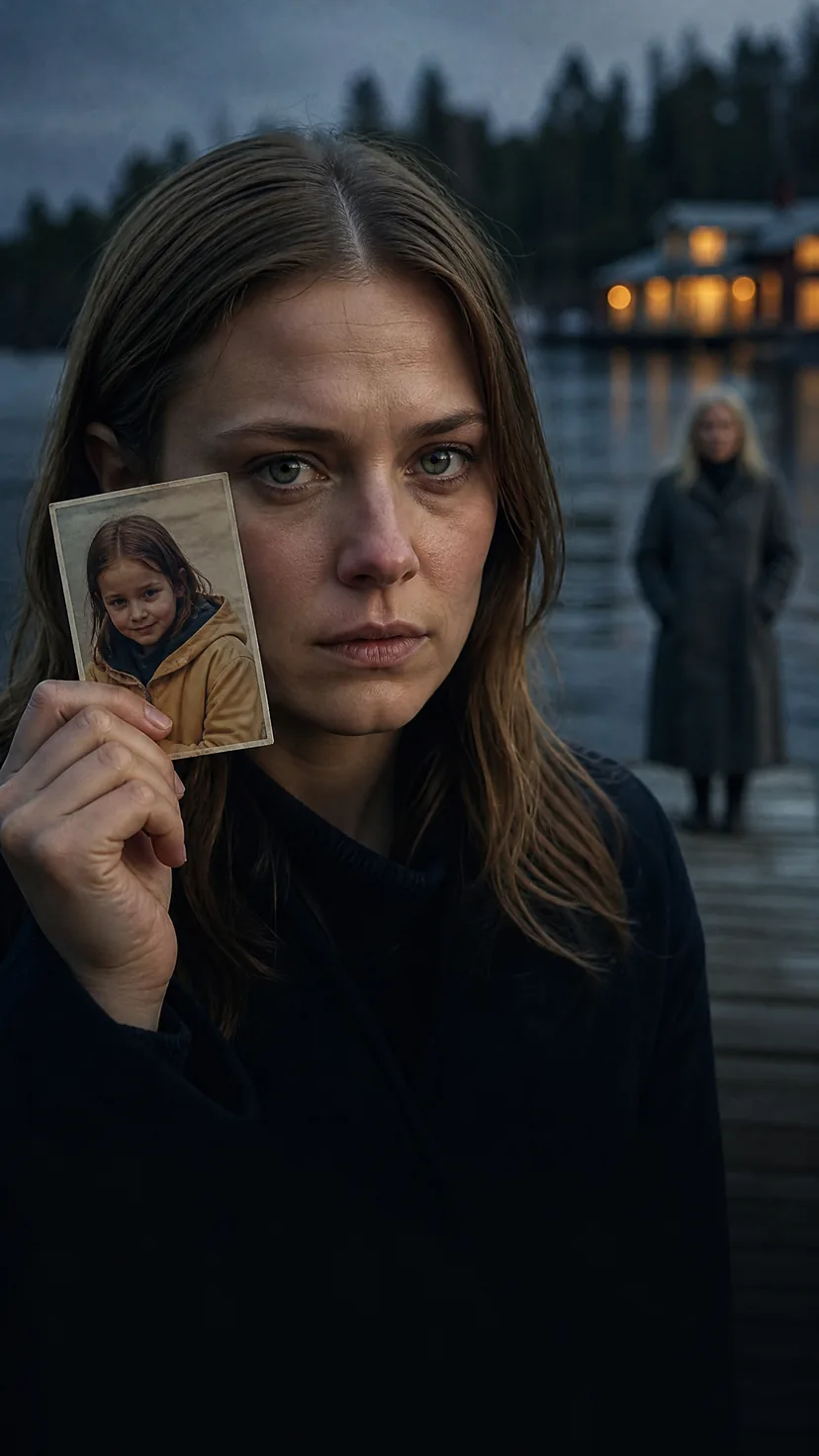
I got out without shutting the door. The dock was a pale stripe against the water, and at the very end of it somebody stood with her back to me, silver hair lifted by the wind. One hand was pressed to the small of her back.
It was the exact spot. The exact stance. The 1994 print, standing up and breathing.
A week ago my mother had looked me in the eye and sworn the woman on this dock was somebody else.