"Ellie?" the old man at the register said. "Didn't know you were back."
I had a bag of pretzels in one hand and the pump receipt in the other. Behind me a pirate and a very small ghost were counting dimes onto the counter for candy corn, and nobody in the whole gas station seemed to think anything had happened.
"I'm sorry?" I said.
He was in his seventies, with a plaid cap and a pencil behind his ear, and a name stitched over his pocket: HOLLIS. He looked at me properly then, and I watched him take my face apart and put it back together.
"No," he said slowly. "No, you're the other one. Arne's other girl."
My hand went to my lip before I could stop it. "Who's Ellie?"
"Nobody." He rang up the pretzels. "Mistook you, that's all."
"You said you didn't know she was back. Back from where?"
"Four dollars and eleven cents."
"When did you last see her?"
The ghost looked up at me. Hollis kept his eyes on the register drawer and made change for a pirate with enormous care. "Arne was a good man," he said. "We were sorry to hear. That's all I've got to say, miss."
It was clearly not all he had. But a man who has said too much once learns fast, and he had the face of someone who had lived sixty years in a town where everybody kept everybody's business. I paid. The bell on the door rang behind me like a verdict.
I sat in the car with the pretzels in my lap and did not eat them. Nobody in my whole life had ever called me Ellie. Nobody had ever called me anything but Ingrid, and he had known my father's name, and that my father had two daughters.
The keys on the wire tag fit. The second one, after the first stuck.
41 Tamarack Point Road was a low cedar cabin at the end of a gravel spur, and the lock turned like it had been oiled last week. Inside it was warm. Someone had been running the furnace. The floor was swept, the woodbox full of split birch, and the air held pine and old woodsmoke and, under that, the clean cold smell of the lake coming through the window glass.
Through that window was the dock.
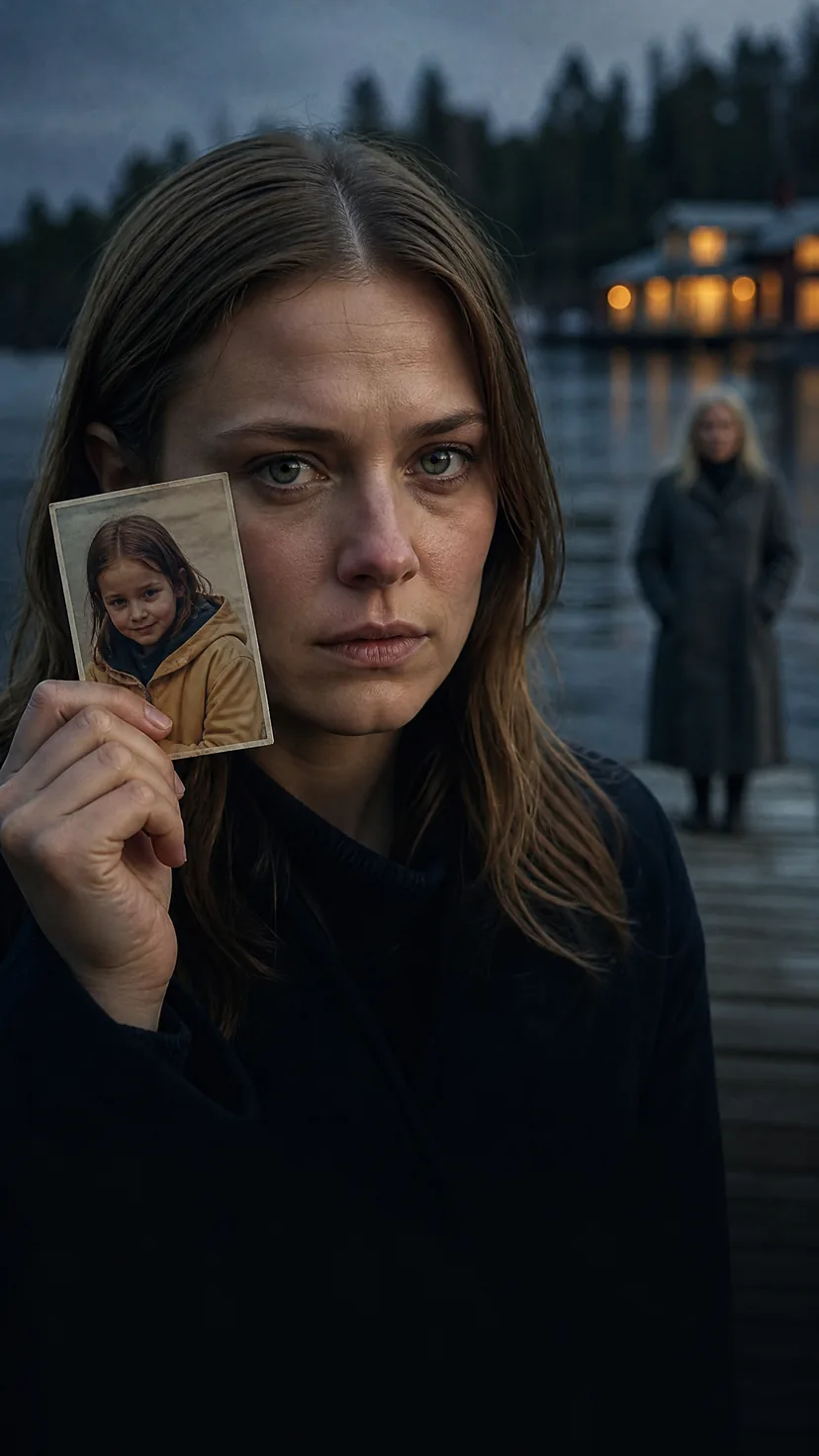
I knew it before I knew I knew it. Gray boards, the third post leaning, pines behind like a dark fence. I went out the back door and walked to the end and stood where the woman in the gray coat had stood in my enlargement. The boards gave a little under my boots. Water slapped the pilings, and the cold came up through my soles and sat in my knees.
Mom had said Dad came here to scatter ashes. A man doing that does not stack firewood.
Back inside, a note was stuck to the refrigerator with a magnet shaped like a trout. Neat, upright handwriting, ballpoint: Furnace filter changed 10/3. E.H.
October third. Four days after he died. I stood there doing the arithmetic as if it might come out differently. Somebody had a key, and somebody had been told, or had not needed to be.
I wanted proof of the one thing my mother had given me: that a girl had been alive and then wasn't. A date on a paper. A stone.
I started in the bedroom. A framed wedding photograph hung over the iron bed: Dad, young and terrified under a brown mustache, and beside him a bride in a veil. A bar of window light lay across the glass and swallowed her face completely. You never judge a print through glass. I would take it down later and scan it right.
I opened the dresser. Wool socks. A flannel shirt that still smelled like him. In the closet, on the shelf above his spare jacket, I found a green cloth album with the spine gone soft.
I sat down on the bed with it.
On the first page, in square capitals on a strip of white tape: AUGUST 1995.
The girl stood at the end of the dock in a red life vest, holding up a fish with both hands. She was eight. The tooth had grown in. The scar ran from her lip toward her nose, thin and white, mine.
Eight months after my mother said she died.
My ears were ringing. I turned the page. AUGUST 1996. A bigger fish. Same dock, same pose, same squint. 1997, the cowlick fighting a hat. A year with a gap in her smile and a year with braces, her mouth tight and shiny with metal. Then a teenager scowling at the camera like it owed her money, a fish held out at arm's length as if she'd been forced. Then a young woman in a canvas work jacket, hair cropped short, still holding up the fish, one corner of her mouth finally giving in.
One print for every August. I turned them slowly. I watched her grow up an inch at a time, the way you'd watch a plant on a windowsill, and every picture but the last had been taken by the same hand. The little shadow on the left edge was always the same shadow, a man in a ball cap holding the camera low.
Every August of my life, my father had gone north for two weeks. He missed every summer fair. He missed the swim meet where I finally won a ribbon, and I had stood on the block looking at an empty space on the bleachers, hating him a little, and told people he was fishing.
He'd been fishing. He had been right here, on this dock, watching her get taller.
I counted without wanting to. Thirty-two pages. Thirty-two Augusts.
The last page had been added more carefully than the rest, the tape straighter. AUGUST 2026.
A woman of thirty-nine stood on the dock in a canvas jacket, holding up a fish with one hand, the other hand fisted at her hip. She had my gray eyes. She had the cowlick, my cowlick, at the left temple. She had my scar.
Behind her at the end of the dock, a gray-mustached man shaded his eyes against the sun. He was thinner than I remembered, and he was laughing.
My father, eight weeks before he died.
My sister hadn't died in 1994. In August, she'd been standing on this dock with him.