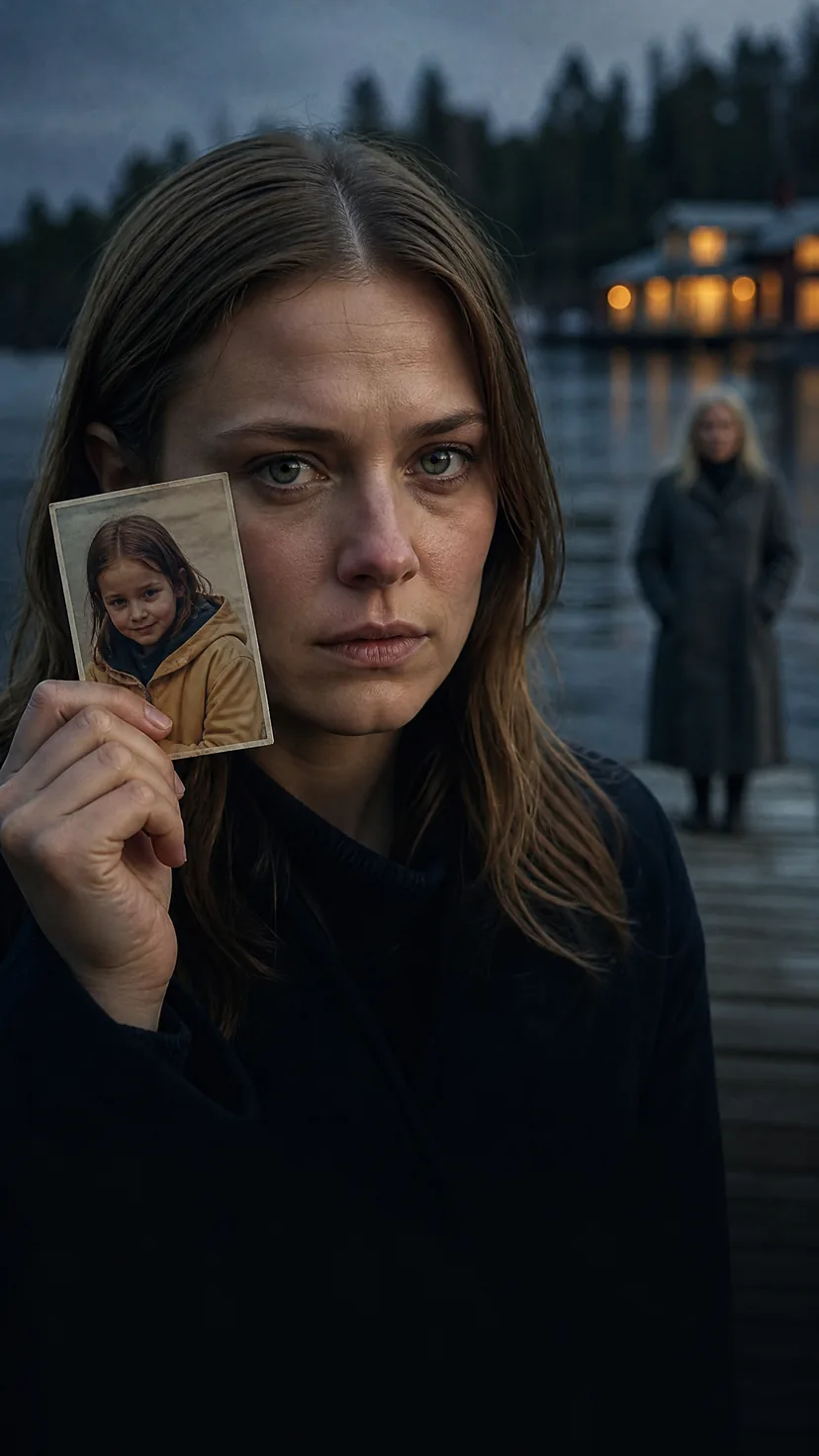
"Get your things," my mother said. She didn't turn around. "We're going home tonight."
Her voice came down the dock flat and pleasant, the voice she used on contractors. If I got in her car, the album would go into a box and the box into a closet, and Ellie would go back to being a girl who died. I would be driving home with a sister who had looked at me across a boat hull and told me to go home.
"No."
"Ingrid."
"I'm staying. You're going to tell me tonight. Here."
She turned then. She looked at the album under my arm, at the snow still melting dark in its spine, and her hand left her back and folded into the other one.
I walked past her to the house and she followed. In the kitchen I opened the album under the lamp and turned it so she could see. An eight-year-old with a sunfish. A scowling teenager with a walleye. Thirty-two Augusts of a woman who had my face.
"You told me she died," I said.
My mother put one hand flat on the table. Then she pulled out a chair for me, and her face went soft in the way that has always made me feel nine.
"Sweetheart. Sit down."
"Where is she, Mom?"
"I'm going to tell you, and you are going to hate me for about a week." She sat. She pressed her left forearm flat on the table, over the white scar. "February of '93. My mother's birthday dinner in Nyquist Harbor. I had wine. Two glasses, maybe three."
I didn't move.
"The roads were glass. I took the curve on County Road 9 too fast and put the car into a tree." She said it to the tablecloth. "The girl was in the back seat. Danny too. That's this." She turned the arm over. "Glass."
"Was anyone hurt?"
"Your father cracked two ribs." Quickly, and she went on. "My mother came to the hospital. Marit. She said I wasn't fit to raise a child, and if I didn't give the girl up she'd go to the sheriff and tell him about the wine." She looked at the album. "She gave me a year and a half to prove her wrong. I didn't."
"So you gave her up."
"So I did."
"To Marit."
"Yes."
"And told everyone she died."
"It was easier." Her mouth worked. "It was easier than saying I gave my daughter away."
I sat with that. It sounded like a real thing. All my life I had known my mother to lie smoothly, in whole paragraphs, and this was not smooth. This came out in pieces.
"You told me your mother died before I was born."
"She's dead to me."
"Her name is Haugen."
"She remarried." She wiped her eyes with the heel of her hand, one quick swipe. "That's all of it, honey. That's every bit. I'm so tired. Can I please go to bed?"
I let her. She went down the hall to the small second bedroom, one hand on the small of her back, and shut the door without a sound.
I sat up with the album in the kitchen. The furnace ticked in the wall. Out past the window the lake was making ice, and every few minutes it boomed, a long low note like a door slamming in a house a mile off.
I turned the pages and for the first time in my life I was sorry for my mother.
One bad night. Three glasses of wine and a curve. And she had paid for it every day since, with a daughter in a barn across the lake, with a lie she had to keep telling a second daughter's face. I had been so busy being the one who was lied to.
I wanted to give her something. I thought of the wedding portrait.
It hung over the iron bed in Dad's room, the one wedding picture that had escaped her matches, a brown print in a dark frame that I had only seen from the doorway, through glare. I could restore it. I could put it in her hands by Christmas.
I took it down and laid it face down on his quilt.
You never scan through glass. I bent back the little metal points one at a time with my thumbnail, lifted out the backing, and eased the brown kraft board away.
The print came up clean, faintly warm from the wall. June 1986, Dad young, a brown mustache on him like a push broom, grinning at somebody off to the left. And beside him the bride, with pearl studs in her ears.
Her nose. Her chin. My mother, or very nearly, with her hair dark and long under the veil.
She was laughing at something past the camera, younger than I had ever imagined her, and happy in a way I had only seen in other people's mothers. I looked at her for a long time.
Something was caught between the print and the backing board. Paper, folded in thirds, the color of weak tea.
I opened it on the quilt. The top edge was stiff with a raised seal, and I ran my thumb over it before I read a word. A certified copy. State of Minnesota. Certificate of Death.
Name of decedent: Annika Marie Sorensen.
Date of birth: March 22, 1961.
That was my mother's name. That was my mother's birthday. I have baked her a cake on March 22 every year of my life.
Date of death: February 6, 1993.
Place of injury: County Road 9, St. Louis County.
Cause: multiple blunt force injuries, motor vehicle collision.
Decedent was: passenger.
I read it again. The furnace ticked. Out on the lake the ice boomed, and the house shivered with it.
My mother had been dead for two years on the day I was born. She was asleep in the next room.