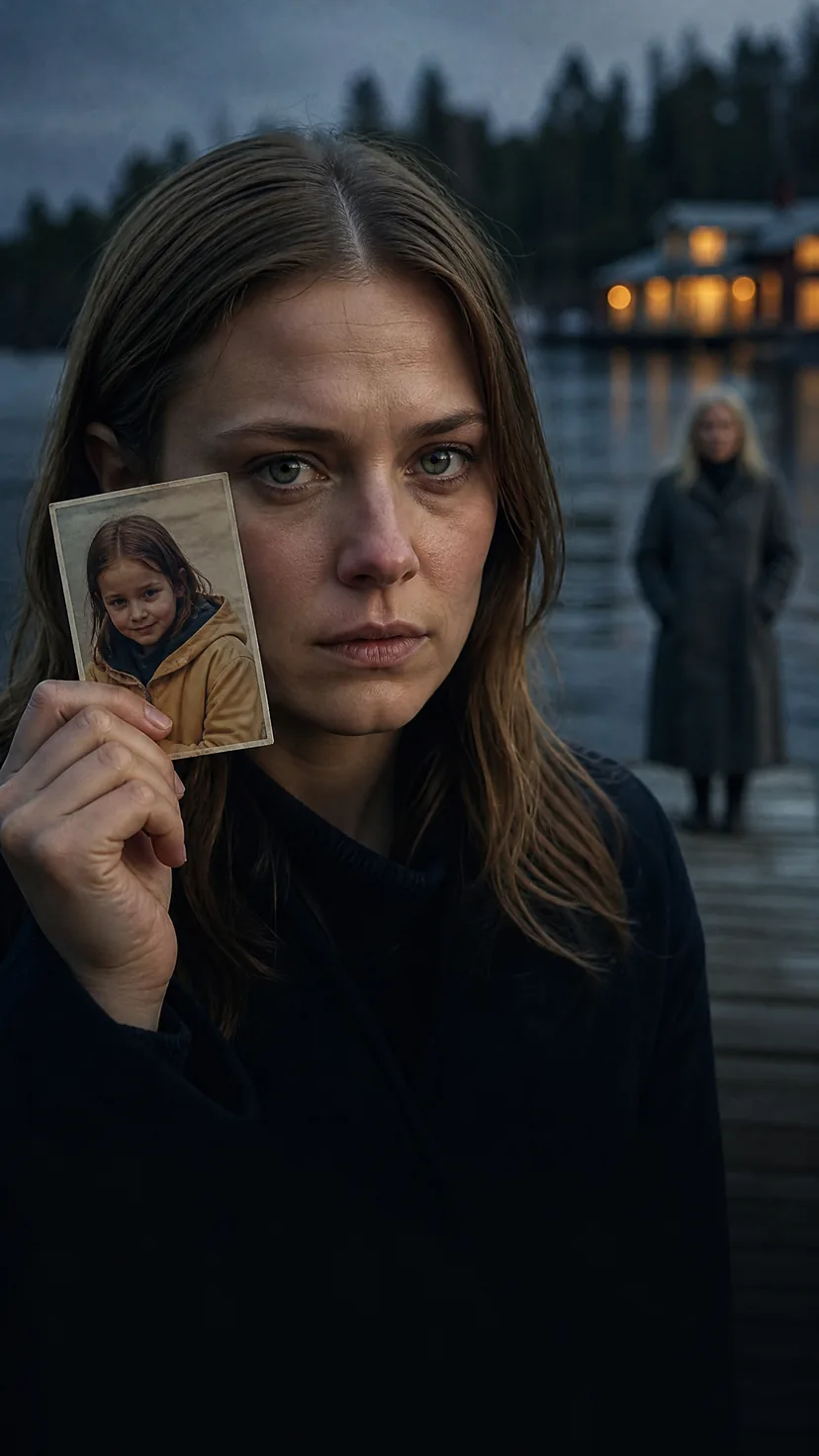
My mother was waiting on the landing outside the studio when I came up the stairs, with two coffees and a shoebox, and she had gotten mine the way I like it.
She never brought me coffee. She brought me tasks.
I had slept four hours in my clothes, and I did not want her gentle. What does a woman bring to a fight she knows is coming?
"You said first thing, sweetheart. It's seven."
"I know what time it is."
The 1994 print was where I'd left it at midnight, face down on the scanner glass with the lid shut. I had meant to rescan the back under raking light and read the lab stamp one more time. I walked past it and laid Bev's baptism print on the light table, orange side up, between her coffee and her hands.
"Tell me who's in it."
She looked at it for exactly as long as a person looks at a picture they know.
"That's Bev, in that awful hat. That's your father." She touched the mustache with one fingertip. "That's me, the day we baptized her."
She said it flat and easy. No catch, no pause. I had driven to Duluth and back for that pause.
"Her," I said.
"Solveig." My mother set down her cup. "You had a sister, Ingrid."
My hand went to my lip. I made it stop.
"Where is she?"
"We called her Ingrid. At home. Solveig was for church." She smoothed the border of the print. "She died of meningitis, December of 1994, in a hospital in Superior. You were two months from being born."
"Bev said you called her last night."
"I did. I asked her to tell you. I couldn't." A short, dry laugh. "I told you the basement flooded because it was easier than the truth."
"There was no flood."
"No." She looked at me directly. "I burned the pictures. All of her. I couldn't look at them, and I didn't think I'd ever have to explain."
"Where did you put her?"
"Lake Quill. We scattered her there, in August, the two of us on that dock. That's why your father went up every year." Her chin moved, once. "When you came he couldn't call you anything else. I let him."
I stood there with the coffee going cold in my hand and the scanner humming behind me, patient as a dog. Under my ribs something kept asking why no one had ever said her name in our house, and I could not make it stop long enough to ask her.
"Danny remembers a car accident," I said. "A girl holding his hand."
"Danny was two."
"He remembers it."
"Then he remembers February of '93." She pushed back her left sleeve and held out her forearm, and there it was, the long white seam I had known my whole life and never asked about. "Black ice. The roads were glass. I broke this in two places, and your brother screamed in his car seat for a year."
"He says a girl held his hand."
"Was she in the car?"
"I'm asking you."
"No." Very quiet. "Ingrid. She was not in the car. Your brother held his sister's hand on every drive of his life, and he is two years old in that memory and thirty-six now, and he has mixed them up. That's all that is."
I wanted to catch her. I wanted a hinge to squeak. She sat with her scarred arm out between us like evidence she was handing over, and I could not find the seam.
"I need the bathroom," she said. "Then I'll show you what's in the box."
When the door shut I opened my laptop and typed Solveig Sorensen into the Minnesota death index. Then every spelling I could think of. The little wheel turned and came back empty.
Of course it did. She'd said Superior. That's Wisconsin, and Wisconsin wanted a written request and two weeks.
The story held. I sat there with the cursor blinking, and I could not make it do anything else.
The toilet flushed. The faucet ran. My mother came back out drying her hands on her slacks, and she lifted the lid off the shoebox and turned it toward me.
A child's barrette, a plastic butterfly with one wing chipped. A crayon drawing of a fish, orange, with enormous eyelashes. A knitted hat so small I could have closed my hand around it.
I picked up the hat. It smelled like cedar.
I had never been told I was second, and it turned out I had been grieving all my life for someone I'd never been allowed to miss. Something in my chest simply gave, like ice in March.
"Oh, honey," my mother said.
I didn't make a sound at first. Then I did. She came around the light table and I was thirty-one years old and I put my face in her shoulder anyway, her blouse smelling of starch and coffee, and cried for a girl who had held a perch up to a camera with both hands.
She held on. She smoothed my hair back from the temple the way she had when I was small and sick, long strokes, steady, her hand never once hurrying.
"I know," she said. "I know. I know."
I don't know how long. Nobody in that room hurried me. Long enough that the scanner's fan shut off.
When she let go she wiped my face with her thumb, the way you do a child's. She fixed one gold earring, put the lid back on the box, and tucked it under her arm.
"I'll call you tonight. Eat something." She kissed my forehead, dry and quick, and her heels went down the stairs past the frame shop, unhurried.
I stood in the quiet with my sleeves wet. Then I went to the scanner, because the light had gone out of it and I wanted to finish what I started.
The lid was up. The glass was empty.
The 1994 print was gone.