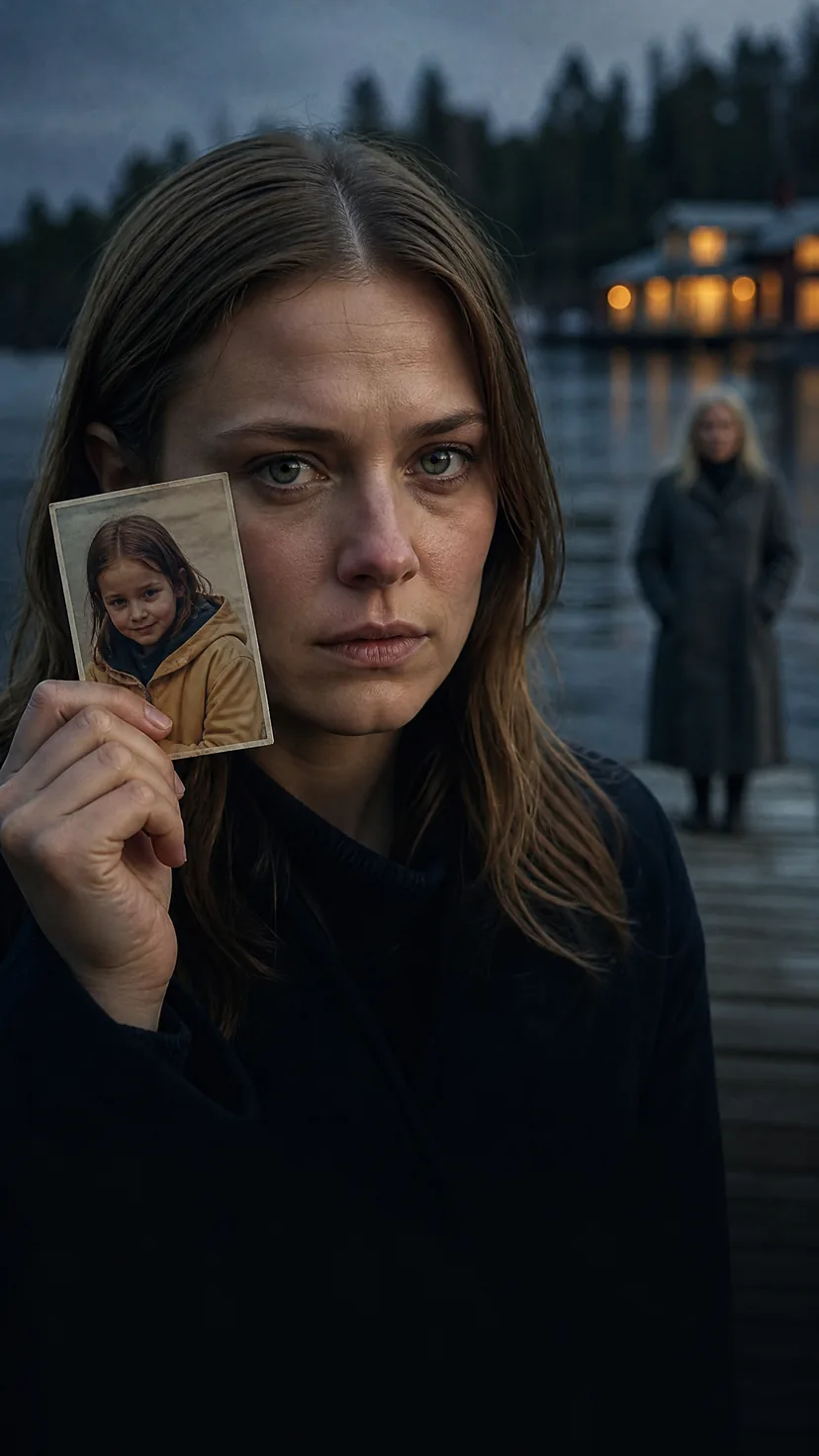
The door opened four inches. The woman behind it looked at my face and said, "You're the second one."
I had been the only daughter in that family for thirty-one years. I stood on her porch on Woodland Avenue with my hand halfway to the bell, and the sentence went through me like a draft. Behind me, in the car, my phone had four missed calls from my mother. I had made my choice somewhere around Hinckley and hadn't called her back.
"The second what?"
She was seventy, tall, in a man's cardigan with the elbows gone. Dad's jaw. Dad's way of standing like a doorframe.
"Your mother called me last night."
"Aunt Bev, I'm Ingrid. I'm Arne's..."
"I know whose you are."
The door shut. The deadbolt turned, loud as a dropped wrench.
I had found her the way I find everything, by looking at the evidence. Every December Dad mailed one card to this address, and in thirty-one years nothing ever came back. Not once. A man who sends a card to a dead address gets it returned. This one had been signed for, or kept.
Mom had gotten here first. Of course she had.
I did not go back to the car.
"Dad died a month ago," I said to the wood. "I am not here for the money."
Wind came up off the lake and went straight through my coat. Somewhere behind the door a clock was ticking. I could hear it, which meant she was standing right there.
"You get a card every year," I said. "From Dad. I looked it up. Thirty-one of them."
"Cards don't need an answer."
"Then what do they need?"
Nothing. The clock.
I touched the scar on my lip, which I do when I'm lying or scared, and for once I didn't know which. Then I took the 1994 print out of my coat and held it flat against the storm door, face out, the way you'd show a cop a badge.
"This is who I came about."
The ticking went quiet, or I stopped hearing it. Then the inside door opened a foot, and she looked at the glass for a long time.
"Turn it over."
I peeled it off the glass and turned it. INGRID, LAKE QUILL, OCTOBER 1994, in square capitals.
Bev put two fingers on the other side of the glass, right on the N.
"That's his hand," she said. "He printed like a man ordering lumber." She took her fingers back. "How did he die."
"Heart. In the garage. September twenty-ninth."
"Did he know?"
"I don't know. His coffee was still warm."
She stood there a second longer, then undid the storm door. "Come in or go. Don't stand there and let the heat out."
The hall smelled of radiator and lemon oil. She didn't take my coat.
"Who is she?" I held up the print. "The girl. She has my face."
"That's your face."
"It's from 1994. I wasn't born."
"I can count."
"Aunt Bev."
She looked past me at the front door. "She's my niece. Arne's daughter. Born in 1987, in June. We called her Ingrid at home."
I heard myself laugh, a bad little sound. "Ingrid. He named us both Ingrid."
"Solveig Ingrid, on the baptism paper. She went by the second one. He liked the name." Her mouth went flat. "I was her godmother. I haven't laid eyes on her since she was seven."
"Why not?"
"I stopped speaking to your father."
"Why?"
"Over what he did."
"What did he do?"
"No."
"Aunt Bev, I have to know what..."
"Your father was a good man."
She said it fast, like a hand slapped over a flame. The lie was so clean I almost believed it, and I knew from the speed that she'd been saying it for thirty-one years, mostly to the wall.
"You cut him off at Christmas. Before I was born. A good man doesn't get that."
"Both things are true." She turned and opened the drawer of the hall table, and her hand stayed in it. "I won't tell you the rest. Not today. Not on my porch. Your mother has a lawyer for words."
"My mother has a lawyer for everything."
"Yes," Bev said. "She does."
She took out a print and held it out between two fingers, as if it might be hot.
It was a square, white-bordered, the cyan gone out of the dyes so every color leaned orange. The paper had the soft, tired tooth of the eighties, the corners rounded by a lifetime in somebody's drawer. A church font, pale stone. Bev, years younger, in a hat. Dad with a brown mustache that didn't have one gray hair in it. In his arms, a baby in a christening gown long enough to hang past his elbow.
Beside him stood a woman with her face turned down toward the baby. All I could see was dark hair and the curve of a cheek.
I knew that stance. The slight forward tilt, protective and a little too tidy.
"Is that Mom?"
"That's the day we baptized her." Bev took half a step back. "That's all it is."
"Is that Mom?"
"Solveig Sorensen. June, 1987. You can have it. I was keeping it for her."
For her. Present tense, folded into the grammar like a coin in a hem.
I looked at the baby's face in the gown. My own forehead, only newer. Someone had wanted this picture so badly that it had outlived every move and a feud.
Somebody had loved her. Somebody had paid for a print.
My throat went tight. I asked the question I had driven here to ask, plainly, because there was no other way to ask it.
"Is she dead?"
Bev took her time. She looked at the print in my hand, not me.
"Your mother called last night," she said, "and asked me to tell you the girl died."
My ears rang.
"I won't say that."
"Then she's alive?"
"Don't ask me to say the other thing either."
She held the front door for me, and when I was on the porch she closed it.