The notice gave us thirty days, which meant I had thirty days to explain to a seven-year-old that quit has two meanings and only one of them was about me.
She didn't buy it. "You can't quit an apartment," she said, Saturday morning, in Pamela's passenger seat. "You can only quit things you do."
"We do live there."
She thought about that all the way down Fourth Street and across the river bridge. "Then we should keep doing it," she said finally, like that settled things.
I opened at five-thirty because I didn't know any better.
The gravel lot on Tannery Road sits between the bus shelter and Hobbs's Diner, a low cinderblock building with a neon coffee cup in the window that's been missing its handle since I was in high school. Across the road, Brenner Castings stretched three blocks long, brick and steel and glass painted over, with two smokestacks and a gate the size of a barn door. The sun came up behind it. For about four minutes the whole factory went gold at the edges, and then it was just brick again.
I'd parked there on purpose. If I was going to start over, I wanted to start where I could see exactly how far I had to go.
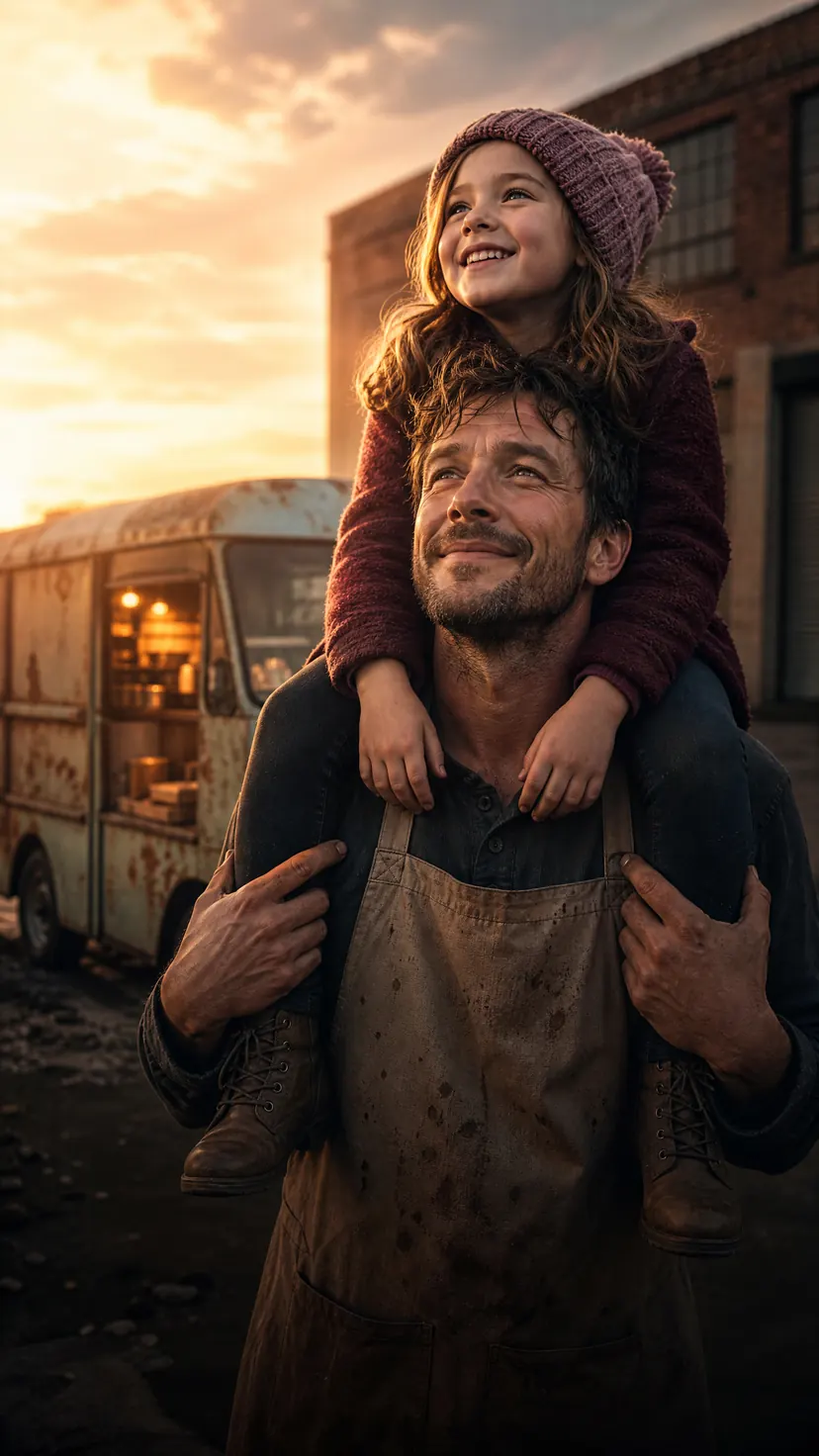
The griddle took twenty minutes to heat. I mixed the batter from Rudy's notebook, the buttermilk one, with his sugar trick, a pinch scattered straight onto the hot steel before the batter hits so the bottom caramelizes. The smell came up all at once, browned butter and burnt sugar and vanilla. Maisie set up her folding table behind the truck with her crayons and a coloring sheet of a horse, and announced that she was the manager.
Nobody came.
At six-fifteen a man in a gray apron came out of Hobbs's Diner and walked across the gravel with his hands in his pockets. He was about sixty, thick through the middle, with a mustache that had gone white before the rest of him.
"Darrell Hobbs," he said. He didn't offer his hand. "That's my diner."
"Ben Calder."
"I know who you are. Your dad used to sit at the end of my counter. Eggs over hard, rye toast, never once left more than a dollar." He looked up at the hatch, at Maisie's sign. "One dollar."
"For a pancake."
"I sell a short stack for four seventy-five." He said it without heat, just stating the fact, and for a second I didn't know what to say. "Second shift was half my dinners, Calder. Sixty-one guys who came in at ten-thirty for the meatloaf. Now it's me and the radio. And you park out here selling breakfast for a dollar."
"I'm not trying to take anything from you."
"Nobody ever is." He looked across the road at the factory for a while. Then he went back inside, and a minute later the neon coffee cup flicked on, handle missing, buzzing in the window.
The first customer showed up at seven-twenty. A girl of about ten and her little brother, on bikes, with a single dollar bill between them that had obviously been folded and unfolded many times. They ordered one pancake.
"To share," the girl said firmly.
I made them one. Then I made them a second one by accident, which is a thing that can happen when you're new at this, and Maisie came around to the hatch and handed it down to the brother and said, "Manager's special," and the boy looked at her like she was the queen of England.
At eight a bus driver bought two. At eight-forty Mrs. Ocampo arrived in a cab with a lawn chair, set it up beside Maisie's table, and ordered one plain with butter, "the way God intended." She stayed until noon. She told everyone who walked past that the pancakes were extraordinary and also that I'd been a very sweet boy until about the age of fifteen.
Nell came at nine-thirty, still in scrubs, eyes half closed. She bought two and ate them standing up beside the hatch.
"These are stupid good," she said.
"Thank you."
"I mean it. I'm annoyed about it. I wanted to be supportive and now I'm just hungry."
She watched me scatter a pinch of sugar on the bare steel before the next pour, and something in her face shut like a door. "My dad used to do that," she said. "The sugar."
"Smart man."
"He was a lot of things." She looked at the empty lot. "Where is everybody?"
"Working."
By eleven I'd made nine dollars. Maisie counted it four times on her folding table, sorting the quarters into towers, and each time it came out nine and she seemed personally offended. "Nine is a bad number," she said. "It's not even ten."
"It's more than zero."
"Zero is a number too, Daddy. That doesn't help anybody."
Around noon the wind picked up and blew her horse coloring page under the truck. She crawled after it and came back with gravel in her knees and her lip shaking. I lifted her up onto the counter inside the hatch and let her flip one. It came out shaped like a boot. She declared it the best one of the day, and it was.
By one-thirty I'd made eleven dollars and fifty cents and I'd started cleaning the griddle. My back hurt. Maisie had fallen asleep across two flour sacks in the back of the truck with her hat pulled down over her eyes. Across the lot Darrell Hobbs was wiping his front window, watching me, not bothering to hide it.
I thought about the fourth Saturday. I thought about how there were three more before it. I had the scraper in my hand and the propane off and I was reaching for the hatch strut, about to close it down.
Then, across the road, the shift whistle went. It was the same whistle I'd heard every working day for fourteen years, and it went straight down my spine.
The big gate rolled open. Men and women came out in a slow tide, hard hats under their arms, squinting into the light. Most of them headed for the parking lot.
Some of them didn't.
They came across Tannery Road in a ragged line, forty of them, maybe more, still in their safety glasses, still gray with sand and graphite. Hector Ruiz was in there somewhere, though he didn't even work there anymore. And at the front, with his wallet already out and his face set like he was walking into a fight, came Walt Prusik.