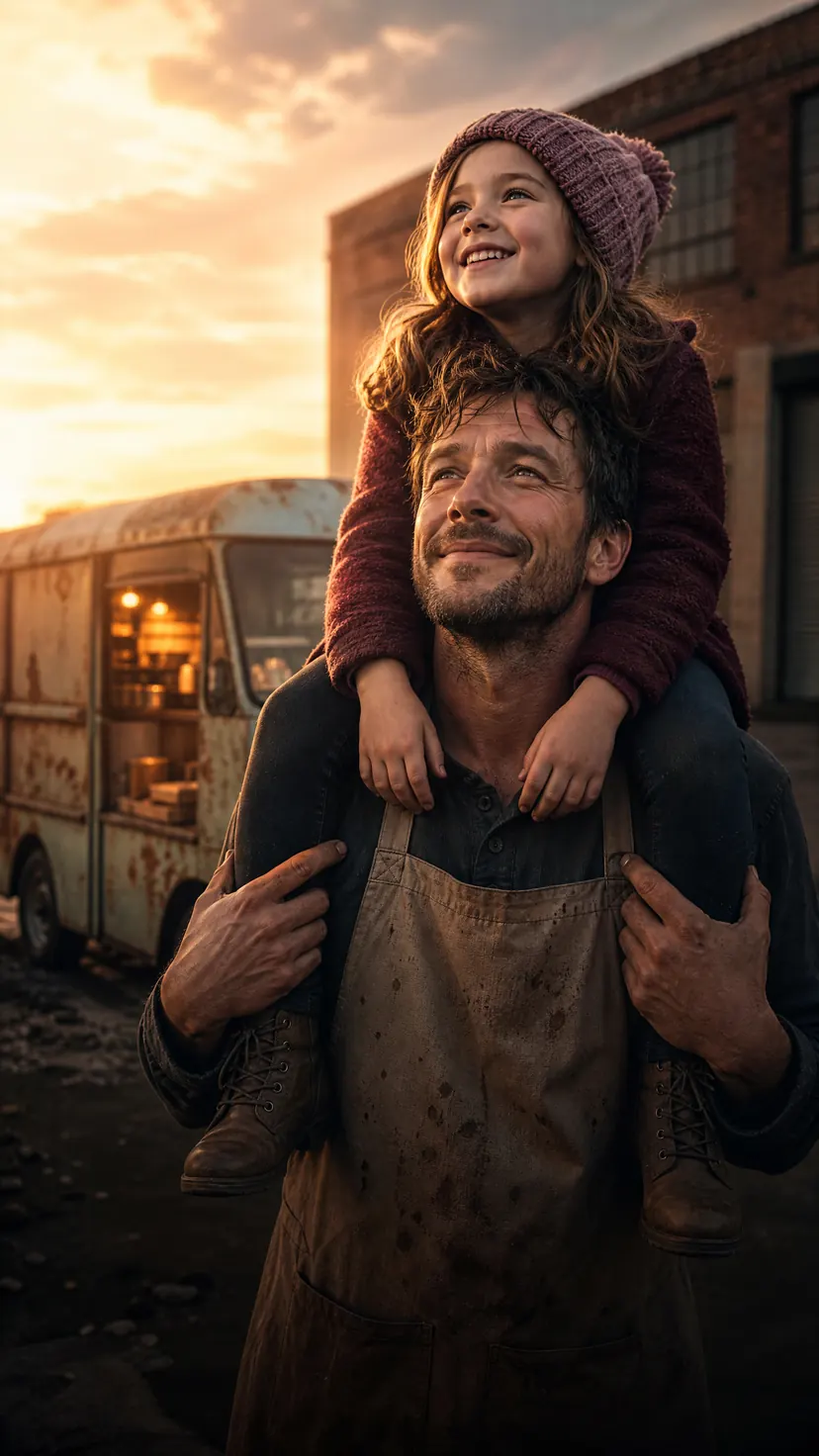
On the eleventh night in Teddy's shed I took my dad's watch off and laid it face down on the workbench, so it couldn't tell me what time it was.
I had nineteen dollars. Pamela needed a propane tank, a regulator and fifty pounds of flour before she could make a single pancake, and the only thing I owned worth more than that had been ticking on my wrist since the week we buried him. I didn't know yet if I could carry it into a pawn shop. I didn't know what I'd tell Maisie if I did.
The first thing I learned about Pamela was that every bolt on her had been put on by a man who never expected anyone to take it off again.
I worked on her every night after Maisie's bedtime, in Teddy's shed, under one hanging bulb that swung when the furnace kicked on. Maisie slept on Teddy's couch those nights with Jo's old cat on her feet, and at eleven I'd carry her out to my car and drive the four blocks home, and at five I'd be back at Brenner's employment office asking if anything had opened up. Nothing had. Then I'd come home and sleep three hours and go back to the shed.
I wire-brushed the rust. I patched the floor with sheet metal from a dryer Teddy's neighbor put out on the curb. I scraped the griddle down to bare steel with a brick and a putty knife and seasoned it the way my dad did, oil and heat, oil and heat, until it went black and slick as a record.
On the second night I called Gus about the R. He said it was Rudy, all right; he'd know that handwriting off a grocery list. He wouldn't give me a last name or a number. "Man asked to be left alone," he said. "Least I can do is the one thing he asked."
Teddy came out most nights at ten with two beers and an opinion.
"Your brake lines are shot."
"I know."
"Your generator's from the Bronze Age."
"I know that, too."
"You've got wire in there that's been chewed on by things with teeth, Ben. Get an electrician."
"With what?"
He didn't have an answer for that. Nobody did. So I watched videos on my phone at one in the morning and rewired Pamela's lights and her little fridge and her exhaust fan myself, splicing what I could, wrapping the joints in electrical tape, and when I flipped the switch and the hood light came on I yelled loud enough that Jo turned on the upstairs bathroom light to see who'd died.
Behind the generator panel there was one junction I wasn't sure about. Three wires that should have been two. I taped it extra and told myself I'd come back to it.
I didn't come back to it. I want to be honest about that now.
There's a pawn shop on Canal Street run by a man named Fitch who wears reading glasses on a chain. On the twelfth morning I brought him my dad's watch. It was a steel one with a cracked crystal and a band that left a green stripe on your wrist, and my dad had worn it every day of thirty years at Brenner, the same as me.
Fitch turned it over. "Ninety," he said.
"It's worth more than that."
"Not to me." He looked at me over the glasses. "You got ninety days to buy it back. People mostly don't."
I took the ninety.
That's how I met Nell. I'd like to say it was romantic. I was coming up the stairwell at Linden Court at six-forty in the morning, covered in rust and griddle oil, with a burn on the back of my hand the size of a quarter, and she was coming up behind me in blue scrubs, carrying a takeout coffee and a bag of cat food.
"You live in 3B," she said. "The kid with the hat."
"That's my kid."
"I'm 3A." She looked at my hand. "That's a second-degree burn."
"It's fine."
"Everybody says it's fine. It's my favorite thing people say." She set down the cat food, dug in her bag, and came up with a little tube. "Silver sulfadiazine. Thin layer, twice a day, don't pop the blister. I work nights at Kessling General. I see a lot of things that were fine."
Her name was Nell Albrecht. She had freckles all the way into her hairline and dark circles under her eyes and a cat named Doctor, which Maisie found out about within forty-eight hours and never got over. "A cat that's named Doctor," she'd say at dinner, reverently, like she was describing a saint.
After that I'd see Nell most mornings, her going in to sleep, me coming home from the shed. We'd talk on the landing for two or three minutes. She'd ask about the truck. I'd ask about the night. It's hard to explain how much I started looking forward to those three minutes. Something about a person who also hadn't slept and wasn't going to pretend otherwise.
By the end of the third week Pamela was ugly in a new way, which was progress. Maisie decorated her on a Sunday. We'd bought a can of red enamel and I'd meant to paint CALDER'S KITCHEN along the side in neat block letters. Maisie had other ideas. Maisie wanted PAMELA'S in pink with a crown over the P.
We negotiated. It took most of the afternoon. In the end the side said CALDER'S KITCHEN in red, and the back door said PAMELA in pink, with a crown, and a dragon nobody had agreed to.
"He's on our side," she reminded me.
Her crayon sign went in the hatch window, the one from the back of the envelope. I'd laminated it at the library for a quarter.
Saturday was set. I'd picked my spot, a gravel lot on Tannery Road across from Brenner's main gate, next to the bus shelter. First shift ran Saturday overtime. Three hundred people would walk out of those gates at two o'clock with their pay in their pockets, hungry.
On Friday night I drove Maisie home from Teddy's, carried her up the three flights half asleep, and found something taped to our door.
A single sheet, folded once. Linden Court Management again. The paper was white this time, which somehow made it worse.
Maisie was awake enough to read the top line. She's a good reader. Her teacher says she's two grades ahead. She read it out loud, slowly, sounding out each word against the dim hall light.
"Notice. To. Quit." She looked up at me with her face scrunched. "Daddy. You promised you wouldn't."