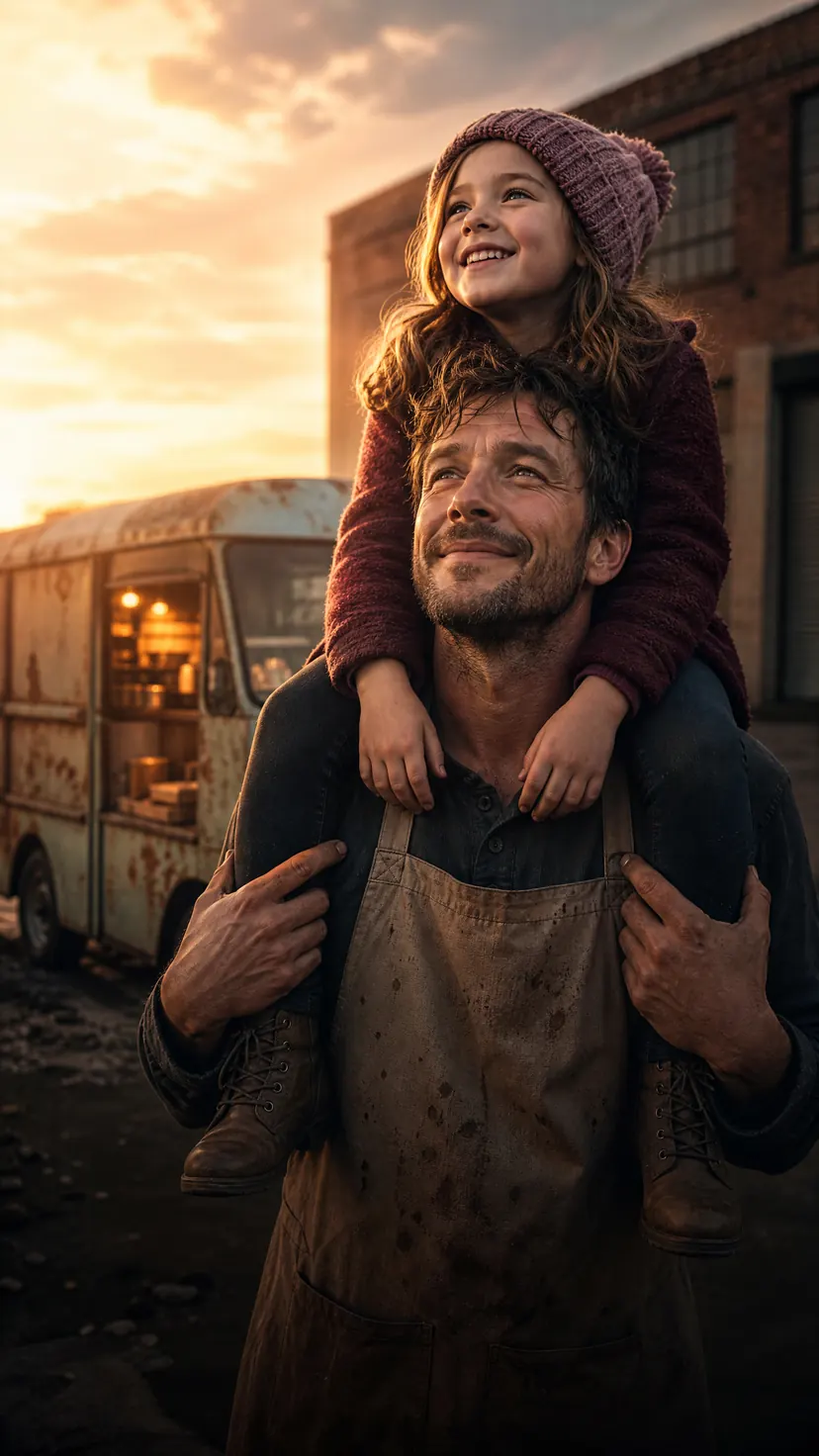
Teddy drove us to Pell's Crossing on Saturday in his pickup, complaining the entire hour.
"You don't know anything about engines."
"I know about brakes."
"You know how to pour the metal for brakes. That's like saying you know about cows because you've seen a hamburger."
Maisie rode in the middle in her booster seat with a juice box and a coloring book she'd brought for the occasion, and every time Teddy said something negative she said, "Uncle Teddy, that's a put-down," because her teacher has a jar for put-downs and you have to put a quarter in it. By the county line Teddy owed the jar a dollar seventy-five.
Gus Varga's farm was a mailbox shaped like a goat and a long gravel drive with grass growing down the middle. Gus himself was about seventy, with a cap that said nothing on it and forearms like fence posts. He was eating a peach.
"You're the one who didn't laugh," he said.
"I'm the one."
"Come on, then. She's out back."
She was. She sat at the bottom of a sloping field, up to her hubcaps in brown grass, and she was worse than the photo. The photo had been kind. Rust had eaten a lacy pattern along the bottom of every panel. One headlight was gone. Under the flaking cream paint you could still read ghost letters from an older life, PELL COUNTY LIBRARY, and under those, if you tilted your head, even fainter ones that said FRESH BREAD DAILY.
"Bread van first," Gus said. "Then the county made it a bookmobile. Then a fella named Rudy put the kitchen in. Then nothing, six years."
Teddy walked all the way around it and came back. "This is two hundred dollars of tetanus."
"Put-down," said Maisie.
"I'm being accurate."
"Accurate put-down."
I went to the side where the serving hatch was. The latch was stiff, and I had to lean on it, and I was ready for the whole panel to come off in my hands. Instead the hatch swung up, smooth as a garage door, and settled on its struts with a soft click. Inside there was a flat-top griddle as long as my arm, crusted and black, and a steel counter, and a little window in the back wall that looked straight across the field at the sunset.
Maisie climbed up the step before anybody could stop her. She stood behind the counter with her chin barely clearing it and looked out of the hatch at the three of us like we were customers.
"Hello," she said. "What would you like?"
Gus laughed so suddenly he nearly dropped his peach.
"Its name is Pamela," Maisie told us.
"Why Pamela?"
"It looks like a Pamela." She said it the way you'd point out that the sky was up.
I asked Gus if it really ran. He said it ran most days and the days it didn't you said something nice to it and tried again in ten minutes. I asked why a cook would leave his truck in a field for six years. Gus wiped his hands on his jeans and took a while answering.
"Rudy paid me a year's parking, cash, and then I never saw him again. Year after that, an envelope comes. Title signed over to me, and a note. Sell it to somebody who needs it, not somebody who wants it." He squinted at me. "So which are you?"
I didn't say anything. I took Maisie's envelope out of my jacket, the past-due one, and turned it over so he could see the drawing. Best in town. One dollar.
Gus looked at it for a long time. He looked at Maisie behind the counter, taking pretend orders from a cow on the other side of the fence.
"Two hundred," he said.
I counted it out on the hood of Teddy's pickup. Twenties, mostly, and a ten and two fives, and when I was done the wallet was empty in a way I could feel through the leather. Teddy wouldn't look at me.
"That's your rent," he said quietly.
"My rent was already gone."
"That's your milk, then."
He was right. I signed where Gus pointed.
Pamela started on the fourth try. She sounded like a blender full of gravel, and she smelled of mice and old syrup, and she would not go faster than thirty-eight miles an hour no matter what I said to her. We drove home on Route 9 with the hazards blinking, Teddy's pickup behind us like an escort for a very sad parade.
Maisie rode with me. We moved her booster into the passenger seat and she sat there with the window down and her hat pulled low and yelled hello at every cow we passed. Around Dorrance she fell asleep with her mouth open.
It was full dark when we pulled into Teddy's driveway. He'd agreed we could keep Pamela in his garage, which he calls the shed, which tells you how he feels about it. I carried Maisie inside to his couch, then came back out to look at what I'd done.
The cab light worked. That surprised me. I sat in the driver's seat for a while with my hands on the wheel, not thinking about the empty wallet, and then I reached up to fold the sun visor out of my eyes.
Something fell into my lap.
It was a composition notebook, the black-and-white marbled kind, soft as cloth at the corners. Every page was filled. Recipes, in small upright handwriting, with notes in the margins and grease spots like maps. Buttermilk batter. Cornmeal batter. Something called a Monday Stack with a star next to it.
On the inside cover, in the same hand, in pencil pressed so hard it had dented the cardboard:
For whoever needs a fresh start. Rule one: the sugar goes in the pan, not the batter. Rule two: do not quit before the fourth Saturday. R.