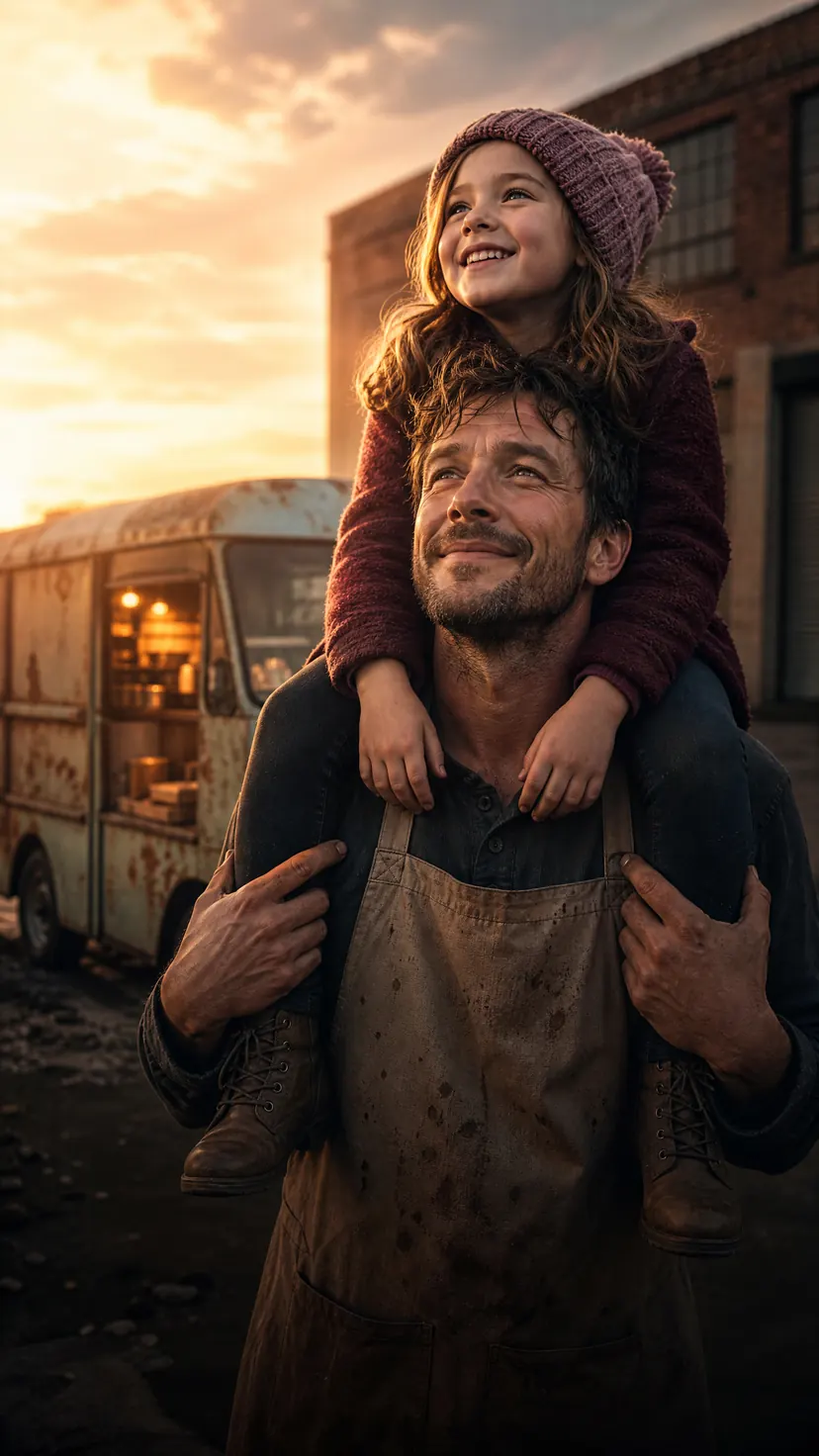
I made the pancakes. Of course I did.
Banana ones, because two bananas were going spotty on top of the fridge, and a smiley face in chocolate chips, because that is the law in our house. I had flour, four eggs, half a carton of milk and a bag of brown sugar gone hard as a brick. I chipped at it with a butter knife while Maisie supervised from a chair she'd dragged up to the stove, which she is not allowed to do.
"You're doing it too thick," she said.
"I've been making pancakes since before you were born."
"You were probably doing it too thick then, too."
My dad taught me on a cast-iron griddle older than he was. Low heat, more patience than you think you need, and you flip when the bubbles at the edge pop and stay open. Every cook in the world wants to flip early. The whole trick is standing there doing nothing while it looks like nothing is happening.
I'd forgotten how much I liked standing there.
Maisie ate three. She eats everything she loves the same way: the eyes first, then the mouth, then a careful circle around the edge until only the middle is left, which she saves and then forgets about. She had syrup in her hair. She had syrup, somehow, on the inside of her hat.
"Daddy," she said with her mouth full, "are we poor?"
I put the spatula down. She'd used the voice she saves for things she's heard at school and isn't sure are allowed.
"Who says we're poor?"
"Nobody. Kayden said when his dad got laid off they had to be poor for a while and he couldn't do swim."
"Right now," I said, "we're poor in money. We're very rich in pancakes."
She considered this with tremendous seriousness, chewing. "Pancakes are better than money," she decided.
"You think?"
"You can't eat money. Owen ate a penny and he had to go to the nurse."
I turned around to flip the next one so she wouldn't see my face. When I turned back she was watching me with the syrupy middle on her fork, not eating it.
"Are you going to leave too?"
"No."
"Like, ever?"
"Not ever."
"Mom said she wasn't going to leave, and she did."
There's no good answer to that, so I didn't try one. I crouched by the chair so we were eye to eye. "I'm not going to quit, Mais. Whatever happens next, I'm going to keep getting up. Every single morning."
She studied me like a used car. Then she stuck out her pinky.
"Spit swear," she said.
"That's disgusting."
"It's grosser, so it counts more."
So we spit swore over a plate of banana pancakes at six-forty on a Thursday. She shook my hand afterward like we'd closed on a house, and wiped hers on my shirt, which was still inside out.
She fell asleep on the couch at eight-ten with the tablet on her chest. The cracked corner glowed. Nobody called.
My brother Teddy came up at nine with a six-pack and the face of a man who'd already heard. Teddy is four years younger than me and works first shift at Brenner, which survived. He sat where Maisie's crayons still were and moved the good orange, both halves, very carefully out of his way.
"Sixty-one," he said. "Jesus, Ben."
"Sixty-one."
"Walt cried in the break room. Did you know that? Big Walt. Cried into a vending machine burrito."
"He didn't cry in front of me."
"Well, he wouldn't, would he." Teddy opened two beers and slid one over. "Jo says you and Maisie can have the back room. It's got the treadmill in it, but you could hang a sheet."
"I'm not moving into your treadmill room."
"It's a nice treadmill."
I got out the calculator. An actual calculator, solar powered, from the junk drawer, because I didn't want to look at my phone and see Dana's name not being on it. Teddy watched me punch it in. Rent, nine-forty. Car, two-eighty. Electric, phone, insurance once Brenner's ran out. Unemployment would come eventually. It would be about half of what Brenner paid, and what Brenner paid had never quite been enough.
"Six weeks," I said.
"Till what?"
"Till we're in your treadmill room."
Teddy didn't argue. That's how I knew the math was right.
After he left I went to throw out the stack of mail on the counter, and stopped. The top envelope was from Linden Court Management, with PAST DUE stamped across it in a red that must have been chosen by someone who never had to read it. Maisie had found it while I was at work. She'd turned it over and drawn on the back.
A truck. A box on wheels, anyway, with a window in the side and a stick man in a tall white hat leaning out. Above the window, in her best capitals, which lean left like they're walking into wind:
DADS PANCAKS. BEST IN TOWN. $1.
I stood in the kitchen with that envelope for a long time. Then I did something stupid. I picked up my phone and searched for food trucks for sale, telling myself I only wanted to see what one cost so I could stop thinking about it.
Most of them cost more than my car. A few cost more than my whole life. Chrome, vinyl wraps, names like Taco Torpedo and The Rolling Brisket.
The ninth listing had one photo, taken from much too far away, of something rust-colored sitting in a field. Old food truck. Runs most days. Griddle works great. 200 dollars firm, no tire kickers. Ask for Gus. Pell's Crossing.
Two hundred dollars. Firm.
Pell's Crossing was three towns over, an hour down Route 9. The listing was fourteen months old.
It was ten-fifty at night. I called anyway. It rang six times, and I was pulling the phone away from my ear when a man picked up, chewing something.
"If this is about the truck," he said, "you're the first one in a year who didn't call to laugh at it."