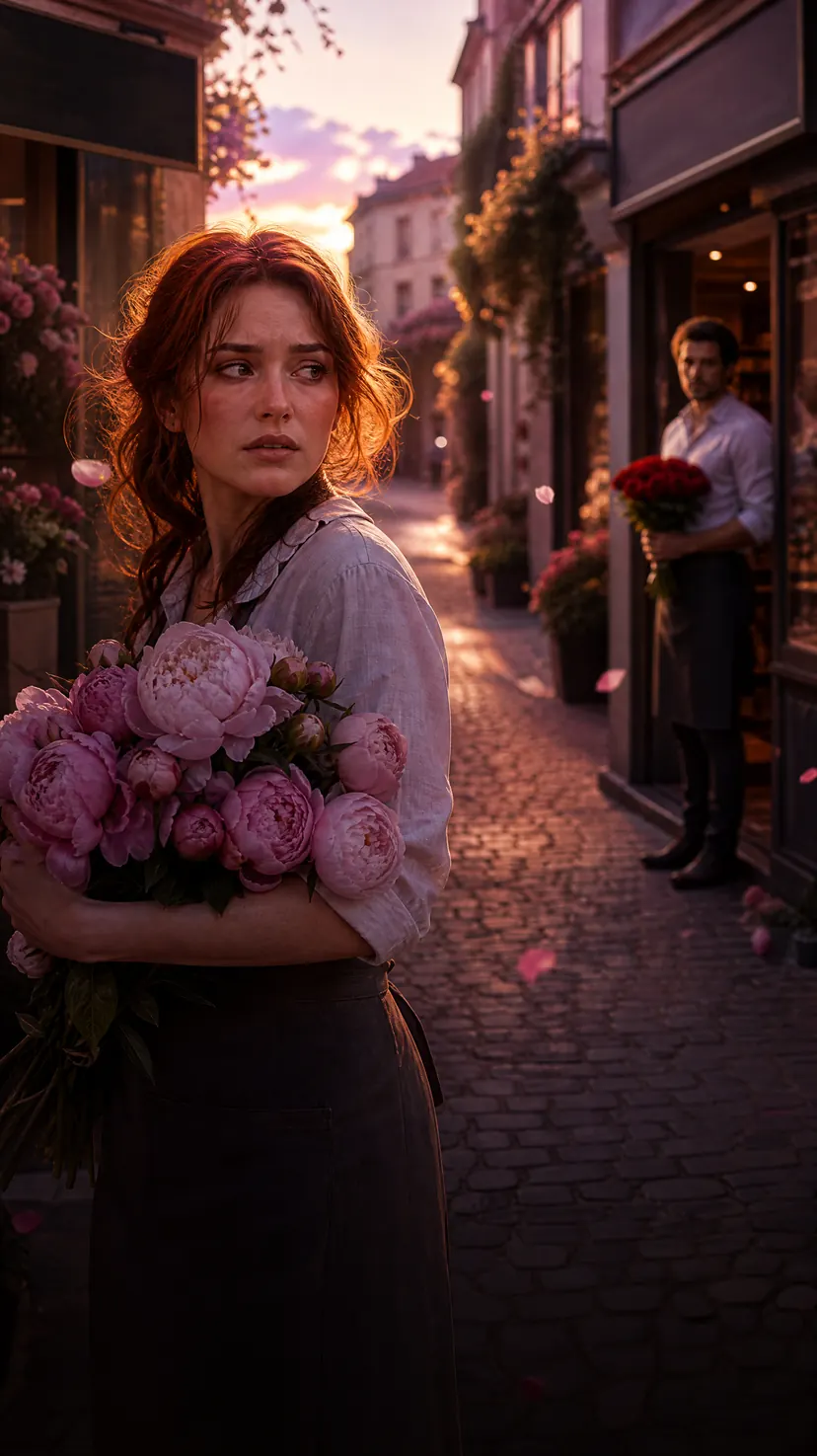
On Wednesday morning Marsh & Moss held its grand opening, so on Wednesday morning I held a half-price sale.
Dot did the chalkboard. Dot does the chalkboard and the window, always, ever since I put a bucket of bronze chrysanthemums in the window and she said it looked like a funeral for a dentist. I told her to keep it classy, and she wrote EVERYTHING HALF PRICE TODAY ONLY, LOCAL SINCE FOREVER in pink capitals and drew a small cartoon grave under the word forever. I rubbed out the grave. I left the rest. I may have underlined forever.
By nine-fifteen we had a line. By ten I had sold every tulip in the shop and most of the hydrangeas, and Mrs. Abernathy had brought two friends from her water aerobics class who bought dahlias they did not want just to be part of the event.
Across the street, Theo had balloons. Three green ones, tied to the awning pole. They bobbed all morning over his empty doorway.
I felt magnificent for about fifty minutes.
Then I noticed he wasn't doing anything about it. No counter-sale. No sign. He stood at his workbench in the window and built a single arrangement, slowly, a low bowl of hellebores and something trailing I couldn't identify at that distance, and every so often he looked up at my line and smiled at it, the way you'd smile at a dog chasing its own tail.
"He's not even mad," Dot said, delighted. "That's so much worse."
"I don't care what he is."
"You've rearranged that bucket of stock four times."
I put the stock down.
At eleven-thirty he crossed the street.
He came in behind a man buying roses for an anniversary, and he waited his turn, and he did not look at anything except the flowers. When he reached the counter he put both hands flat on it. He still had the scar across his right knuckle from the cooler door at his father's nursery. I had kissed that scar once, on a hot afternoon in a greenhouse that smelled of tomato leaves, and I made myself stop thinking about it immediately.
"I'd like to buy some flowers," he said.
"We're closed."
"Your sign says open."
"It's lying. Signs do that. People too."
Behind me, Dot made a small noise like a kettle.
"Ranunculus," Theo said. "The coral ones. A dozen. Half price, I believe."
"Not for you."
"Is that legal?"
"Go and find out."
He smiled then, the real one, crooked on the left, and something old and stupid in my chest tried to stand up. I sat it back down.
"You opened a flower shop across the street from my flower shop," I said, quietly, so the anniversary man wouldn't hear. "Out of every street in this city."
"It was the only lease I could afford."
"Liar."
He held my eyes. "Fine. It was the only lease I wanted."
I wrapped his ranunculus because Dot was watching and because I am a professional. I charged him full price. He paid it without a word and left a twenty in the tip jar, which was a jam jar with a label that said FOR DOT'S EYEBROW BUDGET, and Dot said, "Oh, he can stay."
"He cannot stay," I said. "Nobody is staying. Put that twenty in the till."
"It's in the eyebrow jar. The eyebrow jar is sacred."
"Dot."
"You made the label!"
When the door shut behind him I went into the back room and sat on an upturned crate among the buckets until my hands stopped feeling borrowed.
The back room is my favorite place in the world. Cold, damp, smelling of cut stems and wet newspaper, the skylight above it cloudy with forty years of city grime. Or it had been cloudy. The skylight was new. The leak that had dripped onto my order book every rainy October since I was a teenager had been fixed in March by a roofer I never called.
The landlord's note was still pinned to the corkboard beside the order book. A new company had bought my building over the winter, Juniper Holdings, and the first thing it did was write to every tenant. Typed, on plain paper. Rent frozen for five years. Skylight to be replaced at no charge. Welcome to the new arrangement. Somebody had added the date of the skylight work by hand in pencil at the bottom, Thursday the 17th, and crossed the seven with a little bar through its middle, the fussy European way. There was no name. Only the initials J.H.
I had cried when I read it. I had been three months behind on a heating bill.
I touched the corner of the note now for luck, the way I'd done every day since March, and then I went back out front to sell the rest of my hydrangeas.
At six, when the line was gone and the chalkboard was smudged and my feet felt like two bruises in clogs, a boy of about twelve came in with a single flower in a cone of brown paper.
"Delivery," he said, and dropped it on the counter, and fled before I could ask who had paid him.
It was a white peony. The pink-hearted kind.
Taped to the paper was a small card. The handwriting slanted to the right, cramped at the ends of lines as if the writer kept running out of room, and it was written in green ink.
You still underline forever when you're angry. I missed that.
I looked out the window. Across the street the lights in Marsh & Moss were off, and the three green balloons had begun to sag on their strings. One had worked itself loose and was drifting up past the bakery chimney, very slowly, as if it had somewhere better to be.
I turned the card over. There was one more line on the back.
See you Thursday at ten. Bring the arch sketches. I know you've already drawn them.