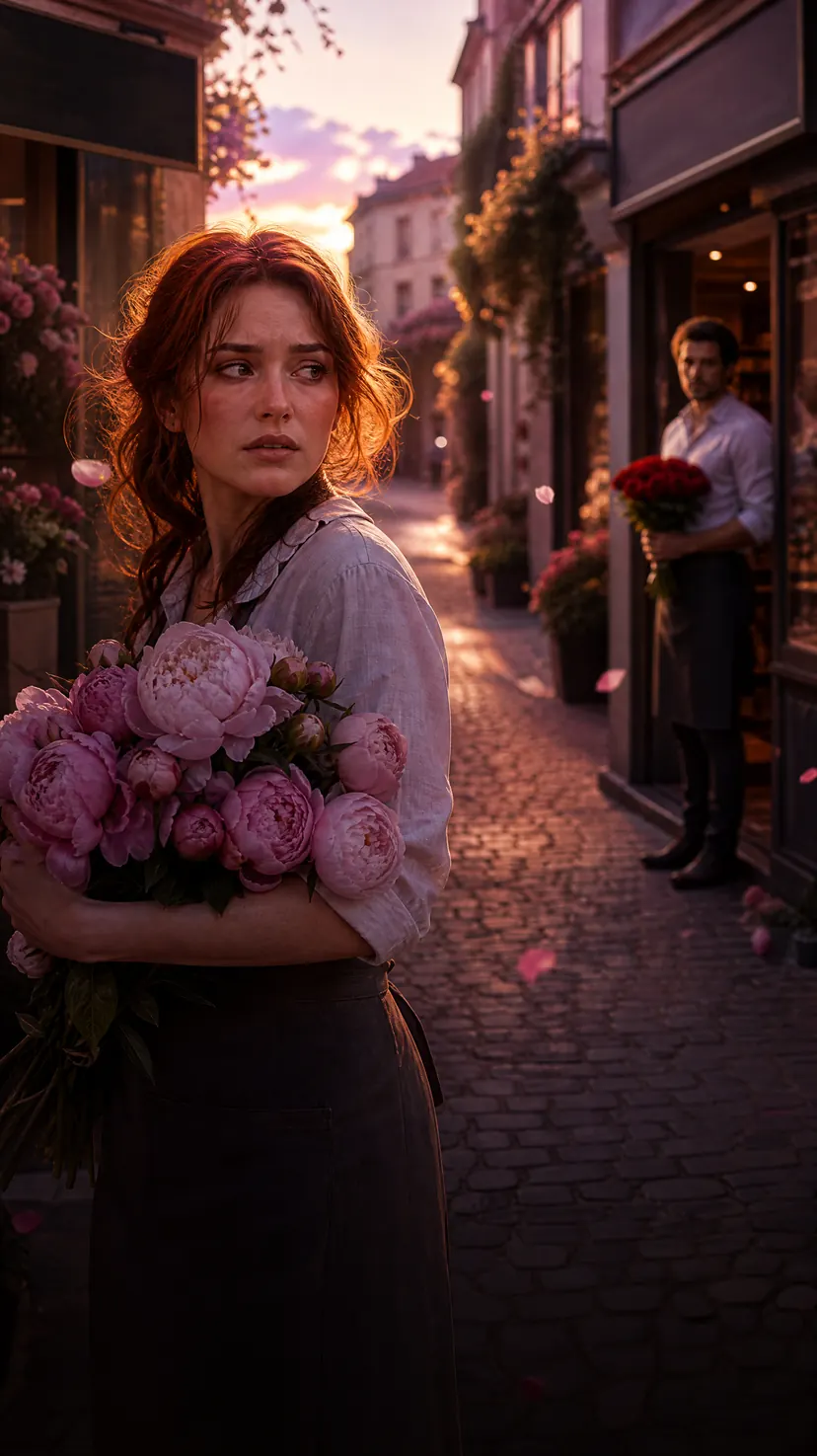
The man who left me at the altar just opened a flower shop across the street from mine.
I found out from Mrs. Abernathy, which is how I find out about most disasters on Juniper Street. She came in at ten past nine on a Tuesday for her striped carnations, the ones she says remind her of her late husband's pajamas, and she leaned over my counter like a spy passing microfilm.
"Have you seen the new florist?" she said. "Opposite. Green awning. Lovely manners. Tall."
"There's no florist opposite. That's the shoe repair."
"Not since Saturday, dear."
I wrapped her carnations in brown paper and tied the twine in a bow so tidy it could have won a ribbon at the county fair. I took her eleven dollars. I counted out her change. She tucked the flowers under her arm and paused at the door, with the bell above it already trembling.
"You might want to look, Nora," she said, and went.
So I walked to the window.
The shoe repair was gone. Mr. Halvorsen's sun-bleached sign with the cartoon boot had been replaced by new glass and white lettering, MARSH & MOSS, and above the lettering hung an awning the shade of a pool table under a bar light. Galvanized buckets lined the cobbles out front. Ranunculus, eucalyptus, a fat bunch of tulips going soft at the necks.
Marsh. There are a lot of Marshes in the world. I told myself that twice, the way you check a lock you already know is locked.
Then the door opened and Theo came out carrying a bucket of white peonies.
He was broader than he had been at twenty-four. His hair was shorter and his skin had the kind of tan you don't get in this city, even in August. But he still rolled his sleeves unevenly, the left one higher than the right, and when he set the bucket down he still straightened the stems with two fingers, as if each one had a preference about where it stood.
White peonies. The kind with a faint pink blush at the heart.
I had ordered two hundred of them, seven years ago. They had waited in buckets in the vestry of St. Brigid's while I waited at the front of the church in my grandmother's veil. The organist played the processional three times. On the third time my mother came up the aisle, took my elbow very gently, and walked me back down it.
Nobody ever told me why. His best man wouldn't look at me. His phone rang out for a week and then stopped ringing at all. His father, a kind red-faced man who smelled of compost and peppermints, stood on my mother's porch with his cap in both hands and said, "He's gone, love. I'm sorry," and would say nothing else.
And here he was, arranging my wedding flowers on the sidewalk.
"Why are you standing like a meerkat?"
Dot came out from the back room with two coffees and a smudge of floral foam on her chin. She is nineteen, she has worked for me for eight months, and she has never once knocked.
"I'm not."
"You're up on your toes." She followed my line of sight. "Oh. Oh, he's hot. Is he the new guy? Mrs. A said he was..." She stopped. She looked at my face. "Nora. Is that him? Is that the altar guy?"
"Don't call him the altar guy."
"What am I supposed to call him?"
"Nothing. We don't call him anything. He doesn't exist."
"He's waving."
He was. He had looked up, straight across the street and straight into my window, and he lifted one hand. A small wave. Just the fingers. The sort of wave you give someone you saw at the bank last week.
I do not remember putting my coffee down. I remember the cold of the cobbles through my clogs, and a delivery van braking hard, and the driver saying something unprintable that I did not answer. Then I was standing in front of the peonies and Theo was standing behind them, and seven years had shrunk to the width of a bucket.
"Hello, Bell," he said.
Nobody else had ever called me that. I had forgotten I used to like it.
"You opened a flower shop."
"I did."
"Across the street."
"That's where the lease was."
"From my flower shop, Theo."
He looked past me at Bell & Bloom, at the hand-painted sign my grandmother commissioned in 1971, at the blue door I repaint every spring, at the window where Dot was now openly pressing her face to the glass.
"It looks good," he said. "You fixed the step."
"Don't."
"It used to wobble. You'd kick it every morning."
"Do not talk about my step." My voice came out lower than I meant. "You don't get to stand there and notice my step. Why are you here?"
He took a long time. The tulips beside him dropped a petal onto the stones. Somewhere up the street the bakery door banged and a smell of cardamom buns came rolling down toward us.
"Honestly?" he said.
"Try it. It would make a change."
That landed. I saw it land. He looked down, and when he looked up again his eyes were exactly the gray I remembered, the gray of the river in March, and I hated that I still had a word for them.
"Because you're here," he said.
I turned around and walked back across the street. I did not run. I did not look back. I would like that on the record.
Dot was holding the door open for me. She was also holding her phone up, screen out, with the expression of a girl who has just won something.
"So, two things," she said. "One, I need to know everything, and I mean everything. Two, Celeste Ashworth's planner just emailed. We made the shortlist."
My knees went loose. The Ashworth wedding. Three hundred guests on a hotel rooftop, a budget that could keep Bell & Bloom alive for two years, and a bride I had been courting with sketches and sample boxes since February.
"Final pitch is Thursday at ten," Dot said. She scrolled down. Her smile faltered. "There's one other florist on the list."
She didn't have to read it out. Across the street, under the green awning, Theo had stopped arranging peonies. He was looking at his own phone.
Then he looked up at my window, and he didn't wave this time.