At 8:00 a.m. Tuesday, Dell Haskins called to say I was suspended from the roster, and that Marnie Shaw would be certifying my daughter.
"Failure to disclose a conflict of interest," he read. Dell only reads aloud when he is frightened. "Montclair's office filed it last night. You had a personal relationship with the witness."
"I learned who the witness was from the caption."
"And you stayed in the chair. You know I love you, kid, but you stayed in the chair."
I had. Leaving would have been a statement too.
Bea sat at the kitchen table sorting crayons by shade, not saying a word. I turned to the window. The radiator knocked twice, the way it does when it wants credit.
"Montclair ordered the transcript expedited," Dell said. "Marnie certifies from your steno file. I need it emailed today, Carrie."
Page thirty-eight, in my own notes. THE CHILD: You have my face. Once Marnie certified it, it would stop being mine. Montclair would file it, and a filing is something anyone can pull.
"Let me certify it myself," I said.
"A suspended reporter can't certify. You taught that class."
"Then seal the page. One page. There's a minor on it."
"She said Bea. That's a first name and a pre-K." He breathed out. "Montclair sues the agency if I touch it. I can't, Carrie. I'm sorry."
"Rent's due Thursday." It was a stupid thing to say, and I said it anyway.
"Suspended means no assignments." He let that sit. "I'm sorry."
Mrs. Okonkwo was in a hospital bed. I hadn't spoken to my mother Jeanette in nearly five years. There was nobody left to ask.
I sent the file at 8:41. It took four seconds to hand my daughter's first sentence on the record to a stranger, and to cancel the job that paid for Thursday.
At 6:00 p.m. someone knocked at 3B, and when I looked through the hole, there was my coat.
Draycott Grant held it over one arm. His other hand held his phone, and an envelope, cream-colored and heavy. "You left this," he said.
The coat smelled of the Harbor Room, lemon polish and cold coffee. I did not invite him in. He did not wait to be invited, only stepped one foot past the threshold.
"Let's all take a breath," he said. "Mr. Thorne would like this handled quietly."
The envelope held two documents. The first was a declaration, already signed, that Gideon Thorne is not the father of any child of mine. The second was a nondisclosure agreement, and on page three was a number. $250,000.
"From Mr. Thorne," Draycott said, eyes on his screen.
I read it standing up, once. Court reporters read fast.
"Paragraph nine," I said. "'Recipient shall not, at any time or in any forum, state, imply, or permit to be inferred that Gideon Thorne is the parent of any child.'" I looked up. "Permit to be inferred. My daughter turns five a week from Saturday. How do I stop her from inferring?"
"Ms. Kerr, it is a quarter of a million dollars."
"It's paragraph nine. I have it word for word."
I tore the declaration in half. Then the agreement, slower, through the number. It makes a good sound, paper. I had made it once before, over a desk, to a check.
Draycott looked at the halves in my hand, and then at his phone, which was safer.
"Goodnight, Mr. Grant."
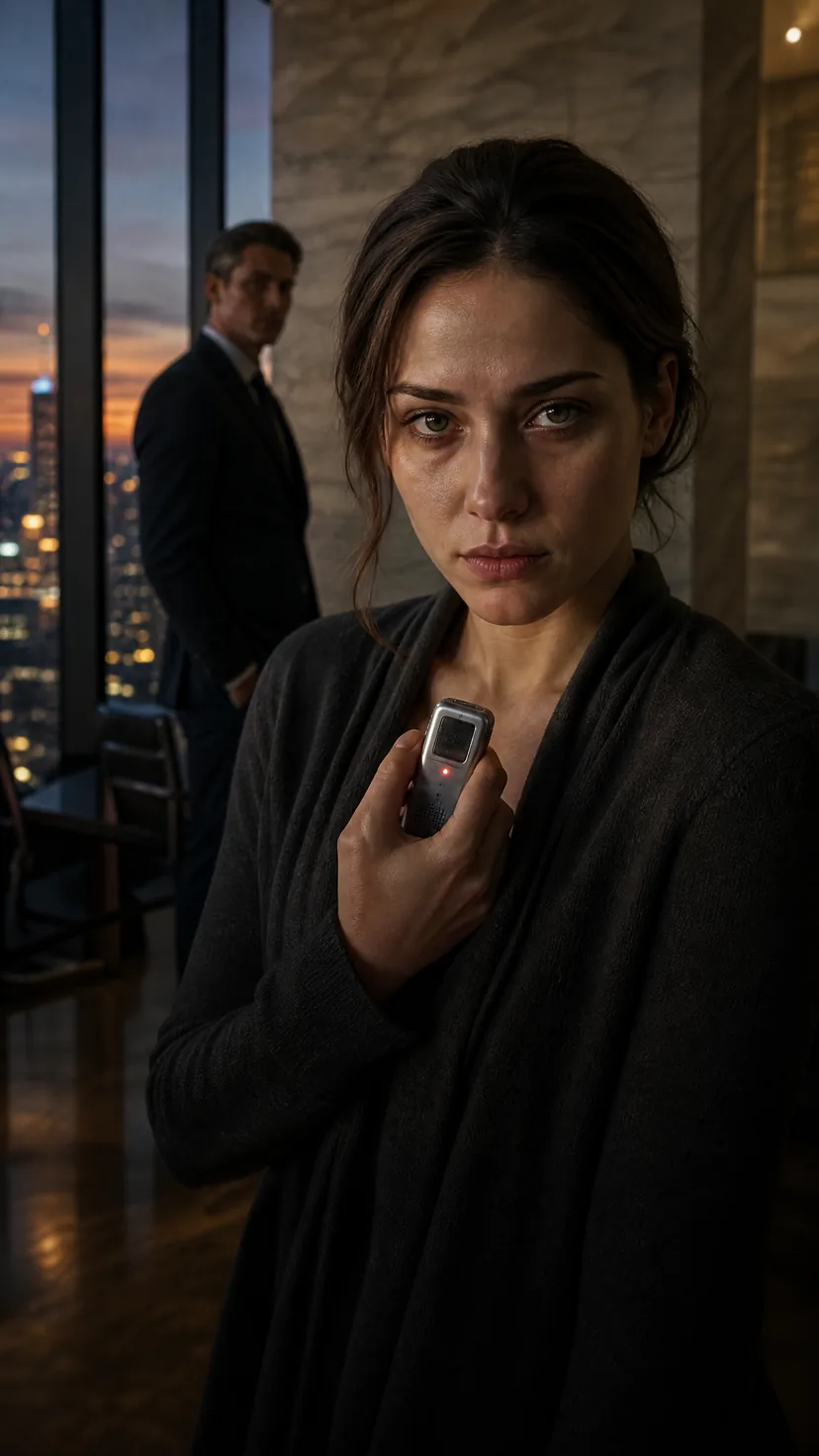
My recorder was in the coat pocket. The silver mouse, battery dead, the red light finally out. I swore an oath to play backup audio only to check a transcript on the job, and I no longer had a job. I put it in the kitchen drawer, beside the takeout menus, and shut the drawer.
At 9:00 p.m. there was a second knock, softer.
Gideon stood in the hall in his shirtsleeves, no coat, no lawyer. Under the buzzing light he looked as if he had walked all the way.
"Your man was here at six," I said. "Two hundred fifty thousand dollars. Is that what you pay for a girl who types?"
He said nothing. Two fingers tapped the doorframe, once, and stopped. He did not say yes and he did not say no, and I filed that, because I file everything.
Then a small voice said, "Mommy, who's that?"
Bea came out of her room in her pajamas, the moon ones, the white streak bright in the hall light. She was holding a folded sheet of paper in both hands.
"Fact," she said to Gideon. "This is for you. You're number eleven."
It was an invitation, in crayon. A purple cake with too many candles. BEA IS 5. SAT MARCH 14. LINDEN PARK PAVILION. 2 O'CLOCK. He took it by the edges, with the tips of his fingers, the way you carry something that might break if you breathe on it.
He read it twice. I watched his throat move.
"Noted," he said, and his voice came out wrong. "I'll be there."
"There might be a bouncy castle," Bea said. "Mommy says probably not."
I walked her back to bed. When I returned, he was still in the doorway, the invitation against his chest, and he looked up with a different face. The boardroom one.
"Draycott can wait," he said. "This can't."
He turned his phone toward me. A photograph of a check, canceled, perforated at the corner, the kind banks used to return. PAY TO THE ORDER OF Caroline Kerr. Fifty thousand dollars, dated September 1, 2020. Celia's signature across the bottom.
"It was in my mother's files," Gideon said. "You cashed it in three days."
"I tore that check in half in front of her."
"Then this is another one." He swiped. "Look at the back."
Blue ballpoint, across the endorsement line. Caroline Kerr. Under it, a bank stamp: DEPOSITED, PENHALLOW POINT SAVINGS. The little bank in the town where I grew up.
The loops were wrong. The J leaned the wrong way, and the K had a tail I have never made in my life.
The signature said Caroline Kerr. It was not my handwriting.