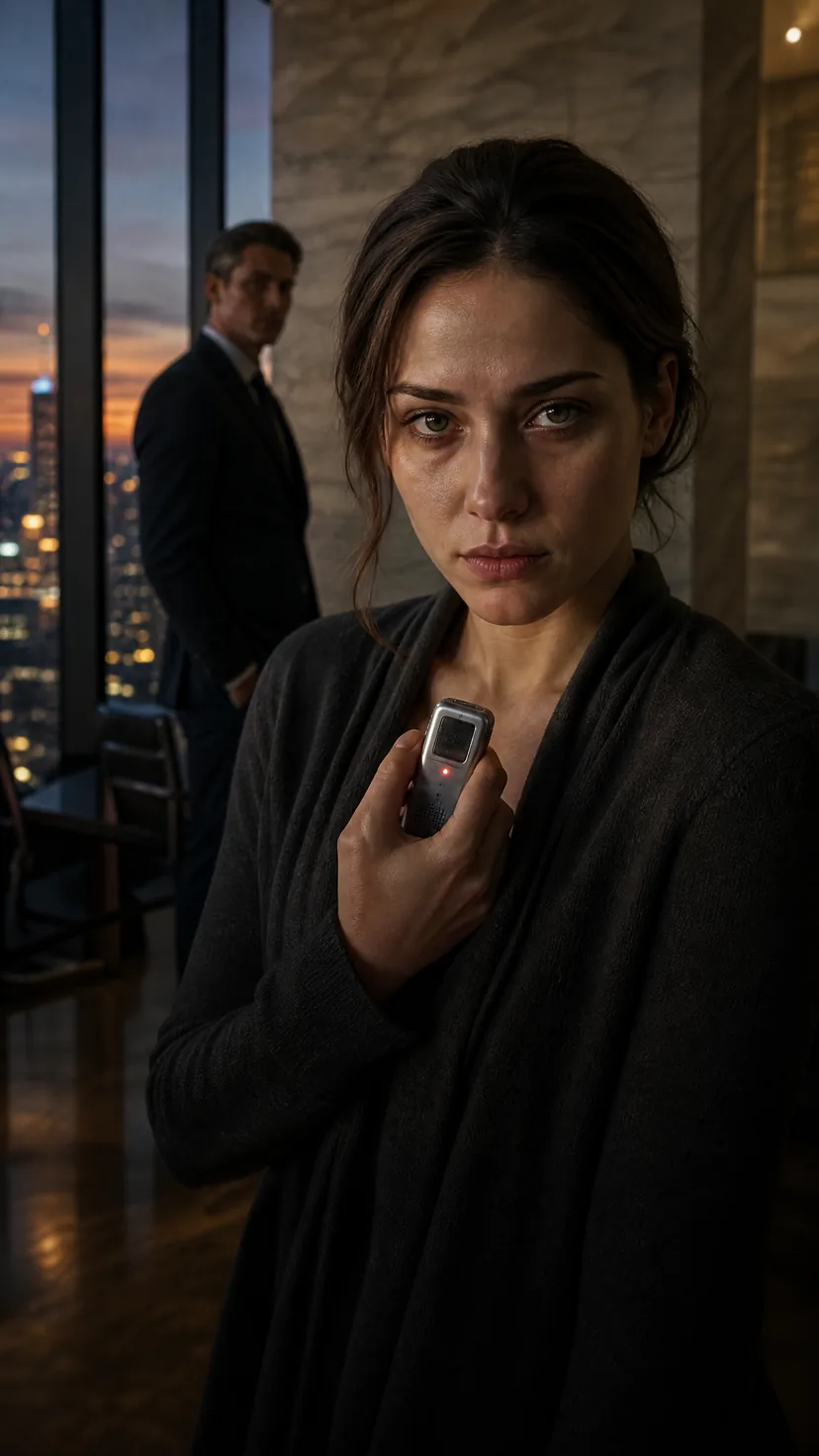
My daughter walked into the deposition at 10:42 a.m., pointed at the billionaire under oath, and said, "You have my face."
I typed it. Nine years of training, two hundred and twenty-five words a minute, and my fingers put the only secret I had ever kept into the official record before my brain could tell them to stop.
Nobody looks at the court reporter. That was the first thing they taught us at Harbor County Community College, and for forty-two minutes it had saved my life.
At 7:10 that morning Dell Haskins had called to say Glen had the flu and could I cover a deposition downtown, rush rate, ten o'clock. Larkin Street pre-K was closed for a burst pipe. Mrs. Okonkwo from 2B, who watches Bea when the world falls apart, had slipped on the ice on Sunday and was in Harbor General with a cracked hip. I said yes anyway. Rent was due Thursday.
So Bea came with me, with her spiral notebook and her sixty-four crayons, and the receptionist on the fortieth floor of Thorne Harbor Tower promised to keep an eye on her. Then I walked into the Harbor Room, set up my machine, and read the caption on the notice.
Ridley Capital v. Thorne Harbor Holdings. Witness: Gideon Thorne, Chief Executive Officer.
I could have left. I thought about it the way you think about jumping when you stand near a railing. Then the door opened and he came in, and he shook hands with the plaintiffs' lawyer, and he did not look at me. Not once. He sat down, unbuttoned his jacket, and tapped two fingers on the table while the oath was read, and I typed I do and kept my head down.
He looked older. Thirty-two now. The hair at his left temple was still dyed the same flat brown as the rest, so nobody would ever see the white streak underneath. I used to be the only one who knew it was there.
Forty-two minutes. Questions about a dividend, a merger, a vote in 2024. My fingers did the work and the rest of me sat very still. Beside the machine my little silver backup recorder blinked its red light. I keep a recorder running on every job. I keep a diary in steno too, in shorthand nobody else on earth can read. Words are the only thing I've ever trusted to stay where I put them.
Then the door opened, and Bea came in holding a crayon drawing of a man's face.
She didn't look at me. She walked straight down the long side of the table, past the lawyers and the water glasses, and stopped beside the witness chair. She held the drawing up next to his head and compared them, frowning, the way she checks her letters against the alphabet chart.
"You have my face," she said.
THE CHILD, I typed. You have my face.
Gideon Thorne went white. His eyes went from her face to her hair, to the streak at her left temple, pale as milk against the brown. The one I never dye.
"I'm Bea," she told him, helpful. "I'm four. I'm five a week from Saturday. You can come to my party."
My hands typed that too.
Across the table, Stuart Montclair leaned back in his chair with the slow pleasure of a man finding money in an old coat. "Let the record reflect," he said, "that the child is indicating the witness."
I stopped typing. A court reporter does not speak on the record. Ever. I said, "Counsel, I'd ask that we go off the record."
"We're on the record, Ms. Kerr," Montclair said.
And Gideon Thorne turned his head and looked at the court reporter for the first time in forty-four minutes.
He didn't say anything for a second. Then he said, "Carrie," very quietly, as if somebody had hit him and he was checking whether he could still talk.
His lawyer, a polished man with a phone already in his hand, stood up. "We'll take ten minutes. Off the record."
10:44. I note times. It's the job.
Habit dropped the recorder into the pocket of my coat on the chair back, red light still blinking, the way I do at every break. Panic left the coat there. I swept my machine into its bag without folding the tripod, took Bea by the wrist and walked out. Behind me Montclair was laughing softly. The polished lawyer hadn't moved. He'd turned to the window with his back to the room, phone to his ear, already talking low.
The elevator came fast. I pushed the lobby button four times.
A hand caught the doors.
Gideon stepped in. The doors closed on the three of us and the elevator began to fall, forty floors of brushed steel, and it was the smallest room I have ever been in.
"Mommy, that's him," Bea said. "The man on the wall." She meant the wall of framed annual reports by reception, his face on every one. "Fact. You told me I got my face from my father."
I had told her that. One time, at bedtime, when she was three and asked why she didn't look like me. I'd never thought she was listening.
"She isn't yours," I said.
Gideon didn't look at me. He was looking at Bea, who was looking back with exactly his expression, the one he used to wear over a chessboard. His hand was on the rail. Two fingers tapped it. Next to him, without knowing why, my daughter tapped two fingers on her notebook.
"Then you won't mind a test," he said.
"I'm making a list," Bea told him. "Of who comes. You can be number eleven. There might be a bouncy castle. Mommy says probably not."
He crouched. A man in a three-thousand-dollar suit, crouching in an elevator. "What's your whole name?"
"Bea," Bea said, because that is what she tells everyone.
He stood back up. To me, very low: "Five years. You let me think you were..." He stopped, because she was listening.
The numbers fell. Ten. Five. Lobby.
The doors opened at 10:51 on a woman in a camel coat, standing in the marble lobby as if she had been waiting for a car. Silver hair, cut sharp at the jaw. Pearl earrings. A face I had seen once, across a desk, on the worst afternoon of my life.
Celia Thorne looked past her son. She looked past me. She bent down to my daughter with a smile that gave nothing away, and she kept her eyes on mine while she said it, so I would know she meant it for me.
"Hello, Beatrix."
I had typed every word spoken in that room. My daughter had told them her name was Bea.
No one, not once, had said Beatrix.