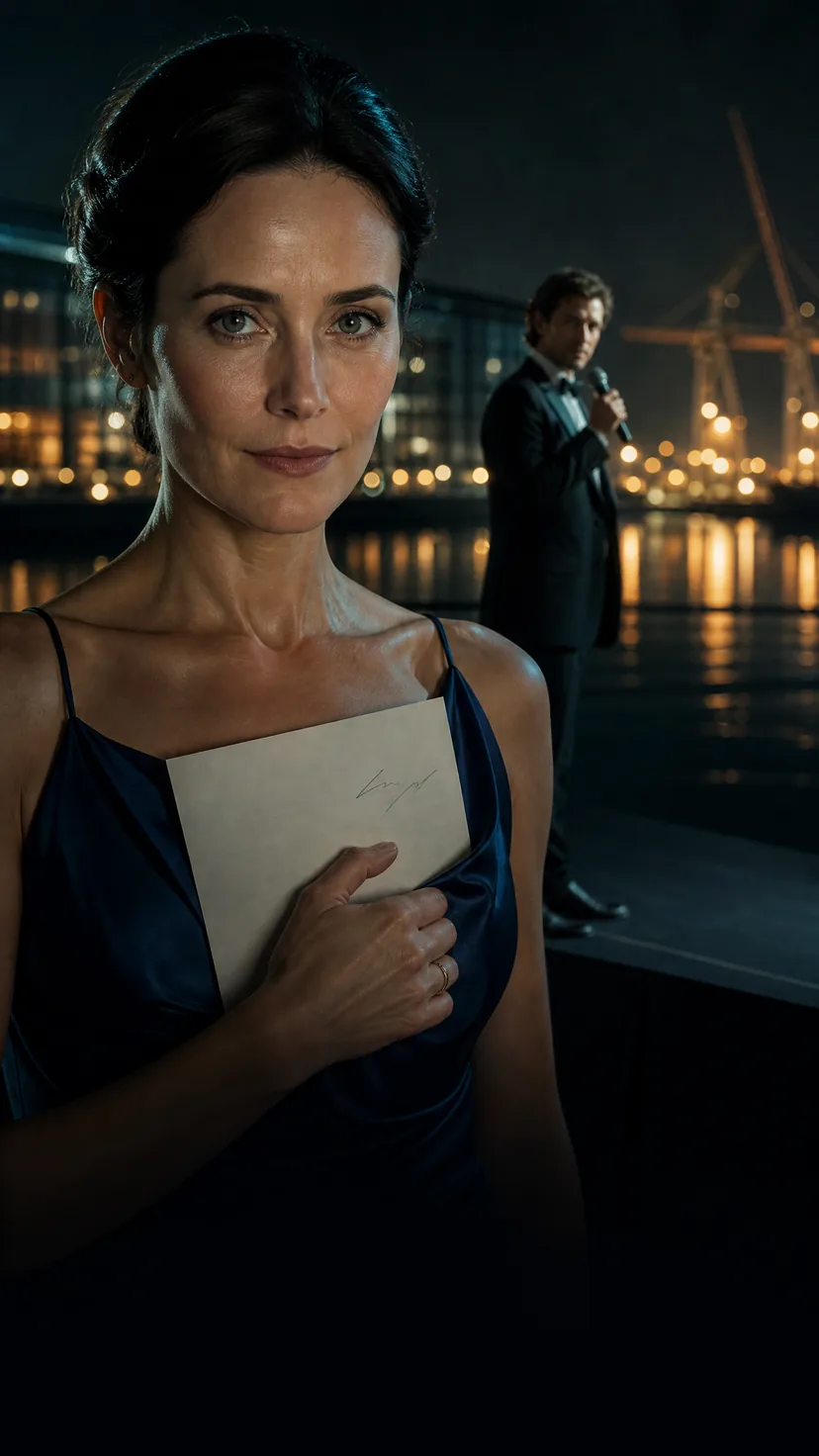
The risotto was already on the table when Mara sat down.
Clams, lemon, no parsley, the way she had ordered it at Corvo's for ten years. He had not forgotten one word of it.
A man did not keep a woman's order for three years unless he meant to spend it.
"Eat," Callum said. "It's the only thing in this room I'm not selling you."
"You're selling me something."
"Always." He smiled. He had on the grey jacket she had picked for him, and the booth by the kitchen breathed garlic and hot oil at them every time the swing door opened. "I asked them for the corner table by the window. Then I remembered you hate a window."
She picked up her fork. She noted that her fingers were warm, the way she noted a clause.
He drew a sheet of paper from his inside pocket. One page, folded once. He slid it across the cloth and did not tap it. He didn't need to.
"Ten million," he said. "Wired Monday. Rory Corwin reinstated, back pay, the report withdrawn. All you do is tell me who really runs Breakwater. And then you leave."
"Leave what?"
"The city. Take a long trip somewhere with a beach." Gentle. "You were never happy here, Mara. You were just good at it."
She did not open the page. "Ines runs Breakwater. Everyone knows her name."
"Ines doesn't sign things. Somebody signs Ines's things." He cut a piece of bread. "I've seen the signature blocks. You're what, her assistant? Carrying her coat and her calendar?"
"I carry her coat," Mara said. "Do you know what that is, after ten years of carrying yours?"
It came out with an edge she had not rehearsed. That was all right. The edge was real, so it would pass for the disguise.
"You gave me one and a half million and a city I couldn't stay in," she said. "I'm in a hotel that smells of strangers' cigarettes. I do what an old woman tells me and I'm grateful for the pay."
"Then take the ten."
"Say the rest."
"Say the rest, what?"
"What it costs. You said you were selling."
He laughed, softly, pleased with her. Then he looked at the candle. "The old woman's patient, I'll give her that. Vossberg's twelve was the only block that matters, and she walked in the week he got tired. Somebody told her he was tired."
Mara cut a clam in half. Her fork did not stop.
"Who tells an old woman things like that?" Callum said. "You'd know."
"I don't know what Vossberg is tired of."
"No. You never did read people. You read paper." He said it kindly, which was worse.
She put the fork down. "You promised me after Kestrel."
He did not ask what she meant. That was the thing she remembered afterward. He looked at the tablecloth for the length of a breath and then at her, and his face was entirely calm.
"I did. I meant it, at the time." He turned the stem of his glass a quarter turn. "Sienna lost a child. Three years ago on the sixth of November, a Monday. The statement went out at eleven."
He said it the way he read quarterly numbers aloud: accurate, rounded, closed.
Not our child. Not the baby, or the spring, or the stage with six hundred phones held up. Sienna lost a child, as if he had been told of it by a colleague.
Mara thought of the woman in green silk, looking down first. Whatever else Sienna Prenderby was, she had stood in that light with her hand on her stomach and believed the man beside her.
And Mara thought, for the length of one swallow of water, of every Sunday after Kestrel. The room they had painted yellow, then painted over.
She hated that it hurt. It was a very old bruise, and he had pressed it by accident, and she hated most of all that it still answered.
"I'm sorry," she said, and meant it for someone who was not at the table.
"Everyone was." He glanced at his watch. "So. Ten."
"No."
"Which part?"
"The leaving. I left once, and you had a microphone for it." She slid the folded page back across the cloth, unopened. "And I can't give you a name worth ten million. You'd pay it and still not believe me."
Callum shrugged. It was a small, generous movement, the shrug of a man who had lost a hand of cards he'd only played for company.
"Fair," he said. "Then dinner's dinner."
He paid. He tipped the waiter twice what the bill required and asked, as an afterthought, for her risotto to be boxed, because she had barely touched it. A white paper bag arrived, warm at the bottom. He carried it out himself and put it into her hands under the awning.
The pavement was wet and shining. Behind them the kitchen door clattered, and somebody laughed in French.
"Since you won't take the ten, I'll give you something free," Callum said. "A courtesy. For old times."
She waited.
"Tidewell Bay Capital refinances the whole twelve hundred million. At par, Friday, nine a.m. Every lender in the syndicate paid in full, to the cent." He buttoned his coat. "Breakwater gets its money back, with a nice profit, and the company goes to the people it always belonged to. You'll want to tell Ines. She likes a profit."
Mara heard her own pulse in the paper bag against her ribs.
A prepayment at par. No vote, no consent, no block of any size. She had put that clause into the loan herself in 2017, because he had asked for room to move.
"You wrote the prepayment clause," he said, reading it off her face. "I'd have called you for advice, but you were busy leaving."
"And Rory?"
"The report goes in the morning." Still pleasant. "I did say the ten was for the name. I never said Rory came free."
He kissed her cheek, once, the way he had kissed it in a thousand doorways, and walked to the curb where a car was already idling.
At nine tomorrow a detective would open a file with Rory Corwin's name on it, and on Friday at nine Breakwater would be paid back in full and lose the company, and she had eaten six mouthfuls of dinner to find out.