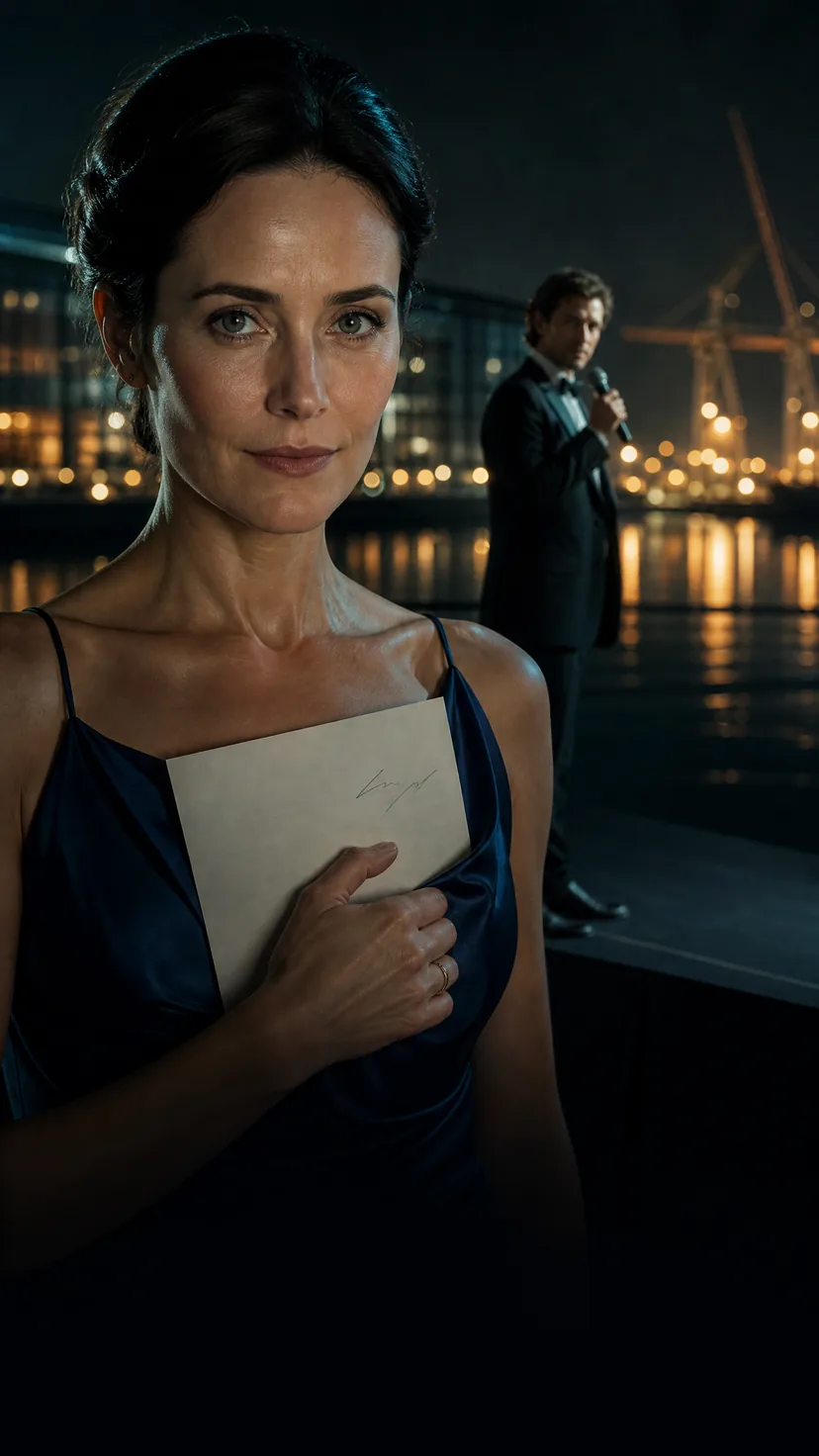
Callum Rourke ended their marriage at 9:40 on a Saturday night, into a microphone, in front of the six hundred people who had come to celebrate it. Mara was standing at the foot of the stage with a glass in her hand. She had chosen the glasses. She had chosen the band, the white peonies, the harbor view through the tall windows of the old Customs Hall, and the date. Ten years ago tonight, she had chosen him.
"Mara and I have decided to end our marriage," he said, in the easy voice he used for shareholders and waiters. "We've been honest with each other for a while. Tonight I'd like to be honest with all of you."
Nobody moved. Somewhere near the bar a fork rang against a plate and stopped.
He turned and held out his hand to the side of the stage, and Sienna Prenderby walked into the light in green silk. His head of communications. Twenty-eight. Mara had approved her hire.
"Sienna and I are expecting a baby," Callum said. "In the spring."
Sienna's hand went to her stomach and stayed there.
The applause started at the back, where the junior staff stood, and died long before it reached the front.
After Kestrel. That was what he had said in 2019, when Mara stepped back from the contracts desk to make room for a family. After the terminal is built. After the loan. After Kestrel, Mara, I promise. She had heard it so often it had stopped sounding like a sentence and started sounding like a place, somewhere they were both driving toward.
Six hundred phones came up, one after another, like lights in windows.
Mara lifted her glass toward the stage. "Happy anniversary," she said, to no one, and drank it, and set it down on a passing tray, and walked.
She made it as far as the cloakroom before anyone touched her.
It was an old woman in grey wool, small and upright, holding out an envelope. Mara knew all six hundred names on the guest list. This woman was not one of them.
"Ines Haldane," the woman said. "Your father-in-law sank my company in 1994. I came to watch his son do something stupid. I didn't expect it to be this."
"I'm not his to do things to."
"Clearly not, as of nine forty." Ines pressed the envelope into her hand. "When he runs out of money, call me."
The envelope said Mrs. Rourke on the front, in fountain pen. The ink was dry. It had been dry for a while.
The service corridor smelled of hot trays and bleach. Mara stood under the fire exit sign and waited, because she had one question and she meant to have it answered tonight.
Callum came through the swing door three minutes later, already unbuttoning his jacket.
"I know," he said. "I should have warned you."
"You should have told me." She opened her clutch and took out the letter. "This came on Wednesday. It's from a bank I've never used. It says I'm the director of something called Greyling Holdings."
She had texted him about it that same afternoon. He had written back: Boring. Ask me Saturday.
He glanced at the letterhead and away. "Dead shell. My father's era. It's being dissolved, it's paperwork." He drew an envelope from his inside pocket. "This is the paperwork that matters."
Eleven pages, stapled. At the top: dated Thursday, October 12.
Two days ago. On Thursday he had kissed her at the front door and asked what she wanted for dinner.
He had folded the corner of page nine down, the way he marked every page he wanted her to sign. He tapped it.
"One and a half million," he said. "More than the prenup asks. You'll be comfortable. You were always good at comfortable."
Then he pushed back through the swing door, into the music, and she heard someone cheer his name.
The harbor steps were wet and empty. Mara sat on the third one in a gown that cost more than her father had earned in a year, and she read every page under the lamp.
She read contracts for a living. She had written the ones that made Rourke Line rich.
Page one to eight: the house was his, the shares were his, the dog they never got would have been his. Page nine, clause fourteen: she agreed to indemnify Callum Rourke against any liability arising from the entities listed in Schedule C.
Schedule C was six registry numbers. No names.
Any lawyer she had ever trained would have told her: do not sign this tonight.
She took out the grey woman's envelope. Inside was a card with a phone number and nothing else.
Ines answered on the first ring, as if she had been holding the phone.
"Did you read it?"
"Every page. There's an indemnity for six companies I can't name."
"Will he give you better terms if you fight?"
"No. He'll give me worse ones, slowly, in public."
"Then sign it. Tonight. Take the money and nothing else. Leave the city in the morning and don't speak to him again." A pause. "Tonight he's watching you. If you fight, he'll watch you for years. If you sign, he forgets you by Tuesday. I need him to forget you."
"For how long?"
"Until he runs out of money. Three years. Perhaps less."
Mara looked up at the tall windows. Inside, people were dancing. Someone had asked the band for the song from their wedding, and the band, who had been hired by her, was playing it.
"And then?"
"Then you take it from him," Ines said, and hung up.
Mara sat on the cold step until her hands stopped shaking. She made herself one promise there, the only one she meant to keep. Whatever she became, she would never put another woman on a stage the way he had just put her.
He was by the cake when she came back in. Five tiers, white on white. She had tasted eleven samples to choose it.
Sienna stood at his elbow. She saw Mara first. Her mouth opened, as if she had something to say, and then she looked down.
"I'll need a pen," Mara said.
Callum smiled, the first real smile all night, and gave her his own.
She laid the settlement on the tablecloth, between the cake knife and a stack of gold napkins, and initialed pages one through eight. On page nine she signed her married name in full, for the last time, where he had turned the corner down.
Then she handed him back his pen.
Six companies with no names. As of eleven minutes to eleven, whatever they owed, she owed.