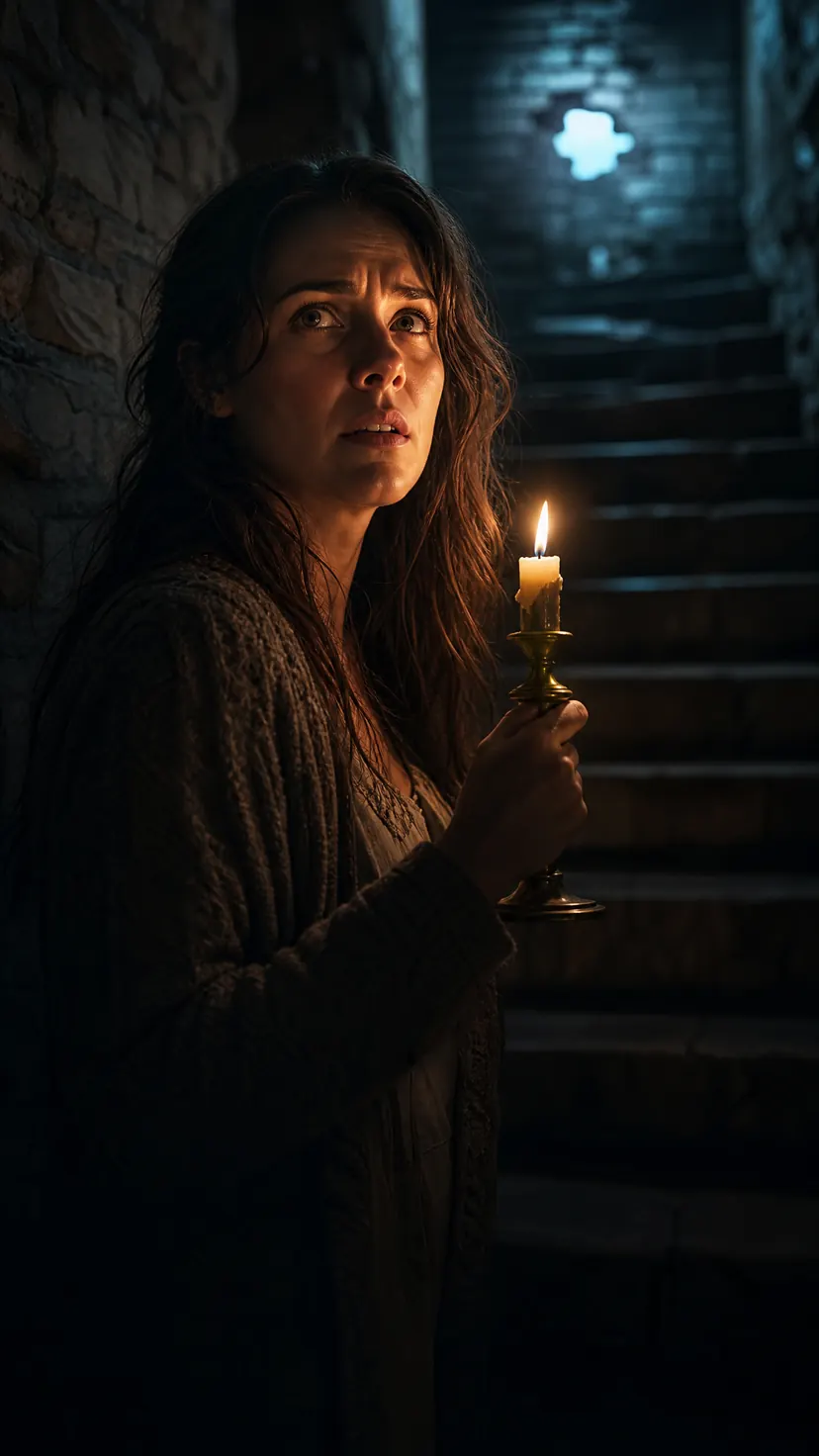
I rang Owen from the car park of The Plough, with the engine running and the heater on full, and I still couldn't stop my hands shaking.
"Tomorrow," I said. "First thing. Can you?"
There was a pause on the line. I heard a radio somewhere behind him, and a kettle.
"Are you sure?"
"No."
"Right," he said. "Seven o'clock. I'll bring the dust sheets."
I didn't sleep. I sat at the kitchen table with my mother's papers spread out in front of me, the plastic folder I'd carried from flat to flat for six years without once opening it properly. Her passport. Her bank cards, cut in half. The order of service from the crematorium.
Her birth certificate was near the bottom, folded in three, soft at the creases.
I had seen it before, of course. I'd needed it for the funeral. I had read it then the way you read anything in the week someone dies, without taking in a single word.
I read it now.
Name: Anne Evelyn Calloway. Date of birth: 14th April 1969. Place of birth: Hollow Lane, Ashcombe. Father: blank. Mother: Evelyn Mary Calloway. Informant: E. M. Calloway, mother, present at the birth.
Father blank. My grandfather Arthur had died in 1960. I had seen his grave. My grandmother, a widow for nine years, had registered a baby with no father on the line, at the age of forty-one, at home, in a house where she had been hiding her pregnant daughter all winter.
And I kept coming back to the request book. Anybody can write a name, Margaret had said, and she was right. A woman who wanted me angry enough to fetch a hammer could have written it. A woman who was alive, who had a key and a candle and fifty years of reasons, would surely have knocked on my door by now. Nobody had knocked.
I sat with the certificate until the window went grey.
Owen came at seven. He looked at my face and didn't ask anything. He carried the dust sheets upstairs and laid them across the landing, tucking the edges under the skirting, and set out his tools in a row. Lump hammer. Bolster chisel. A crowbar. A pair of goggles he handed to me without a word.
He had just lifted the hammer when the doorbell rang.
It was the vicar. He was out of breath, in his cassock with a coat thrown over it, and his white hair stood up on one side as if he'd slept on it badly, or not at all.
"Mrs. Dacre saw the van," he said. "Miss Calloway. Iris. Please."
"Come up," I said. "You may as well watch."
He climbed the stairs behind me with one hand on the rail. On the landing he looked at the dust sheets and the tools and at Owen, and something in his face folded inward.
"Your grandmother left one instruction," he said. "One. Is it really so much to ask?"
"Margaret Hollis heard Sylvie singing in that room the night before it was bricked up. Nobody ever saw her come out." My voice was steadier than I felt. "Do you know what's on the other side of this wall, Reverend?"
He didn't answer.
"Then I'm going to look."
"Iris." He reached out and stopped short of touching my arm. "Your mother was born in that room."
Owen lowered the hammer.
"I know," I said.
The vicar stared at me.
"I know she was born at Hollow Lane. It's on her certificate." I took it out of my cardigan pocket, where I'd put it at dawn, and unfolded it. "I know the midwife was paid on the fourteenth of April. I know my grandmother was a widow of forty-one and the line for the father is empty. And I know her daughter Sylvie had been hidden upstairs since October."
It was the first time I'd said it aloud. The words came out sounding like someone else's.
"So tell me I'm wrong," I said. "Tell me Evelyn Calloway was my mother's mother."
The vicar opened his mouth. Nothing came out. He looked at the wall, at the gap, at the two letters in the mortar. His eyes were wet.
"I can't," he said at last. "God forgive me. I can't tell you that."
He turned and went down the stairs very slowly, holding the rail with both hands, and I heard the front door close behind him with a click as soft as the one I'd heard from the attic.
Owen looked at me.
"Do it," I said.
It took him most of the morning.
He started at the gap where the missing brick should have been, working the chisel in, tapping, levering. The mortar came away in grey crumbs and puffs of dust that hung in the stripe of light like smoke. The first brick out he passed to me, and I stacked it on the dust sheet without knowing why it seemed important to stack them neatly.
Behind the first layer was the second. Behind the second was the dark.
I stood with my back against the banister and watched the hole widen, a brick at a time, until it was the size of a hand, a head, a child.
Behind the wall was a door.
An ordinary wooden door, painted pale yellow, the paint gone chalky and cracked. Taped to the middle of it, curled at the corners and brown with age, was a child's drawing of a sun. Fat yellow crayon, rays going out in all directions, and a wobbly signature in capitals at the bottom. SYLVIE AGED 6.
Owen pulled the last row of bricks from the threshold. He set down the chisel. He wiped his hands on his trousers and looked at me, and I nodded.
He put his palm flat on the yellow paint and pushed.
Nothing happened.
He tried the handle. It turned, all the way round, and the door didn't move a quarter of an inch. He put his shoulder to it. The wood creaked and held.
Owen crouched and shone his torch into the narrow crack between the door and the frame, moving the beam slowly upward. At about the height of his chest it stopped on a dull grey line of iron, crossing the gap.
He sat back on his heels.
"The handle turns fine," he said. "There's a bolt."
I didn't understand. Then I did.
My grandmother had not been my grandmother. The girl who was had been singing behind this door the last night anyone heard her voice. Joe Finch had bricked up the doorway from the landing, from this side, at six o'clock in the morning.
And the bolt that held the door shut was on the inside.