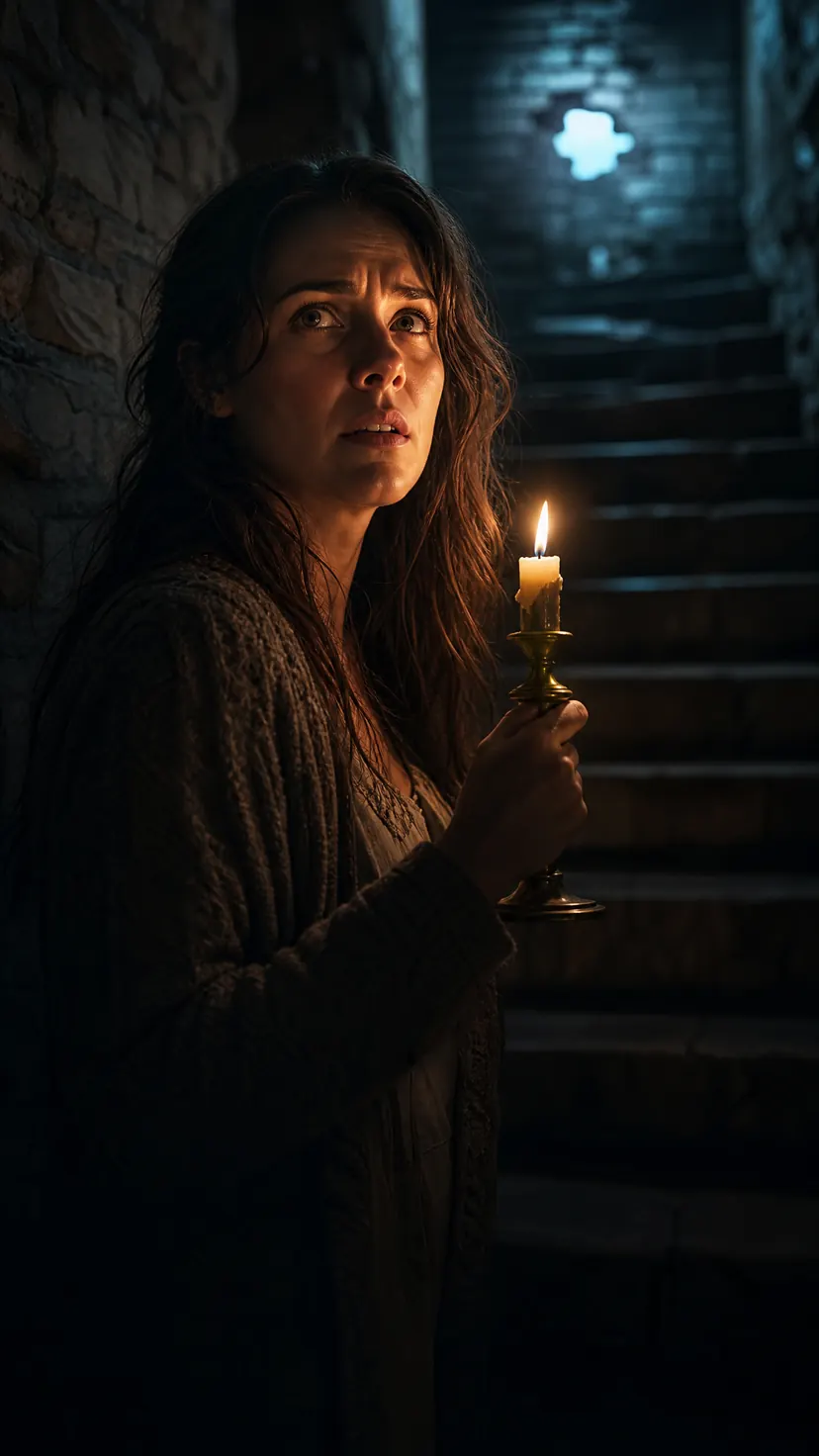
"Hello?" I said.
My voice went up the last turn of the stairs and didn't come back. The house ticked around me. Somewhere a pipe knocked twice and was quiet.
I made myself walk every room with the brass candlestick held out in front of me like a weapon. Four bedrooms, sheets over the furniture. A bathroom with a green enamel bath. A narrow door to the attic stairs, locked from my side with a hook and eye. Nobody. No open window. No wet footprints on the boards, though it had rained all afternoon.
Then I went back to the wall.
Close up, it looked older than the brick on the outside of the house. Darker, and laid with care. The doorframe had been left in place, so the wall sat inside it like a picture inside a frame. About level with my chin, one brick was missing. The gap was black and no wider than a letterbox.
I held the candle to it. The flame bent inward, toward the room, and a breath of cold air touched my wrist. It smelled of paper and old lavender and dust.
I put my fingers into the gap as far as the second knuckle. Nothing. I took them out quickly.
Below the gap, someone had scratched two letters into the mortar. The edges of the grooves were pale and sharp, and there was a fine grey powder on the floorboards underneath.
S.C.
I blew out the stranger's candle and carried it downstairs with me. I slept in the kitchen in my coat, with a chair wedged under the door handle and the brass candlestick on the table where I could reach it. I don't think I slept much.
In daylight the wall looked smaller. It also leaked light.
A thin pale stripe came through the missing brick and lay across the landing floor. So the room had a window somewhere, or a crack in one. I stood in the stripe for a while and felt foolish and frightened in roughly equal parts.
Then I went to buy milk.
Ashcombe Stores sold everything from firelighters to birthday cards, and smelled of both. Two women were talking by the bread when the bell rang over the door. They stopped. When they started again, they were talking about the weather, and they were half a beat too late.
The woman behind the counter had reading glasses on a chain and a name badge that said MRS. DACRE.
"You'll be Evelyn's girl," she said. It wasn't a question.
"Her granddaughter. Iris."
"Iris." She rang up the milk and a loaf and a box of matches. "Staying long?"
"I don't know yet."
"No," Mrs. Dacre said. "I don't suppose you do." She counted my change into my palm one coin at a time. "She was a private woman, your grandmother. We respected that."
"Did anyone ever ask her about the room?"
The two women by the bread found something fascinating in the crumpets. One of the women put a loaf back on the shelf, picked it up again, and put it back. Mrs. Dacre took off her glasses and let them drop on their chain.
"That'll be four pounds ten," she said, though I had already paid.
An old man was working on the roses by my front gate when I got back. He was bent nearly double, in a tweed cap gone shiny at the brim, and he didn't stop clipping when I said good morning.
"Walter Finch," he said to the roses. "Mrs. Calloway paid me through to Christmas. I'll finish what she paid for."
"That's kind of you."
"Kindness doesn't come into it. She paid." Snip. He straightened, slowly, one hand on the small of his back, and looked at me properly for the first time. The secateurs stopped halfway to the next stem.
"You look just like her," he said.
"Like my grandmother?"
He shook his head. "No. Like the other one."
Cold went straight through my coat. "What other one?"
But he had already turned back to the roses. They were yellow, I noticed, every bush along the fence. Not one red or white among them.
"Mr. Finch. Which other one?"
"Room's been shut since sixty-eight," he said. "My dad did the brickwork. That's all I know and it's more than I should." Snip. "You'll want to leave those ivy roots alone by the lean-to. They're holding half that wall up."
The vicar called at four, as if Ashcombe had held a meeting and drawn lots.
He was tall and stooped, about seventy, with white hair that wouldn't lie flat and a habit of folding his hands over his chest. He introduced himself as Hugh Penrose. He accepted tea and didn't drink it.
"Your grandmother was a good woman," he said, too quickly.
"That isn't what I asked," I said. "I asked what happened in 1968."
He folded his hands over his prayer book like a man shielding a candle from wind. "Some doors are closed for the comfort of the living, Miss Calloway. I'd leave them closed."
"Someone was in this house last night. They left a candle burning on the landing."
His hands came apart.
"Come and look," I said, and I didn't wait to see if he would.
He followed me up both turns of the stairs, slower than I did, breathing hard. When he reached the landing he saw the wall, and then the letters in the mortar, and he put out a hand to the banister as though the floor had tipped.
"S.C.," I said. "Do you know who that is?"
For a long moment the vicar didn't answer. He stared at those two letters the way people stare at a name on a gravestone they didn't expect.
"She swore," he said quietly, "she would never set foot in this house again."