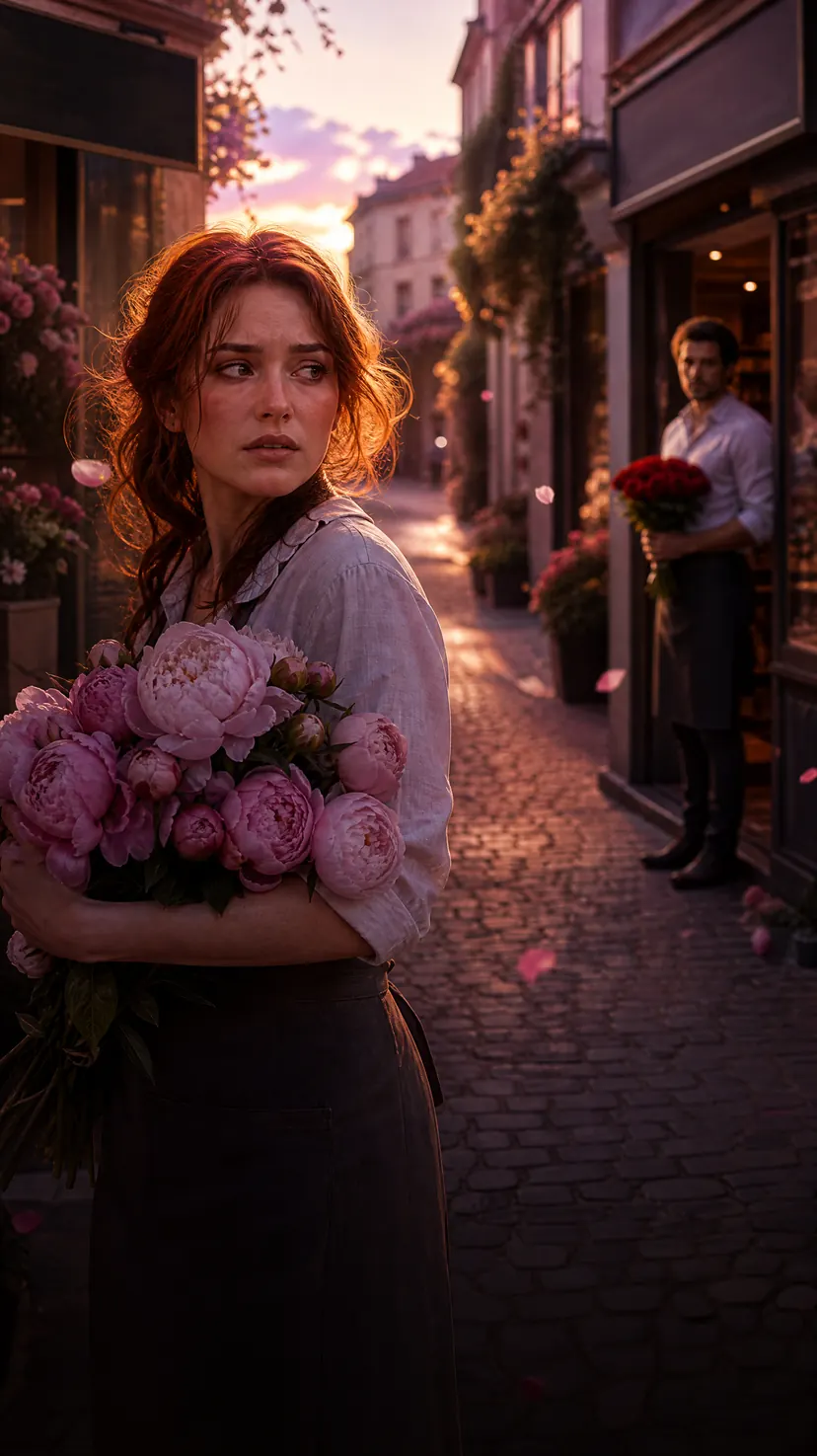
She was standing at the foot of the ladder when I came down it with the shoebox in my arms. She still had her gardening gloves on. Garden club had been moved outdoors that week, to somebody's allotment, and then it had rained, and there was no lemon cake at an allotment. The knees of her slacks were damp and brown.
She looked at the box. She looked at the tape stuck to my jeans. She didn't say a single word.
That was the worst part. I had braced for a lie, and she didn't even try one.
We went down to the kitchen because that is where Bells have arguments. She sat at the table. I stayed standing, with the box against my chest like a shield. The kettle was cold. The window over the sink looked out at the rosebush my father planted the year I was born, an old dark red climber that has never once been pruned properly.
"Eighty-four letters," I said.
"Yes."
"You kept them."
"Yes."
"You didn't open one."
"No." She was looking at her gloves. "They weren't mine to open."
"They weren't yours to keep!"
My voice went up to the ceiling and came back down. My mother didn't flinch. She began to take off the gloves, one finger at a time, slowly, the way she used to take off her good gloves after church, and laid them side by side on the tablecloth with the fingers pointing at me.
"You knew where he was," I said. "That whole first year. You knew, and you let me lie on your sofa and watch television with the sound off for a month."
"I knew where he was."
"Did you know why he went?"
She looked up then. Ruth Bell is sixty-one years old, with my chin and my auburn hair gone the color of weak tea, and in all my life I have seen her cry exactly twice. Her eyes were dry. They were very steady.
"He didn't run from you, sweetheart," she said. "He ran because I asked him to."
The fridge hummed.
"Why?"
"That's his to tell."
"I'm asking you."
"And I made a promise, seven years ago, to a man I would happily see fall down a well." She folded her hands on top of the gloves. "Theo made the same promise. If he's ready to break his, he'll tell you. If you knew why, Nora, I think you'd understand. I'm not sure you'd forgive me. I would still do it again."
I took the box and left. I didn't slam the door. I wanted to. I closed it so quietly that I heard the latch click, and somehow that was worse for both of us.
I read them in bed, in order, over four nights.
I made rules. One letter at a time, then the light off. No crying on the paper. I broke both rules by the second night.
The early ones were short and bad. He didn't know what to say, so he wrote about the weather and the work. A rose farm in the highlands of a country I had only seen on the news, rows of greenhouses down a red hillside, two thousand people cutting stems at dawn. He was a picker. Then a grader. Then, by letter nineteen, he ran a greenhouse.
The birds on the stamps were called long-tailed widowbirds. He drew one in the margin of letter six. It was a terrible drawing.
His father had a fall in letter thirty-one and recovered by thirty-three. His father died in letter sixty-eight, two winters ago, and that letter was one line long. I turned the page over twice, looking for more.
He never asked me to write back. He wrote about the woman in the next house who taught him to make chapati, and the night a hailstorm tore through four acres of greenhouse plastic. On my birthday every year he wrote what he would have bought me. Letter forty-four said a new step for the front of the shop, because the old one wobbled.
I read eighty-three of them.
The last one sat on my nightstand, sealed. Thicker than the others. Postmarked in March, from the post office on Tanner Street, ten minutes' walk from my door. He had been in this city when he wrote it, and he had still sent it to my mother's house, like a habit he couldn't break.
I didn't open it. I told myself I was too tired. The truth was that eighty-three letters had been a story, and the eighty-fourth would be an ending, and I didn't know yet which one I wanted.
It rained on Thursday night, the kind of rain that turns Juniper Street into a black mirror. Both shops glowed in it, mine yellow, his white. At ten o'clock I was still up in my flat over Bell & Bloom with the lights off, and he was still in his window, rearranging the same bucket of tulips for the third time.
He always did that when he was nervous. I hated that I still knew.
I went down the stairs and out the door without a coat. By the time I reached his awning my hair was plastered flat and my shirt was stuck to my back. He opened the door before I knocked.
"You read them," he said.
"Eighty-three."
Something crossed his face. Relief, I thought. "Not the last."
"No."
"Good. Don't. Not yet."
"Why not?"
"Because it says something I need to say to your face first." He reached out, slowly, as if I might bolt, and pushed a wet strand of hair off my cheek. His thumb stayed against my jaw. It was warm. Everything else about the night was cold. "After the rehearsal on Friday. I'll tell you all of it. I promise."
"You promised me things before."
"I know." His thumb moved, a quarter of an inch. "I kept every one of them except one."
We were very close. I could smell the rain on him, and cut stems. I could have leaned in. Some reckless animal in me was already leaning.
I stepped back into the rain instead.
"Friday," I said, and walked home.
At my door I turned around. He was still under the green awning, watching me go, and he wasn't alone. A man in a dark suit had come down the hill under a black umbrella. He held out a cream envelope, and when Theo didn't take it he tucked it into the tulips and raised his voice so it carried to me.
"Mr. Pike reads every guest list, Mr. Marsh. He lands tomorrow. He'd like you gone before he does."
He walked back up the hill. Theo took the envelope out of the tulips, and didn't open it, and didn't go inside.