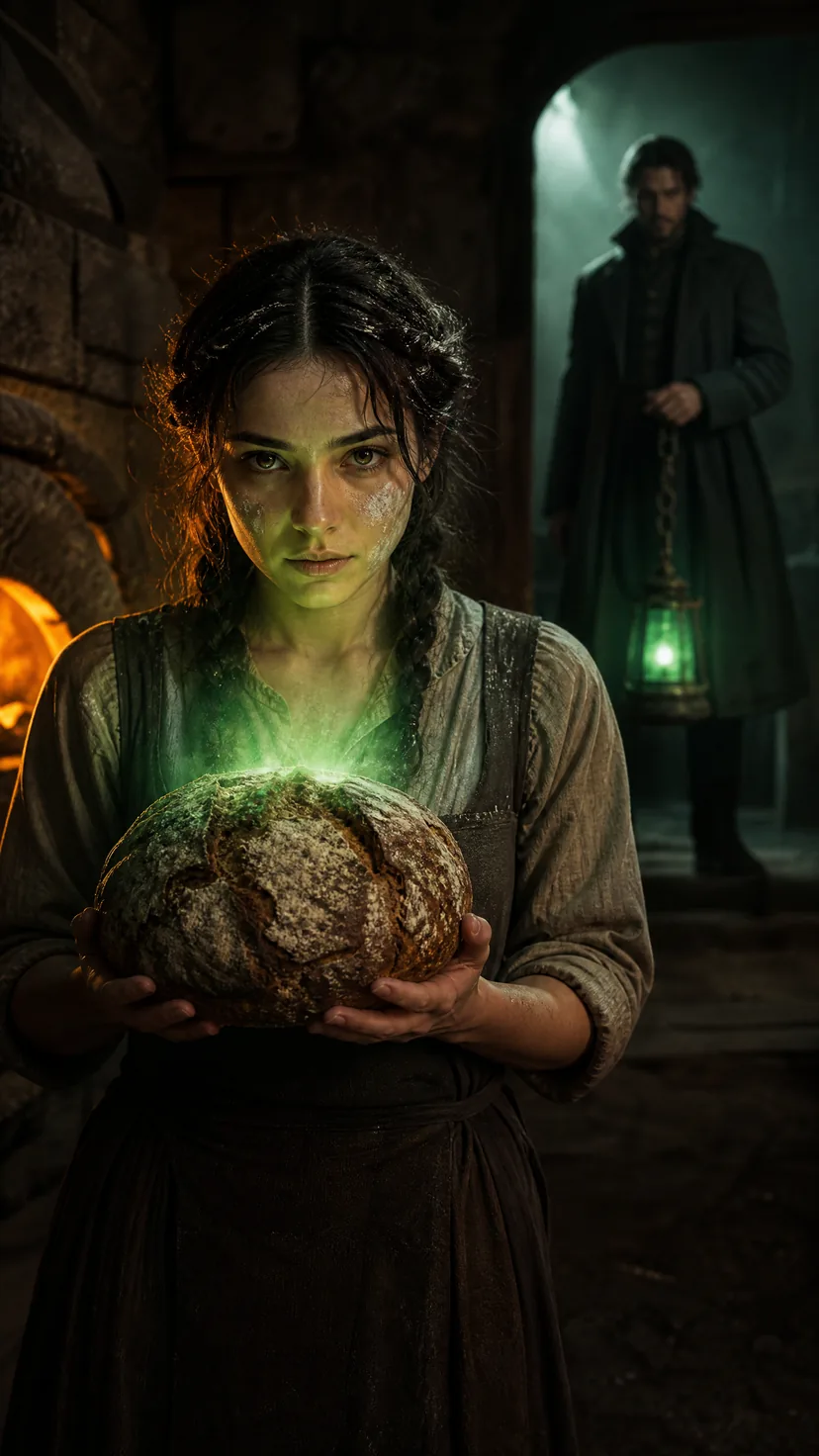
Fenn snored against the cart wheel with half a cake still in his fist, and the key to the iron door hung from his belt where I could reach it.
I was cold to the bone, and my fingers were so stiff I could hardly feel the key when I lifted it, only watch it swing.
Three in the morning, and Bastian had been sitting in my kitchen with his lantern when I left. Had he heard the back door?
Albright had folded up on the far side, chin on his chest. The lanterns on their poles leaned against the cart, two steady yellow flames. I had put the cakes in their hands warm and told them it was kindness, because it was. Two men in chestnut shells at the cold end of the night. One had said, God keep you, Mistress Rook.
The lock took three tries. The door swung, and Pip sat up in the straw with his boots in his lap.
"Tam, I didn't say anything, honest, I said I was fetching the bread tray and the sergeant said what bread tray and I said the one for, and then I couldn't think what it was for."
"Boots on."
A step scuffed the cobbles behind me.
Bastian came out of the dark by the pump with the lantern in his left hand, the chain looped round his wrist, the flame standing yellow in the glass. Nothing was being worked. Only bread, finished, asleep in two men's bellies.
He crouched by Fenn, picked a crumb off the man's coat, and rubbed it between finger and thumb.
"Sleep cakes," he said. "My mother baked those. Too much honey."
"Arrest me, then."
"With what?" He held up the glass. "It's yellow."
"You saw. The first night, you saw."
"Green, through your apron." He stood. "I've said nothing since."
"Why?"
"Miss Rook. The boy's boots."
"Why, Captain? I'm out here with a key and a child. You can lift one finger or you can't."
Pip had gone quiet, which never happened. Bastian looked at the pole lanterns, not at me.
"I was ten," he said. "My mother was hiding in a cellar, and the Lantern came asking, and I pointed. She burned in the market. Nineteen years and I still can't tell you she was a witch. She baked. That's all I ever saw her do."
I should have said I was sorry. I put Pip's other boot in his hand instead.
"Carry that," I said. "We've a mile."
Brook Row smelled of yarrow and tallow. Hazel opened her door with a poker, in a nightcap, seventy-four and unafraid of anything that walked.
"Chick. It's the dead of night." Her eyes went to the lantern and stayed there. "That's a Lantern."
"He's carrying a boot."
"Is he." She took Pip by the collar and turned him round, as she'd turned half the valley at their births. "I've broth on. Sit. Don't touch the jars."
Pip pulled off the grey wool cap Hazel had jammed on his head at the door and pushed it into my hands. "Keep it, Tam. So you have to come back for it."
Hazel shut the door on all three of us, which was her way of saying yes.
First light found me in the bakehouse with flour to the elbows and the oven roaring. Mott's lease lay under the bin, still unsigned. Evening bell, he had said.
Bastian set the lantern on the floor by the door and came across the boards. He took my right hand and turned it over. They were cold as pump iron, and the chill went in as far as the second joint and stayed there.
"Does it hurt?"
"It's bread. Bread doesn't hurt."
He folded both of his round it. His palms were cold from the yard and the oven was hot on one side of my face, so I felt it in two halves. He brushed a streak of flour from my jaw with his thumb and kept the thumb there.
"Tamsin," he said.
Nobody had said it like that since my mother, and she had said it like a warning.
I kissed him first. He tasted of cold air and my own barley, and his hand went into my hair and brought down a cloud of white. The oven ticked behind us. The lantern burned on the floor, yellow, steady, a thing that had never seen anything.
When we stopped, neither of us moved away.
"If your name is on that paper tonight," he said, "I'll read another."
"Whose?"
"Anyone's. Mine, if I must." His thumb was still on my jaw. "I'll hang for it."
"No. I'll stand up before you've finished the first word."
"Then I'll say it louder."
"Then I'll say it louder than that."
He looked at me the way he'd looked at my shelves on the first day, as if counting. Neither of us gave. The loaves behind me were turning from gold to brown, and I let them.
At noon the shop was full of Sunday and rye. Bastian had gone to the reeve's at eleven when Ede came for him, lantern swinging, and the bell over my door had not stopped since.
Then it rang once more and the room went quiet in the way rooms do.
Magister Vey was alone. No sergeant, no guards. He wore a plain brown coat and he smiled at the queue until it dwindled out of my door one by one, taking their loaves with them.
"Miss Rook. That rye smells like my mother's kitchen."
"It's a penny, Magister."
"I'm sure it is worth more." He reached into his coat and took out something wrapped in a napkin. He laid it on my counter and unfolded the cloth with two fingers.
Half a sleep cake. Barley and honey, a crescent bitten out of it, and pressed into the crust, neat as a seal, the three-toed foot of a rook.
"From Fenn's pocket," Vey said. "He slept until nine, poor man. He woke with his mouth full of honey."
I did not look at the door. I did not look at the back stairs. I did not look at the place where a boy's apron still hung on its peg.
He did not mention the boy. He did not look at the peg either, and that was how I knew he had counted it.
"Such a fine impression," he said gently, and turned the cake so the foot faced me. "After the reading, Miss Rook, you and I will talk."