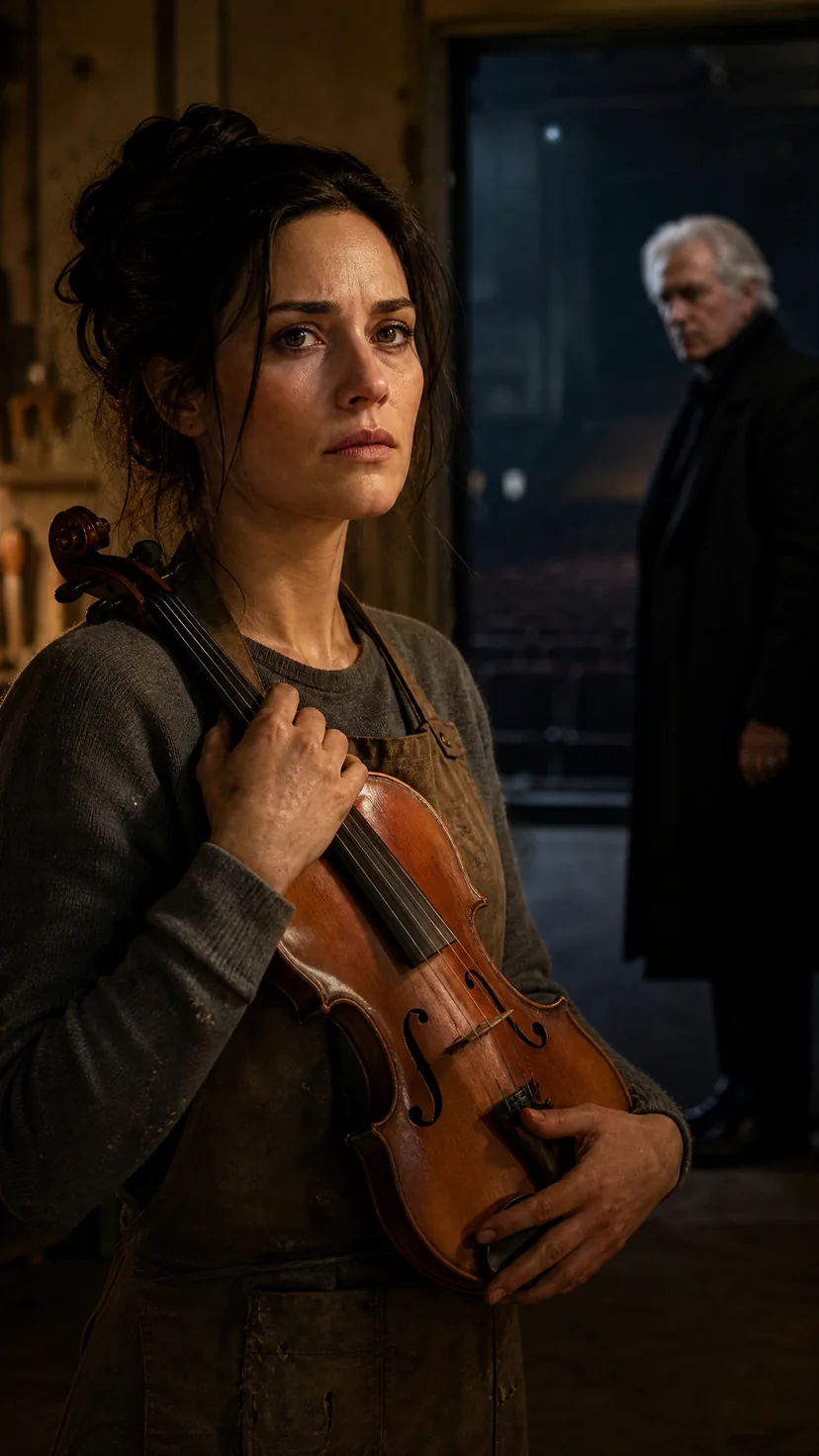
The girl put the violin on my counter the way you'd put down something that had bitten you. "It has to be fixed by Friday. Saturday I audition for the Harrowgate, and it's the only violin I've got."
The Harrowgate Philharmonic had one seat open that autumn: Assistant Concertmaster. Fifteen years ago I walked out of the final round for it.
And I knew the scroll of that violin before she let go of the neck.
I kept my hands flat on the counter. Most violins are cousins, my grandfather used to tell customers who'd found a masterpiece at a yard sale. Don't fall in love with a family resemblance.
"We close at six," I said. It was ten to.
"I know. I ran from the bus." She was seventeen, maybe, in a laundromat polo shirt with SUDS & SPIN on the pocket, and she was still breathing hard. "I'm Ada. Whitcombe. Can you look at it or not?"
I opened the case wider. The crack ran down the top on the treble side, from the lower eye of the f-hole toward the bridge foot, about three inches. Under the strings the soundpost had fallen and was rattling around inside like a loose tooth.
"Two weeks," I said. "Twelve hundred dollars. The top has to come off."
"I have three hundred and forty." She took an envelope out of her backpack and set it on the counter beside the violin. It was soft from being folded. "Mr. Lasko's guy wants three weeks and eleven hundred. Mr. Lasko said not to bring it to you."
The name went through me like a nail through a thumb. I kept my face where it was.
"Lasko's your teacher."
"Since I was twelve. He lends me the violin. He said you'd ruin it to spite him." She shrugged with one shoulder. "So I figured you must be good."
The last time I saw Viktor Lasko, I was eighteen and he was standing in the doorway of a warm-up room, telling me I played like a very good copy. I don't remember the stairs after that. I remember the cold outside, and that my hands were empty.
"I'm not taking it," I said.
I should have closed the case then. Instead I picked up the violin, because a crack is a question and I have never been able to leave one alone.
I tilted it under the bench lamp. A crack from a fall lifts at the edges and splinters along the grain, and there's a dent where it landed. This one had none of that. The edges of the crack had been pushed down into the body, clean and even, as if somebody had pressed the top in with the heel of a hand right over the soundpost until it gave.
At the head of the crack there was a mark in the varnish. Small, flat and oval, the size of a fingernail, left where the heel of a hand had leaned, pressed so hard that the varnish had puckered at the edges.
"How did this happen?" I said.
"I don't know. It was like that when I opened the case. Thursday." Her chin came up. "I didn't drop it. Everybody's going to say I dropped it."
"I didn't say you dropped it."
My grandfather's rule was to photograph everything that comes in damaged, before you touch it, so nobody can ever say you made it worse. I took my phone off the shelf and shot the crack from four angles, then the oval mark, close enough that the varnish looked like ice. Ada watched me as if I were taking her temperature.
"Why are you doing that?"
"Job log." I put the phone down. "I still haven't said yes."
On the bench behind me, under a sheet, the Halvorsen cello waited with its top off. Mr. Halvorsen was paying me twenty-eight hundred dollars to have it together by Friday. I was three months behind on rent. There was no way to do his cello and her violin both in four days. I'd have had to be two people, and I hadn't managed to be one for years.
"Then let me play something," Ada said. "So you know it's worth it."
"It's not about you."
"Everything's about somebody." She was already looking past me at the shop fiddles on the wall. "Can I?"
I should have said no. I took down the best of them, a German factory instrument with a decent back and a dead G string, and tightened the bow for her.
She played a three-octave scale in A, slow, and then without asking she went into the opening of the Mozart.
It was the Mozart I'd been warming up the day I walked out. Her bow arm was all wrong at the elbow, too high, too eager. And she was good. The dead G string didn't matter. Under all the wrong things there was a sound that refused to apologize, and I knew that sound, because I used to make it. I hadn't made it in front of anyone in fifteen years.
She stopped in the middle of a phrase and lowered the fiddle. "Well?"
I had to clear my throat. "Your elbow's too high."
"Mr. Lasko says it's fine."
"Mr. Lasko," I said, "is wrong about elbows."
She laughed, one surprised note, and covered it with her hand, as though nobody had laughed in front of her for a while either.
I took the envelope. I didn't count it. "Friday, six o'clock. If it's not right, you don't pay."
"You already have the money."
"Then you'll have to trust me."
She looked at the violin on my counter for a long moment, the way you look at a dog you're leaving at the vet. Then she zipped her backpack and went, and the bell over the door rang behind her.
I called Mr. Halvorsen's voicemail and told it the cello would be late. He would take it elsewhere. Twenty-eight hundred dollars went down the phone line in one long breath.
At eight o'clock, with the blinds down and the sign turned, I got out the dental mirror and the penlight.
Every violin has a label inside, glued to the back, where you can read it through the bass-side f-hole if you know the angle. I knew it. I had watched the label go in.
I told myself again that most violins are cousins. Then I slid the mirror in, tilted it, and the light found the paper.
The ink had gone brown. The handwriting was my grandfather's, the slanting capitals he used for invoices and birthday cards and nothing else.
*Ferenc Sandor, Port Ellery. Made for my Mira.*
It was my violin. I had left it on a chair fifteen years ago, and I had never once let myself ask who picked it up.