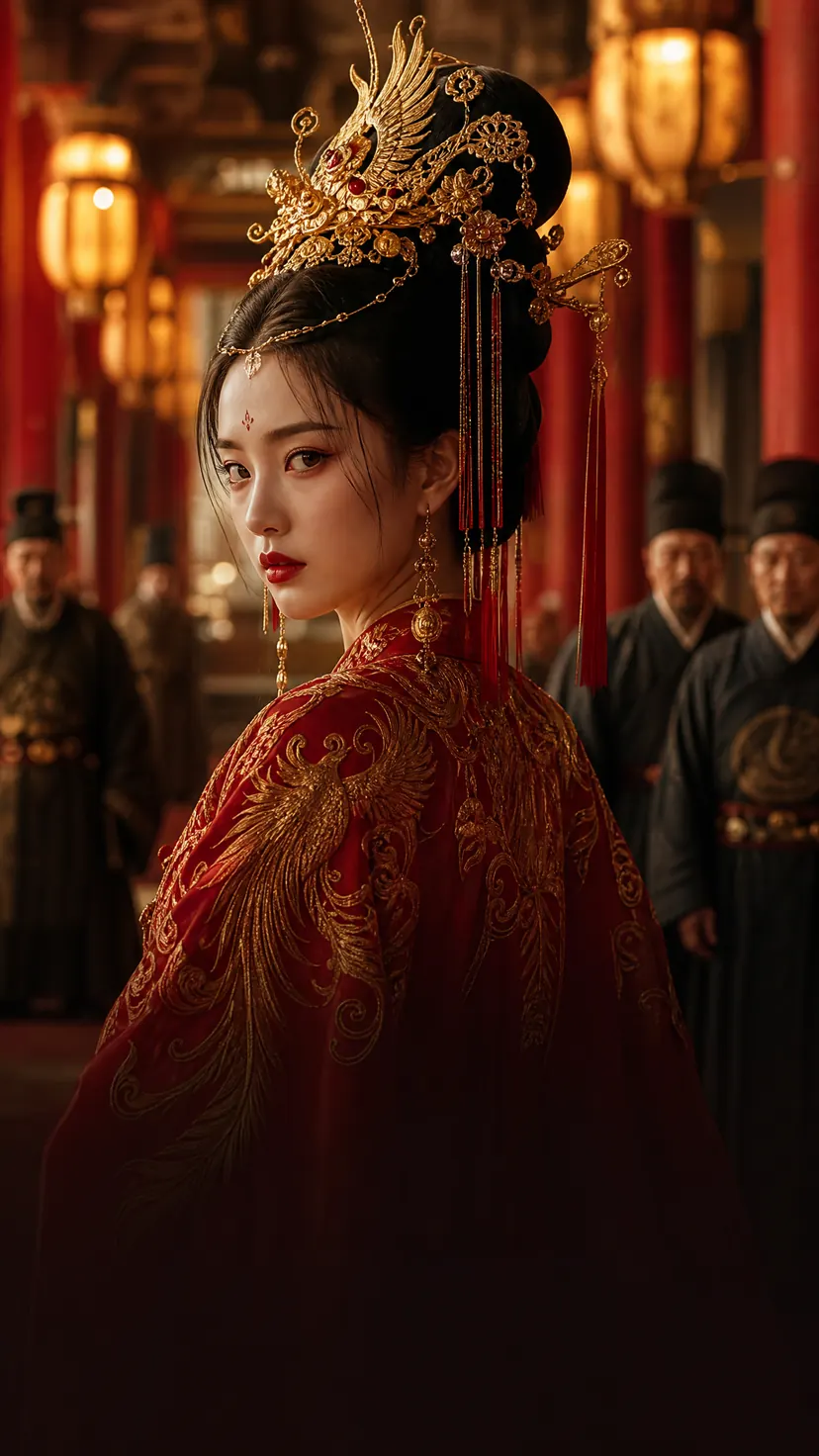
At the hour of the dragon, a new empress kneels at the threshold of the Dowager's palace and waits to be called.
Lian knelt on the stone outside the Hall of Lingering Spring for the better part of an hour while the sun crawled across the courtyard and found her. Tao stood behind her holding a parasol she wasn't allowed to open. Sweat ran down the back of Lian's neck under the heavy court collar.
The first time, she had knelt here and fretted that she'd done something wrong.
This time she used the hour to think about handwriting.
She'd held the note to every lamp in the bridal chamber. Good paper, the smooth mulberry kind the palace bought by the cartload. Ordinary ink. The brushwork was fast and practical, the strokes cut short, no flourishes. Someone who wrote a great deal and didn't care whether it was admired. Someone who could slip a hand into an empress's sleeve on her wedding day without being noticed.
Which was half the palace.
"Her Majesty receives the Empress," a eunuch sang out at last, and Lian rose on knees that had stopped belonging to her.
The Hall of Lingering Spring smelled of sandalwood and something sharper underneath, camphor or medicine. The Dowager Empress Wen sat on a low couch by the window with a tea table in front of her and a white cat asleep against her hip. Two senior attendants stood behind her like a pair of folded screens.
Up close the Dowager was smaller than she looked on her throne, with very straight shoulders and hands spotted brown at the knuckles. Her eyes were the color of steeped tea and missed nothing.
In the first life, this woman had disliked Lian quietly for eleven years. She had never raised her voice or made a scene. Then one winter afternoon she had carried a letter into the Emperor's study, a letter in Lian's handwriting addressed to a northern rebel general, and laid it on his desk without a word.
One strike. Perfectly placed. Lian had never learned whether the Dowager believed the letter was real.
"Sit," the Dowager said.
Lian sat. A maid came forward with the kettle to pour, and Lian lifted her hand.
"Allow me, Majesty."
The maid froze. Behind the couch, one of the attendants drew a breath through her teeth. An empress did not pour. An empress was poured for, by servants, and a daughter-in-law who served the Dowager with her own hands was either groveling or making a point.
Lian took the kettle anyway. She warmed the cups first, tipping the water out into the slop bowl. She measured the leaves with the little bamboo scoop. She let the water cool for the count of twenty before she poured, because these were spring buds from Mount Lu and boiling water would have bruised them, and she poured in three passes so each cup got the same strength.
She'd learned that in her eighth year as empress, nursing the Emperor through a fever. He'd liked his tea exactly this way. Nobody else had ever bothered to find out.
She set the first cup in front of the Dowager and folded her hands.
The old woman looked at the tea and then at Lian, and her eyes had sharpened to two points.
"Who taught you that?"
"My mother, Majesty."
"Your mother pours like a magistrate's wife. I've seen her." The Dowager picked up the cup and breathed in. "Spring buds, cooled to the count of twenty. Three passes. That's how they did it in the old Empress's household, forty years ago. There's perhaps one other person alive in this palace who remembers it."
Lian kept her face pleasant. "Then I'm lucky to have guessed."
"Hm." The Dowager drank. Set the cup down. Stroked the cat once along its spine, and the cat stretched without waking. "The Duke of Rong has offered his daughter to my son. As a consort of the second rank. I'm inclined to accept."
There it was. In the first life this had happened a month after the wedding, and Lian had smiled and said whatever the Dowager wishes, because she had been raised to say it. Rong Xiu had entered the palace that winter. Four years later Rong Xiu had lost a child, and wept, and pointed.
"The Duke is very generous," Lian said.
"But."
"I didn't say but, Majesty."
"Your whole face said it." The Dowager almost smiled. "Go on. I'm old. I enjoy being surprised."
Lian picked up her own cup and turned it a quarter turn on its saucer. Carefully now.
"The eastern dykes on the Huai River," she said. "The ones the Duke's engineers rebuilt last spring. I've heard they were built cheap, Majesty. Rubble instead of dressed stone, and the difference kept. If the summer rains come heavy, they may not hold."
The room was very quiet. The cat's tail twitched.
"You heard," the Dowager repeated. "From whom?"
"People talk to brides."
"No, they don't. They talk at brides." The Dowager leaned back. "And if the dykes hold?"
"Then I'm a foolish girl who listens to gossip, and you'll have lost nothing by waiting until autumn to answer the Duke."
In the first life the Huai dykes had burst on the ninth day of the seventh month. Eleven villages had drowned. The Duke of Rong had blamed the river god and the Emperor had paid for new dykes out of the privy purse, and by then Rong Xiu was already sleeping in the Palace of Gathered Fragrance.
The Dowager studied her for a long time. Long enough that the steam stopped rising from the cups.
"Wen Ruo," she said without turning her head. "Take the cat and go out. Both of you."
The attendants went. The door slid shut. Now there was only the old woman and the window and the smell of camphor and cooling tea.
Lian looked at the old woman's hands, brown-spotted and quick, and thought of seven words written fast, the strokes cut short.
The Dowager reached across the table and took Lian's hand. Turned it palm up. Her thumb moved across Lian's fingers one by one, pressing gently at the place on the second finger where, in another life, a callus from ten years of brush and seal had been.
Lian did not pull away. It took everything she had.
"Smooth," the Dowager murmured. "Twenty years old. Not a mark on you." She let go and sat back, and those tea-colored eyes were very bright. "And yet you pour like a woman who has buried someone. Tell me, child. In whose grave did you learn it?"