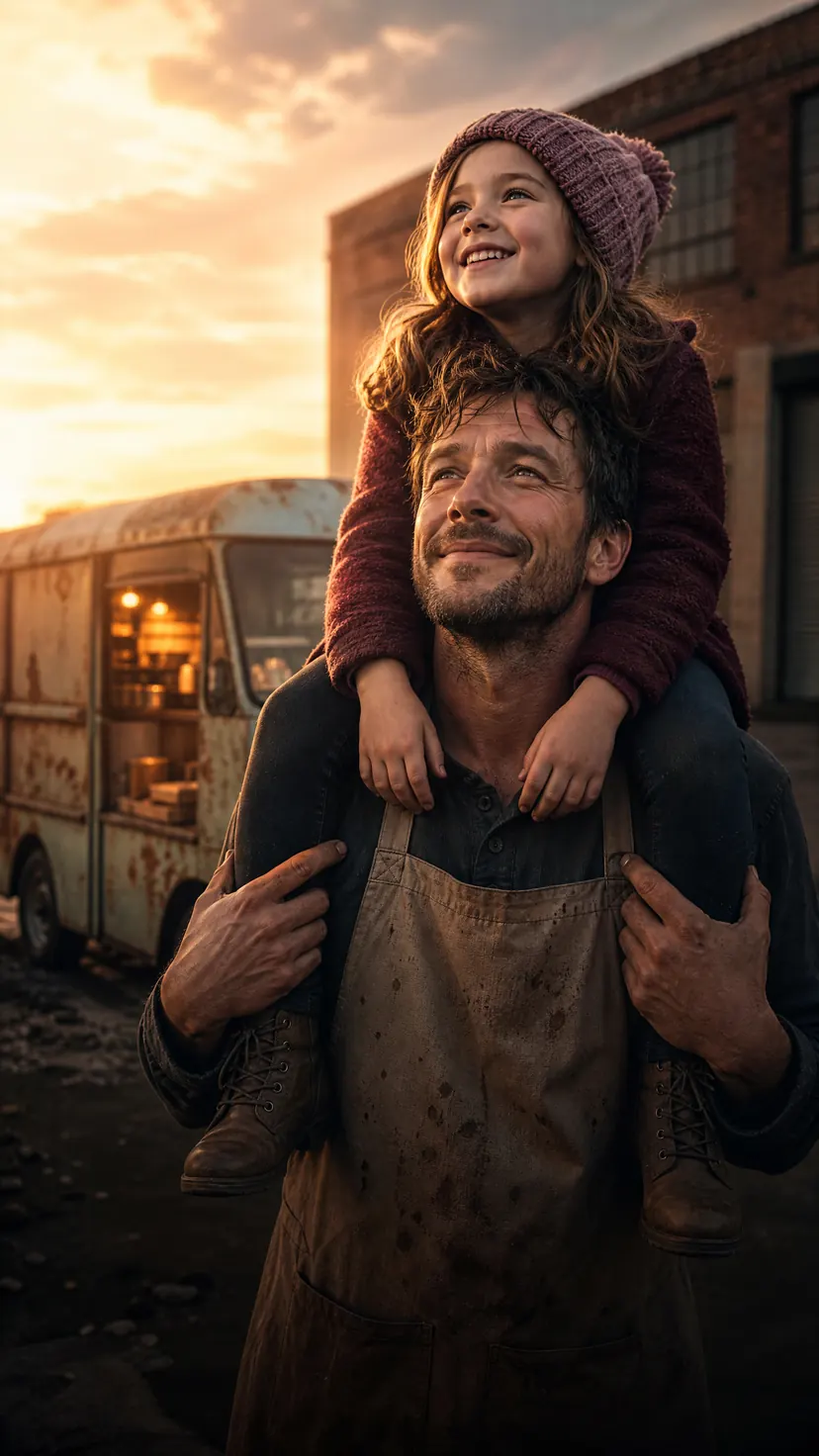
By December the line was shorter, and I knew most of the people in it by name.
That's what a closing does to a town. It starts months before the last day and takes a little more every morning. The first-shift guys started bringing their own coffee in thermoses. Bernadette took a job at a call center in Dorrance and came by only on Saturdays. Hector drove up to a plant in Michigan for an interview and came back two days later and didn't talk about it.
I put a second sign in the hatch, under Maisie's. BRENNER BADGE? PAY WHAT YOU CAN. Most of them still paid a dollar. Some paid a quarter. A few paid nothing and looked at the gravel, and those were the ones I gave two.
My coffee can got lighter. I'd turned in my temp badge the day the permit went up, and Teddy never asked if I'd go back, which was worse than him asking.
Darrell Hobbs had started leaving his back door propped open in the mornings, the one off his kitchen, so I could fill my water jugs from his sink. He never mentioned it. I never thanked him. It was the most complicated relationship I'd ever had with a man, including my father.
Dana showed up on the first Tuesday of December, at five-forty in the morning.
I didn't recognize her at first. She'd cut her hair to her chin, and she was wearing a wool coat I'd never seen, and she stood at the very end of a short line with her hands in her pockets like any other customer. When she got to the hatch she didn't order. She just looked past me, through the truck, to the back.
Maisie was asleep on the flour sacks under my work coat, the space heater ticking at her feet, her hat pulled down over her eyes.
"Hi, Ben," Dana said.
I'd rehearsed this. Eleven weeks of rehearsing, then twelve more, on the stairs and in the shed and in the shower. None of it came out. What came out was, "You said Tucson."
"I've been back three weeks. I'm at my mom's on Birch Lane." She said it carefully, like reading from a card. "I'm working in her office. I'm seeing somebody, a counselor, every Thursday. I'm doing better."
"Good."
"I mean it."
"I said good." I flipped two pancakes nobody had ordered. "Did you want to wake her up?"
"No." She watched Maisie breathe. "Ben, it's five-forty in the morning. It's twenty-six degrees. She's sleeping in a truck."
"She's sleeping in a truck with a heater, next to her father, who is working."
"On sacks of flour."
"You left," I said. It came out louder than I wanted. A guy in line behind her looked at his boots.
"I know I left." Dana didn't raise her voice at all, and that was how I knew she'd practiced, too. "I know exactly what I did. I'm telling you I want her with me now. In a bed. In a house. I'm telling you first because I think you deserve to hear it from me first."
She bought one pancake. She paid a dollar. She walked back to her mother's car and sat in it until Maisie woke up at six-fifteen, and then she drove away before Maisie could see her.
I didn't tell Maisie. I should have.
The fire started two days later, on a Thursday, at five-twenty in the morning.
I was ninety seconds away. I've timed it since. Ninety seconds to carry the trash bag around the bus shelter to the dumpster and back. I'd left the space heater running because it was nineteen degrees, and I'd left the generator running because the griddle was heating, and I'd left my daughter asleep in the back because that is where she slept.
I smelled it before I saw it. Sharp and chemical, like a burnt hair dryer. When I came around the shelter there was a gray ribbon of smoke curling out of the vent beside the generator panel, the panel I'd taped extra, the one with three wires where there should have been two.
I don't remember crossing the gravel. I remember the back door handle being hot. I remember the inside of the truck being a wall of smoke so thick and low that I couldn't see the flour sacks, only hear her coughing, small and wet and scared, and the orange light behind the panel cover where something had already caught.
I got her by the ankle first, then the coat, then all of her. I don't know how we got out. Darrell Hobbs was there, somehow, in his apron, with the big red extinguisher from his kitchen, blasting white powder into the back of the truck and swearing at it like it owed him money.
Maisie coughed against my neck. Her hat was gone.
"Pamela," she said, between coughs. "Daddy, Pamela."
Nell was on shift in the emergency room at Kessling General. She didn't say anything when they brought us in. She just took Maisie's wrist in two fingers, counted, and then put a hand on my back for exactly one second before she went to work.
Smoke inhalation, mild. Oxygen for two hours. Observation until evening. Maisie slept most of the day with a plastic clip on her finger that made it glow red, which she would have loved if she'd been awake.
The fire marshal came at noon. Lieutenant Kemi Oyelaran, tall, quiet, with soot on her cuffs. She had photographs on a tablet.
"The junction behind the generator panel," she said. "Three conductors spliced into a two-wire run, wrapped in tape. Your space heater was on the same circuit. It overloaded and the insulation went." She looked up. "Mr. Calder, did you do this wiring yourself?"
There wasn't any other answer.
"Yes," I said. She wrote it down.
The back half of Pamela was gone. The marshal said the cab was mostly intact. She said it the way you'd say the frame of a house was still standing.
At six o'clock, when the nurse was taking the clip off Maisie's finger, Dana walked into the room. Her mother Loretta was behind her, holding a manila envelope. Behind Loretta, staying politely in the doorway, was a sheriff's deputy I'd gone to high school with.
Dana's eyes were red. She'd been crying in the car. She took the envelope from her mother and held it out to me, and her hand was shaking, and she didn't let that stop her.
"It's an emergency order," she said. "Temporary custody, until the hearing. Judge Halloran signed it at four o'clock." She looked at Maisie, small in the big bed, then back at me. "She's coming home with me tonight, Ben."