Page two was gone, and Sorrel knew whose hand had taken it. Hollis had stood locked in that study with Fallow the morning Edmund died, a whole hour, and she had been too busy carrying trays to wonder why.
She had slept three hours with her boots on. One night left to buy a vote, and nothing in her pockets but a name she could not prove.
Lucan had ridden north at dawn to meet the Wyndmere captains. So at eight she went alone down to the gate lodge, where Dr. Anselm Fallow kept his surgery in a cottage that smelled of carbolic and old brandy.
He was already dressed, already sitting, a glass at his elbow with nothing in it yet. Sixty-three, grey stubble, hands that had delivered half the pack and buried the other half.
"You'll want to know whether I vote for your release," he said. "And before that, what I wrote on Edmund's certificate. Shut the door, girl. The draught gets in my joints."
She had not said a word. She shut the door. "Who told you I was coming?"
"Nobody. You've the look of a woman who counted the hours on the walk down. Sunset tomorrow, five votes, and Hollis owns two of them." He turned the empty glass a quarter turn. "I wrote the wasting. It was a wasting. Go and scrub something."
"My tongue goes to sleep after my tea these nights," she said. "Edmund wrote that. I read it last night."
His hand stopped on the glass.
"Then you've read a dead man's grumbling."
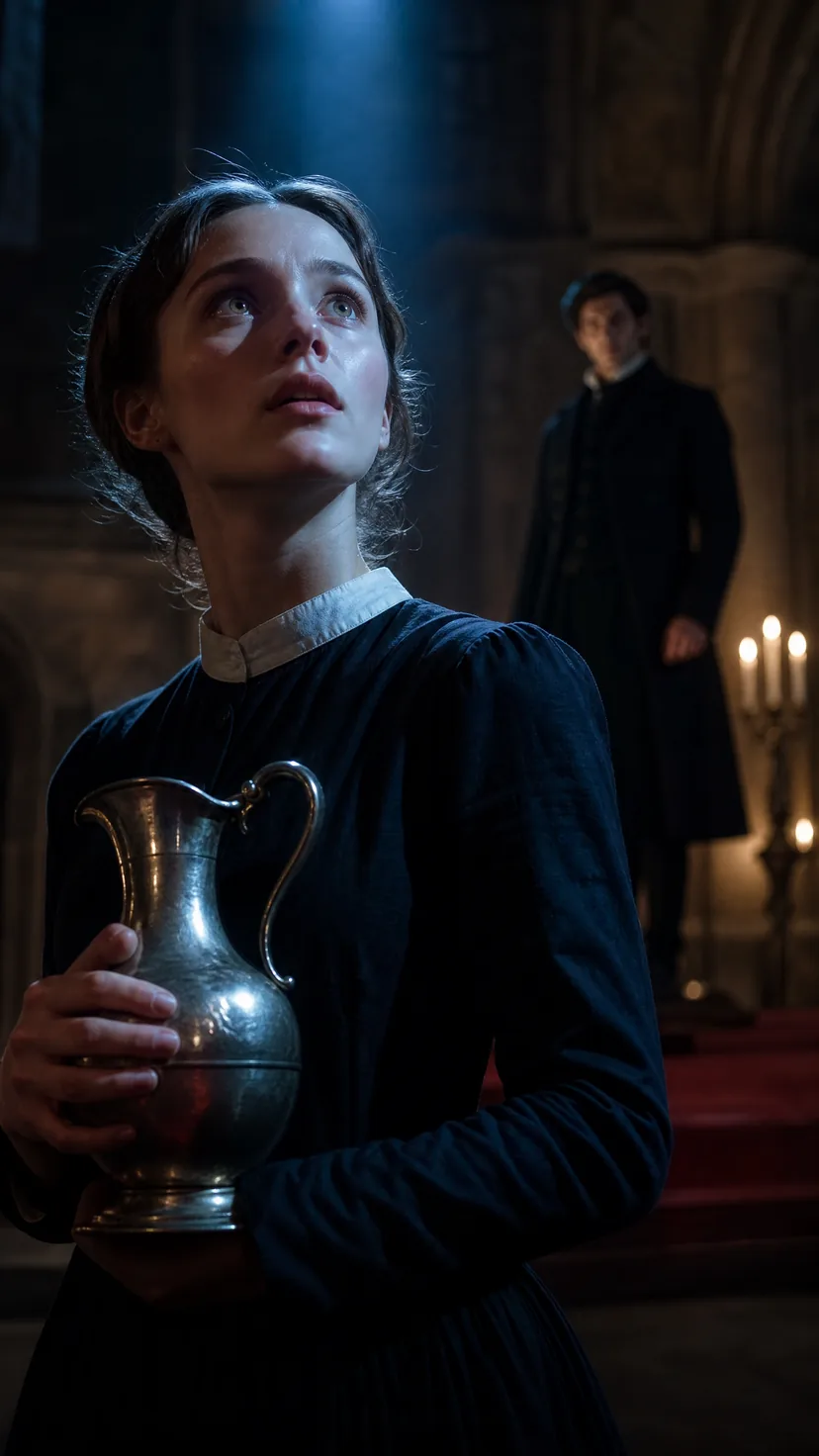
She did not move from the door. She was good at standing where she was put, and better at remembering what she had heard while she stood. The old Alpha's wake, a Tuesday last September, the long table, the cold mutton. She had been filling Fallow's cup at the end of it, close enough to smell the camphor on his coat, and neither of them had looked down at her.
"You said it to Hollis by the sideboard," she said. "Keeping your voice low. I won't carry this forever, Hollis."
Fallow's face did something slow. The colour went out of it from the top down.
"A girl with a jug," he said at last, but there was no weight in it.
"Who counts," said Sorrel.
He laughed once, a dry sound, and got up. For a while he stood at the cabinet with his back to her. Then he took down a black notebook, thumbed it open and held it out at arm's length, the way a man holds something that might go off.
The entry was dated the twentieth of September last year. Nail beds blue-grey. Tongue numb after drink, per patient. Aconite, small dose, repeated over weeks. Someone in the house.
"Hollis read that at nine in the morning," said Fallow. "He had it buried by ten. If it was a guest who did it, that is war with Corrin while Corrin is leaning on our border. Any pack that shelters an Alpha's killer is outlawed by every pack. He called it mercy."
"And you signed."
"I signed." He shut the book on his thumb. Then he looked at her properly, for the first time, and she saw he had been waiting a year to say it to somebody. "Who brought him his cup, girl?"
The room went very small.
Ten o'clock, every night, up the back stairs with the tray. Her own hands on the saucer. One dollar a night, left under the sugar tongs, for her trouble. She had spent that dollar on boot leather and a tin. Her fingers closed hard around the doorknob behind her.
"I carried it," she said. Her voice came out exact and flat. "I didn't make it."
"No. Somebody in that kitchen did, or somebody on the stairs." He sat down heavily. "I'll tell you what I won't do. I won't stand in the Moon Court and say it. I won't vote your release, because the first vote Hollis counts against him is mine. I am sixty-three and I have one pack left to be buried by."
"Tomorrow they put silver on me."
"Yes." He reached for the brandy bottle, and for the first time since she had come in, he did not look at her. "I'm sorry for it."
She looked at the notebook on the desk, open under his shoulder. At the spine, where the stitching was loose.
He poured. The glass chimed against the bottle's neck. She crossed the room in four steps, caught the edge of the page, and tore it free along the thread, one clean pull. He turned with the bottle still tilted and brandy running over his knuckles.
"Sorrel."
"I'm sorry for it too," she said, and went out into the cold with the page folded small inside her sleeve.
No vote. Not now, not ever. She felt that settle in her, a cold flat stone, all the way up the hill.
Coal smoke and lye hung in the cellar scullery. She checked the chute bolt out of habit. Broken, the same as when she had reported it three times. Four, now, in her head.
Linnet came in after dark with an empty scuttle, his ears red from the yard.
"Where were you all afternoon?" she asked.
"Coal shed. Mr. Hollis's orders."
His eyes went to the left when he said it. She had watched fourteen years of people lie to her over a tray, and Linnet had never learned to do it well. His boots were new, stiff at the toe, still yellow with shop polish.
She said nothing. There was only the one stove and one page, and the night was running out.
He went. She waited until his steps had gone up the stairs, then pulled the page from her sleeve and spread it flat under the stove's red eye.
Fallow's cramped doctor's hand, the same entry she had seen, the date, the blue-grey nails. Below it, squeezed in at the foot where no patient would ever read it, one more line.
H. says sign wasting. God forgive me.