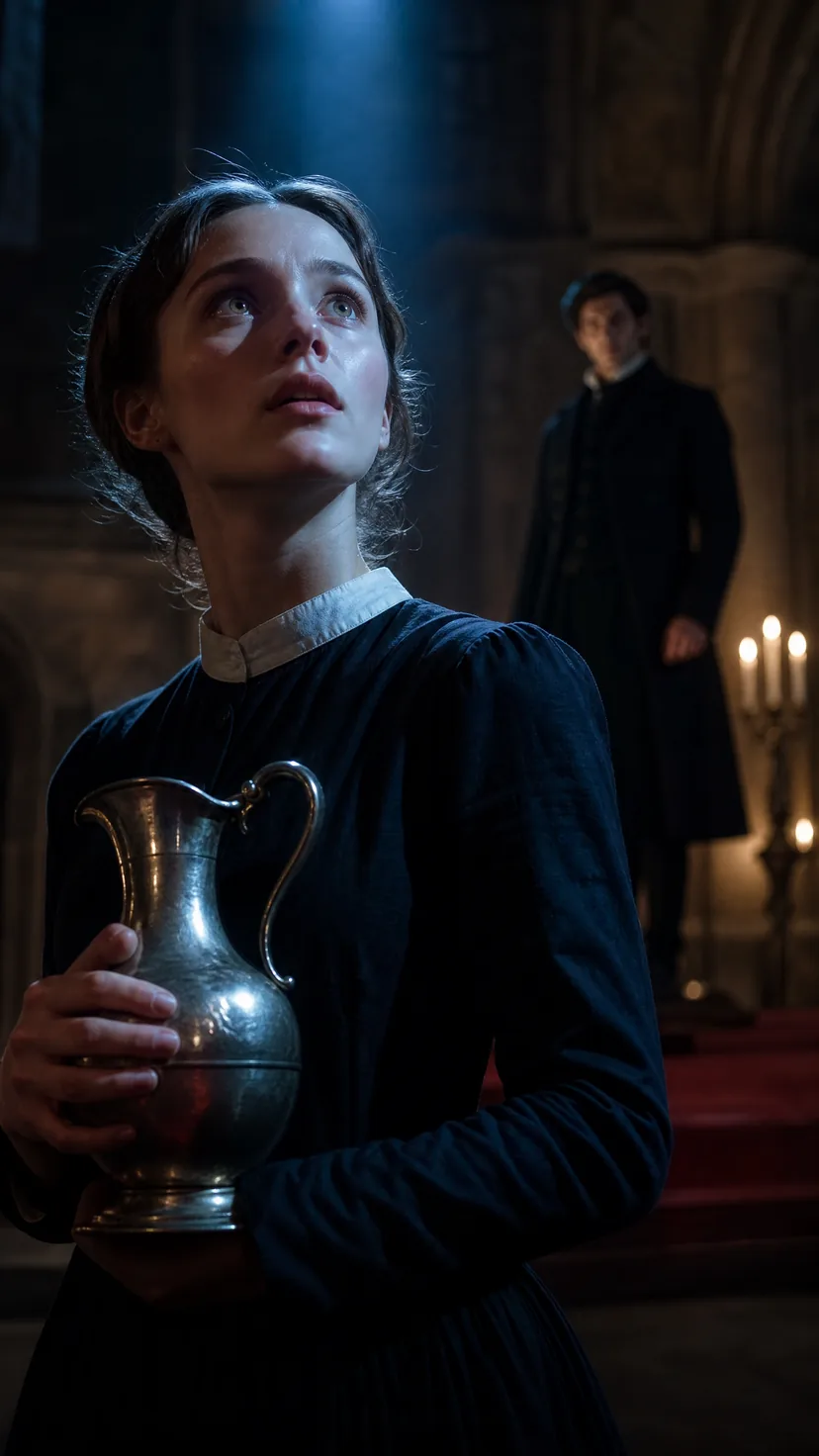
Delphine Marlowe came down the cellar steps at seven on Wednesday morning, and Sorrel, who had not slept, dropped the kettle straight onto her burned hand.
She did not make a sound. She set the kettle upright and put the hand behind her apron, over the paper that still lay folded in the pocket, the confession she had refused to sign. Nobody from the front of the house had ever come down these steps. What did a Luna-to-be want in a scullery?
"Please, don't get up," said Delphine, though Sorrel had not been sitting. She wore a grey shawl with a green fringe, and she carried a small blue pot in both hands like something that might spill. "I heard about your hand. Cook's girl told my maid, and my maid told me, and here I am being a nuisance."
The cellar smelled of lye and cold stone. Delphine's heather scent went through it like a window opening, and Sorrel's sharpened nose, which since Saturday found out everything, could have told the blue pot held comfrey and lard.
"It's nothing, miss."
"It still looks sore, I can see it from here. Give it here." Delphine took the hand as if she had done it a hundred times and worked the salve in with her thumb. She was gentle. Her own fingers were cold. "I could speak to Hollis, you know. About all of it. I'd be glad to."
"Please don't, miss."
"Then I won't." She smiled. "Is it very dreadful, waiting for Saturday?"
"Saturday's the easy part. Then there's the Binding." Sorrel watched the thumb. "The council will be full for it, I suppose."
The thumb stopped.
"My father arrives Monday," Delphine said. "At noon. He's very much looking forward to it." She screwed the lid on the pot, too tight. "You'll need the cloth changed twice a day. Will you tell me if the skin lifts? Please."
She was gone up the steps before the cloth was found. Sorrel stood with the pot and a memory she had not asked for: thirteen months ago, the old Alpha's wake, a decanter of brandy, and Alaric Marlowe of Wyndmere leaning on the sideboard. Corrin's been at my east fence all year, he had said, to nobody, to the glass.
A father who looked forward to things did not look like that.
Lucan's study door was open when she found him, and the corridor outside it was cold with ink fumes. He stood over a table of border reports with a pencil in his fist, and he did not look up. The room held the smell of a man who had not opened a window since Monday, and a cold cup at his elbow that nobody had dared to take away.
"Not now."
"Your father's desk key, sir."
The pencil snapped. "No."
"I only need an hour with the papers."
"I have not opened that desk in thirteen months." He still had not turned. "I will not have a servant in it."
Sorrel counted the reports on the table. Eleven, ink still wet on the top one, a smear of it along the edge of his hand. Nobody had told him to stop working since the funeral, and he had not stopped. She was not leaving this room with nothing, and the one coin she had was the one she least wanted to spend.
"I saw your father's hands," she said. "The morning he died. I brought the tray at six, and the sheet was down, and his nails were blue."
Now he turned.
"Maud says wasting turns them yellow," Sorrel went on, steady, precise, because precise was what she became when it hurt. "Hollis shut Dr. Fallow in the study with him for an hour. When Fallow came out, he wrote the wasting. A week before, Maud heard Hollis and the Alpha shouting behind this door."
It hit him. She felt it land through the bond, a door slammed on a hand: the morning he had not been here, the whole length of a border between him and the bed. His breath went out of him without a sound.
"Who else has heard this?"
"Maud. Me."
"You waited until now."
"You weren't asking before." Her voice stayed level. His anger came across the room and into her ribs, hot and grey, and it was aimed at her first, because she was the one standing there. "Sir. The key."
He stared at the snapped pencil. Then he opened a drawer and took out a small brass key on a faded blue cord, and held it in his closed hand so that her fingers stopped an inch from his knuckles.
"I come with you."
"Sir, I can manage."
"Tomorrow night. Late, when the house sleeps. Hollis goes up at eleven." He did not look at her. His thumb moved once over the cord, the way her own did over the tin lid. "He was my father. I will not have you find it first."
The inch between her hand and his felt like a mile of lit lamp. She could have closed it. She folded her fingers into her pink palm instead and took the key when he opened his fist.
"Tomorrow, then," she said. "At the stair foot."
"And Sorrel." Almost gently, the tired voice he used when nobody was watching. "Do not tell Maud I flinched."
"I'll say you swore."
The corner of his mouth moved. Then something ran down the bond like a hand along a wall, a cold, quick prickle of being watched, and his head came up, past her shoulder.
They both turned.
The study door stood open on the corridor, as it had stood the whole time. Delphine Marlowe waited in it with one hand on the frame and her face open and sweet.
"Forgive me, Lucan, I only came to ask about the garden." She looked from one to the other. "Goodness, what faces. Whatever it is about the nails, you mustn't carry it alone."
She smiled, and the open door behind her had been wide enough for every word.