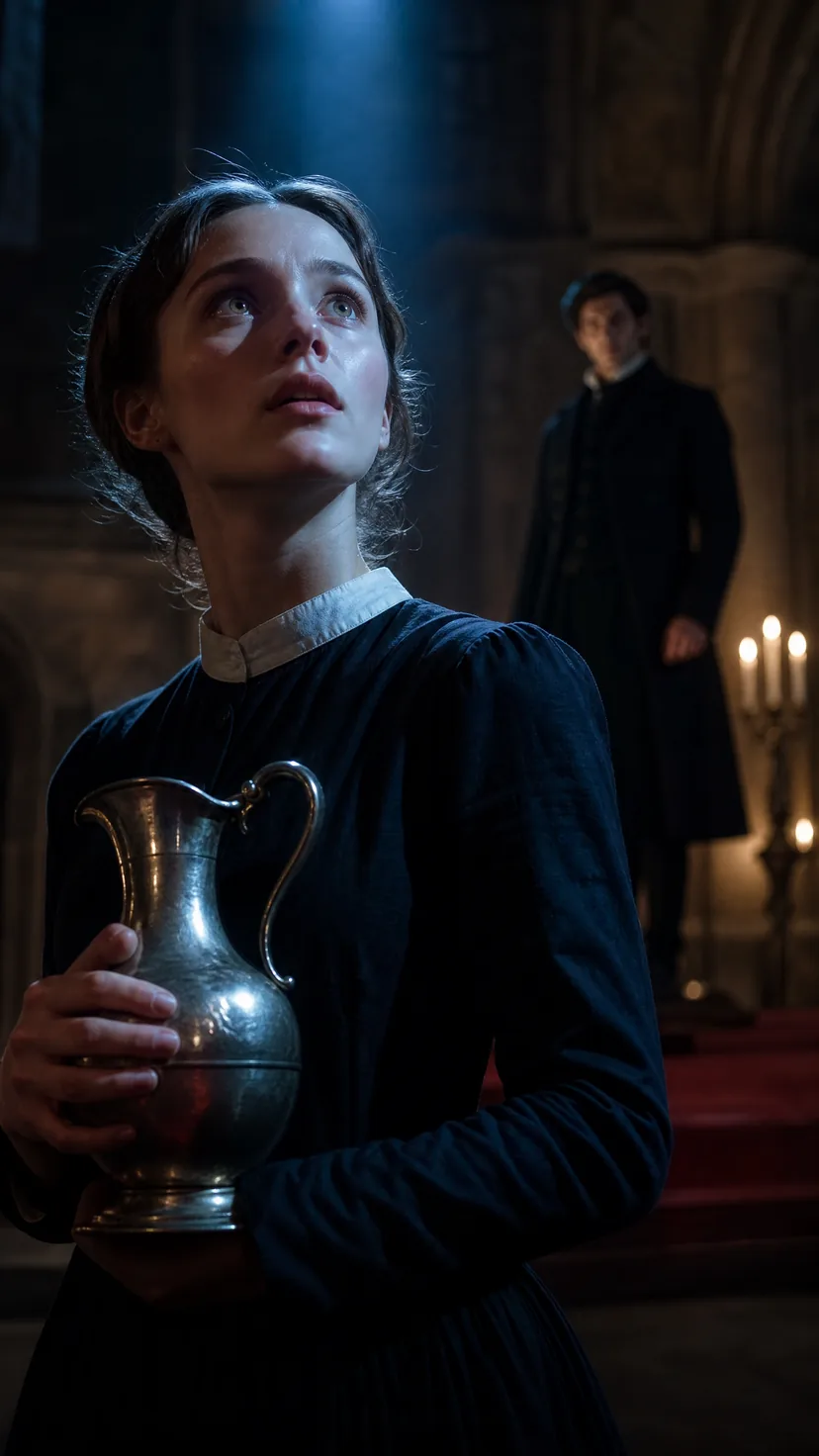
Six nights left, and the Alpha wanted her to end them with a signature.
Sorrel had not slept. The whole house had crept into her nose instead: Maud's porridge two floors down, a mouse in the pantry wall, and under it all the iodine on Lucan Greaves's hand, somewhere west of her. She had thrown the attic window open at midnight and was still burning.
Why would a man who lied to a hundred and forty wolves pay a servant to go away quietly?
The study was on the ground floor of the west wing, and nobody had opened it in thirteen months. Sorrel knew, because she had dusted the outside of the door every Friday.
Inside, old pipe and ink hung in the air. Edmund Greaves's chair still sat square to the desk, and on the blotter was a pale brown ring where a cup had stood.
Her cup. Her tray. Ten o'clock, every night, and a dollar left beside the saucer. In his last weeks he had grumbled, "Your tea puts my tongue to sleep, girl," and drunk it to the bottom anyway.
She put the memory down where she put everything, and looked at the living Greaves.
Lucan stood at the window with his back to the room. The napkin had been replaced by a proper bandage, and the bandage had a brown stain in the middle of it. Through the bond she got a thing like a stone sinking in a well, and understood it was the chair.
"Six nights," he said. "You will want to be gone before the seventh."
"I will be gone on the first, sir. I was always going to be gone on the first."
"There is a way." He turned and laid a single sheet on the desk, with a pen beside it. "Sign this before the council. A woman who renounces the moon can be released by vote. I will add money, so that you leave on the day you planned."
She did not touch the pen. "How much?"
"That depends on what you will ask."
So she asked. She named a figure that would buy a cottage, a cow and a lock for the door, enough that she would never again stand on anybody's step with her hat in her hands. It was an insulting sum. She said it flat, watching his face.
"Yes," said Lucan.
He had agreed before she finished the sentence. A man who agreed that fast was either very rich or very frightened, and the bond told her which.
"You didn't know my name until last night," she said.
"Maud told me." His jaw worked. "She said it twice. I thought I should have it right."
Sorrel looked at his hand, the stain spreading slowly through the white. "That should be sewn."
"It will heal."
"It's been a night. It's not healing."
He put the hand behind his back like a boy caught stealing, and said nothing, and she picked up the paper.
She read it standing, every line, moving her lips the way she had trained herself out of doing years ago.
Lucan watched her. "You can read."
"Your father left his newspapers on the tray. Somebody had to know what the Pack was saying about me." She did not look up. "I'm reading, sir."
The first lines were ordinary. By the fourth she was reading slowly, so as to be sure.
"'I, Sorrel Thornbury, confess before the Pack that I placed myself in the light of the Moon Eye knowingly, and by design, to deceive the Alpha and to take the place of the Luna.'" She laid the sheet down flat. "This says nothing about renouncing."
"It is a release."
"It says I did it on purpose. A woman who confesses a deceit gets the silver, and the vote only decides how fast." She turned the paper toward him. "Who drew it up?"
"My uncle gave it to me this morning." Lucan took the sheet and read it, properly, from the top, and she felt it begin in him: a cold that started under the breastbone and spread. No lie in it anywhere. "He said it was a form of words. He said you would only be giving up what you did not want."
"Hollis writes a good verdict," said Sorrel.
Lucan took hold of the paper with both hands, bandaged one and bare one, and tore it across. Then across again. The pieces landed on the blotter, over the ring from her cup, and neither of them looked at that.
"I did not know," he said. The formal voice had gone out of him. He sounded tired, and young, and as if he were saying it to someone else.
"I know," said Sorrel. She hated that she knew.
"The offer of money stands."
"Then I'll take it, for when you've sworn." She picked up the pen and put it in her apron pocket, because it was good ink and she had paid for worse. "I'm not signing anything Hollis wrote. Sir."
"No." Something happened at the corner of his mouth, and was dealt with. "I would not let you."
That was the whole alliance. Nobody said anything warm. She left him standing over the torn pieces and the empty chair, and she did not look back, which she had practised.
The back stairs smelled of everything. Damp plaster, boiled cabbage, a maid's lavender soap from a floor away, mice. She climbed them two at a time without deciding to, hot to the roots of her hair, a body she had never been allowed to use asking what else it could do.
Servants did not shift. She had not run in years. She was suddenly sure the whole house could hear her wanting to.
Six more days, she thought, and then I will be at a cottage door with my own key, and I will sleep for a week.
Her room was at the top, under the slope of the roof. The door stood a hand's width open.
She had shut it. She always shut it.
The bed was made. The window was as she had left it. The third board from the chimney had been lifted and laid neatly aside, the way a person lays a thing down who has all the time in the world.
She knelt. The ledger was gone, with its fourteen years of columns, and so was the note from the kitchen door, and so was the biscuit tin with every dollar she had ever saved.
Under the floorboard there was only dust, and a clean square where it had sat.