My father gave me away at my brother's grave, between the second shovel of dirt and the third.
"My daughter will marry Rafe Corvino," he said, loud enough for the back rows, "and there will be peace."
Then he looked across the open grave at the man everyone in Port Morrow said had put Nico in it, and nodded, as if the two of them had settled the price of a boat.
The gravedigger stopped with the third shovel halfway to the hole. Nobody told him to go on. Two hundred people in black stood among the headstones of St. Agnes, and every one of them turned to look at me.
I had the phone in my coat pocket. I always had it now. On it was a voicemail from Friday, October tenth, at 11:41 at night. Fourteen seconds. I had played it thirty-one times since the police came to the door.
Liv. Pick up. I'm fixing it tonight, all of it. Breakfast tomorrow, I'll explain. Save me the burnt toast.
I had not picked up. We'd had a fight the night before, about him leaving the city, and I had wanted him to call twice. He never got the chance to call twice.
"No," I said.
It came out small. I said it again, properly, so the back rows could have that too. "No."
My father didn't turn. He was sixty-one and heavy through the shoulders, and grief had put ten years on his face in six days. He'd wept at the Mass, and I had never once seen my father cry, not even for my mother. He had told the Table he never knew where Nico was going that night. If he had known, he said, he would have gone with him.
"Livia," he said. Never Liv. Only Nico called me Liv. "This isn't a conversation."
"It's my wedding. I think that makes it a conversation."
A cane tapped on stone. The Widow Bassi came forward from under the cemetery yew, seventy-eight years old and dressed like a closed door, and the crowd moved out of her way without being asked. She chaired the Table. Three families sat at it, and for forty years nobody in Port Morrow had gone to war without her saying so first.
"Miss Ferro." Her voice was thin and exact. "I'm sorry for your brother. I'm sorry for this too. But I will say the terms once, here, so that nobody can tell me later they didn't hear them."
She said them.
The Corvinos would pay two million dollars in blood price. I would marry Rafe Corvino in nine days, at St. Agnes, in front of the Table. Until the vows, I would live in his house as the pledge of my family's good faith. Every Sunday I would dine at my father's table, so that no one could say the Ferros had lost a daughter as well as a son.
"And if I refuse?"
"Then there is no treaty." She didn't blink. "And your father's men and the Corvinos' men will finish this the old way, and I will be burying boys at this cemetery until Christmas."
I looked at the crowd. Our cousins. The cooks from the restaurants. Tommy from the linen service, who was nineteen. Half of them had brought their children.
I looked at Rafe Corvino.
He stood at the foot of the grave in a black overcoat with no flower in the lapel, thirty-two years old and very still. Dark hair, a face cut too cleanly to trust, and gray eyes that had not left me since my father said my name. He had not looked away once. Not at the priest, not at his own cousin muttering beside him. Just at me, the way you watch a dog you've been told might bite.
The Don of the Corvinos had come to my brother's funeral. Under the Table's protection, he was allowed. It was the most obscene thing I had ever seen, and he did it in a good coat.
I walked around the grave to him. Nobody stopped me. Up close he smelled of rain and cedar, and there was a small nick on his jaw where he'd shaved too fast this morning, as if he had been nervous. I didn't believe that for a second.
"Did you kill him?" I said.
The crowd went silent enough that I heard the yew drip.
He took his time. "I was there when he died."
That was all. Not yes. Not no. I waited for more and he gave me nothing, and somehow that was worse than a lie.
Behind me my father cleared his throat. "Livia. Get your things. Aldo will bring the rest tonight."
"Tonight?"
"The pledge goes home with him today," the Widow Bassi said. "Those are the terms."
Uncle Aldo had given me a cardboard box that morning, before the Mass. He'd held it out with both hands like a cake, peppermints rattling in his coat pocket, and said, "Your brother's things, kid. From the police."
Nico's watch, stopped at 2:17 because he never remembered to wind it. His wallet. Eleven dollars and a receipt for two coffees. His folding knife, bone handle, N.F. scratched into the side with a nail when he was ten. He taught me to open it one-handed when I was ten, and to open a lock with a hairpin when I was twelve, and Papa never found out about either.
No phone. "The police kept it," Papa had said. "Evidence."
The box was in my father's car. I went to it while the crowd pretended not to watch, took the knife, and put it in my coat pocket beside my phone, beside fourteen seconds of my brother's voice.
Then I walked to the black car waiting at the cemetery gate, because there were children in the back rows and Tommy from the linen service was nineteen.
Rafe Corvino's driver opened the door. Rafe was already inside. I got in beside him, and the door shut on St. Agnes, and the car pulled out onto Harbor Road.
He didn't speak. He was looking out his window at the water.
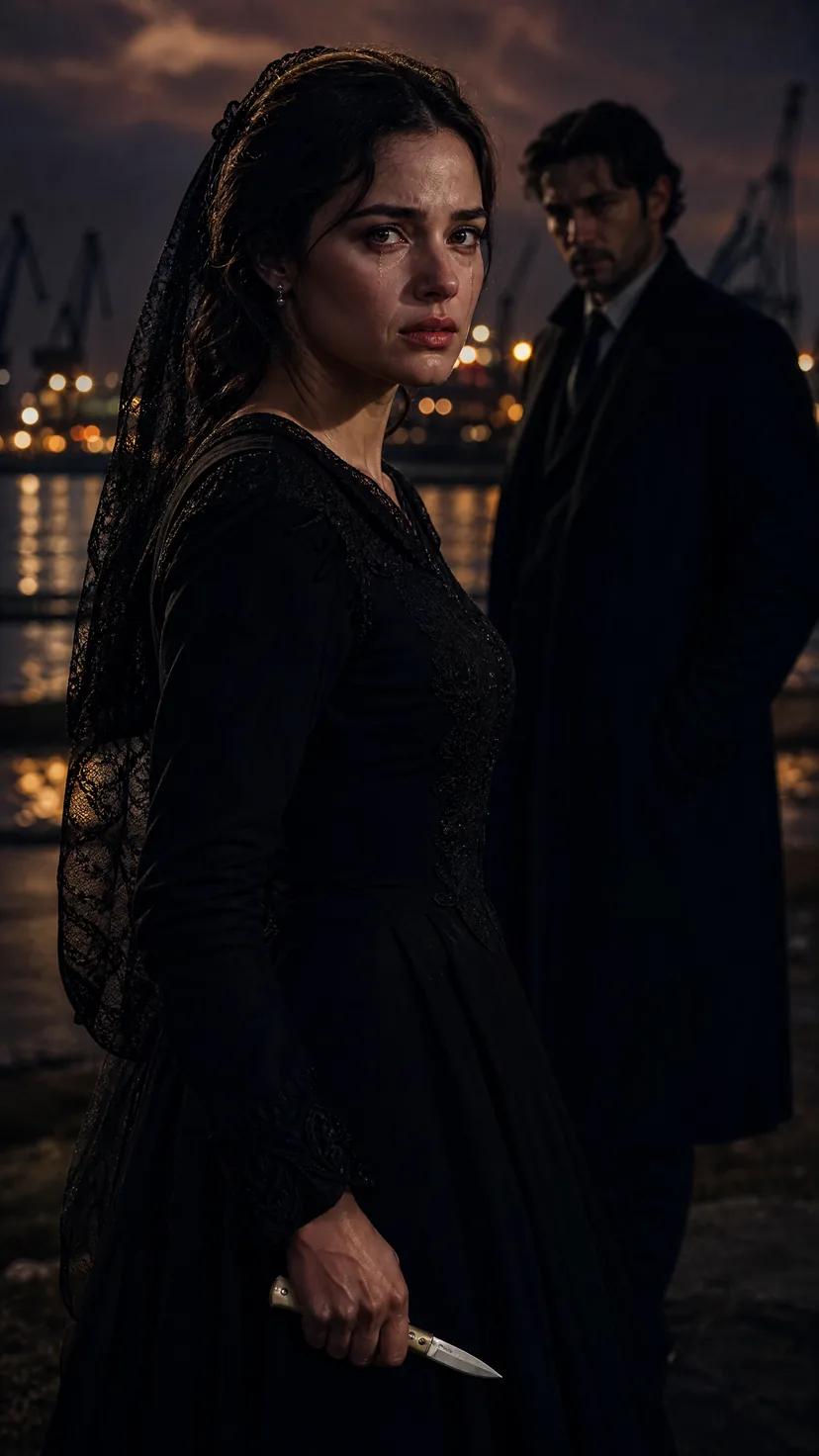
I opened the knife in my pocket with my thumb. Then I took it out and put the point against his ribs, just under the good coat, where a heart would be if he had one.
He didn't flinch. He didn't even turn his head.
"Your father called me this morning," Rafe said to the window. "He told me you'd bring a knife. He asked me not to hurt you when you used it."