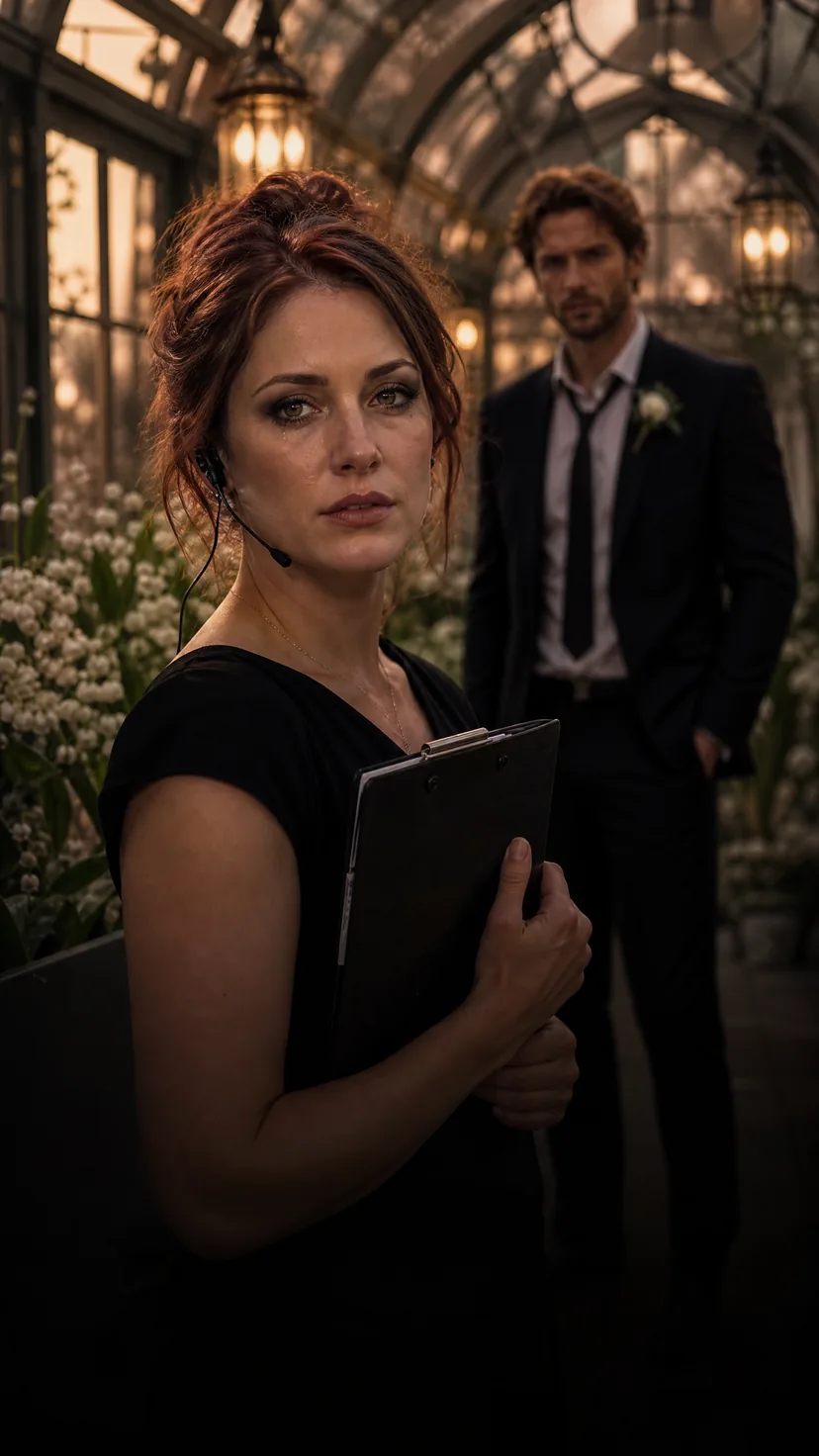
The gardener at the Glasshouse knows my name before I give it, and I have been standing in his doorway for four seconds. It is 8:52. I am here as a professional, with a clipboard, and a seventy-four-year-old man in muddy corduroys is looking at me as if I am a bill he has finally decided to pay.
"Miss Kinsella," says Abel Vandermeer.
"We haven't met." I say it pleasantly. I have a smile for this.
"No. You took the water to the cellist." He holds the door wide. "Forty minutes in. Nobody told you to. I thought, that girl is going to be all right."
I was not all right. I walk past him without a word, and the smell closes over my head: wet soil and warm iron, the whole glass roof sweating in the morning sun.
Rhys has texted. *Stuck at the yard, so sorry, you've got this Mae.* Yard, as in the shipyard where his father's firm keeps its boats. I read it once, put the phone in my pocket, and do not throw it into a planter.
Sloane arrives at nine in a cream coat and a cloud of fig. Dec comes ten steps behind her, carrying her folder, saying nothing.
"Lovely," she says to the glass. She says it again to the aisle, the lighting plan, the Plan B for rain, which I wrote on the train last night and which is currently the most reasonable thing in the building. She approves everything in the time it takes me to read it aloud. At 9:40 she checks a slim gold watch and says her father's people are waiting.
"Maeve will finish up with Declan," she says. "You two work so well together."
The heels go away down the gravel. The door sighs shut.
Dec is reading the venue contract, upside down on a trestle, like a man who hopes a clause will stand up and rescue him. I walk the other way.
Vandermeer finds me by the potting shed, at the back, where the glass gives way to brick. He doesn't say anything about my face. He just opens a narrow green door I hadn't noticed and shows me the lane behind it, and a gate, and a bus stop at the end.
"Service door," he says. "Nobody uses it. For leaving without being seen."
I look at the latch. It is very well oiled.
"I wish I'd shown it to you that day," he says. "I had it in my head and I didn't dare. You were in a wedding dress. I thought it was none of my business."
"It's a lovely door," I say, and my voice does something I have to ignore. He nods, as if that was an answer, and goes back to his ferns.
I go to the front instead.
The aisle is flagstone, with one slab near the top a shade darker than the rest. I know it. I put my heels on it in June and stayed there until they went numb. I take out my tape. I measure the runner. I count the chairs, because that is what hands do. A row at a time. Two hundred and twenty. Three years ago there were a hundred and forty, and the gaps between them looked like teeth missing.
The third row is the one I don't look at. Marisol sat there.
Fifty-two minutes. The pipes ticked in the heat. The cellist's bow shook on the same four bars. I stood on this slab and thought, very clearly, *the timeline says the processional is over.* I thought about the florist's invoice. I thought about anything else a person could think about. I did not move.
I stand on it now, and it is just a stone, and my whole body is shaking so hard the tape rattles. I put one thumb against my wrist where the ribbon sat. Nothing there. I count chairs again.
"Maeve."
Dec is in the aisle with the contract folded under one arm. He has seen all of it. He has the decency to look at the roof.
"The vestry," I say. "Where is it?"
"Left of the altar. You know where it is."
"Show me."
The door is oak, narrow, with an iron key in it as long as my hand. The room is the same: a bench, a high window, a smell of old hymn books. I go in. He comes in behind me, because he is a man who finishes a sentence when asked.
I turn the key, take it out, and put it down the front of my blouse.
Dec looks at the ceiling. "That is a legal fiction of a hiding place."
"It's a very good one. You won't touch it."
"Maeve. This is false imprisonment."
"You'll sue me. You're a family lawyer, you'll draft it beautifully." My voice is calm and horrible. "Nobody leaves this room until you tell me what happened on the morning of June tenth."
"I told you at twelve twenty-two. He wasn't coming."
"You told me *what*. I'm asking *when*. Because the only person who walked in here that day knew too much, too fast, and I sat on that floor and thanked you for it."
He is quiet for a long time. I wait. I am very good at waiting for men to come in the door.
"I am Rhys's friend," he says. "There are things that are not mine to say."
"Then say the ones that are."
"Sloane will be back for me."
"Sloane has gone to see her father's people and she won't think about you for a while. Mr. Vandermeer will not come in here, because he is seventy-four and tactful." I fold my arms over the clipboard. "You have been looking at me since the first day as if I'm a witness. Go on. Be one."
The high window throws a long square of light onto the floor. We both look at where it falls.
He puts the folded contract down on the bench. His hands are bare, and perfectly steady, and I hate that I notice.
"He called me," he says. "That morning. Ten past six."
"Ten past six." I do the sum before I can stop. Five hours and twenty minutes before the ceremony. "Why?"
"To ask me something."
"What?"
Dec looks at me then, straight, the way he looked at me once on this exact floor with my flowers in his hands.
"He asked me if he should marry you," he says. "I told him no."