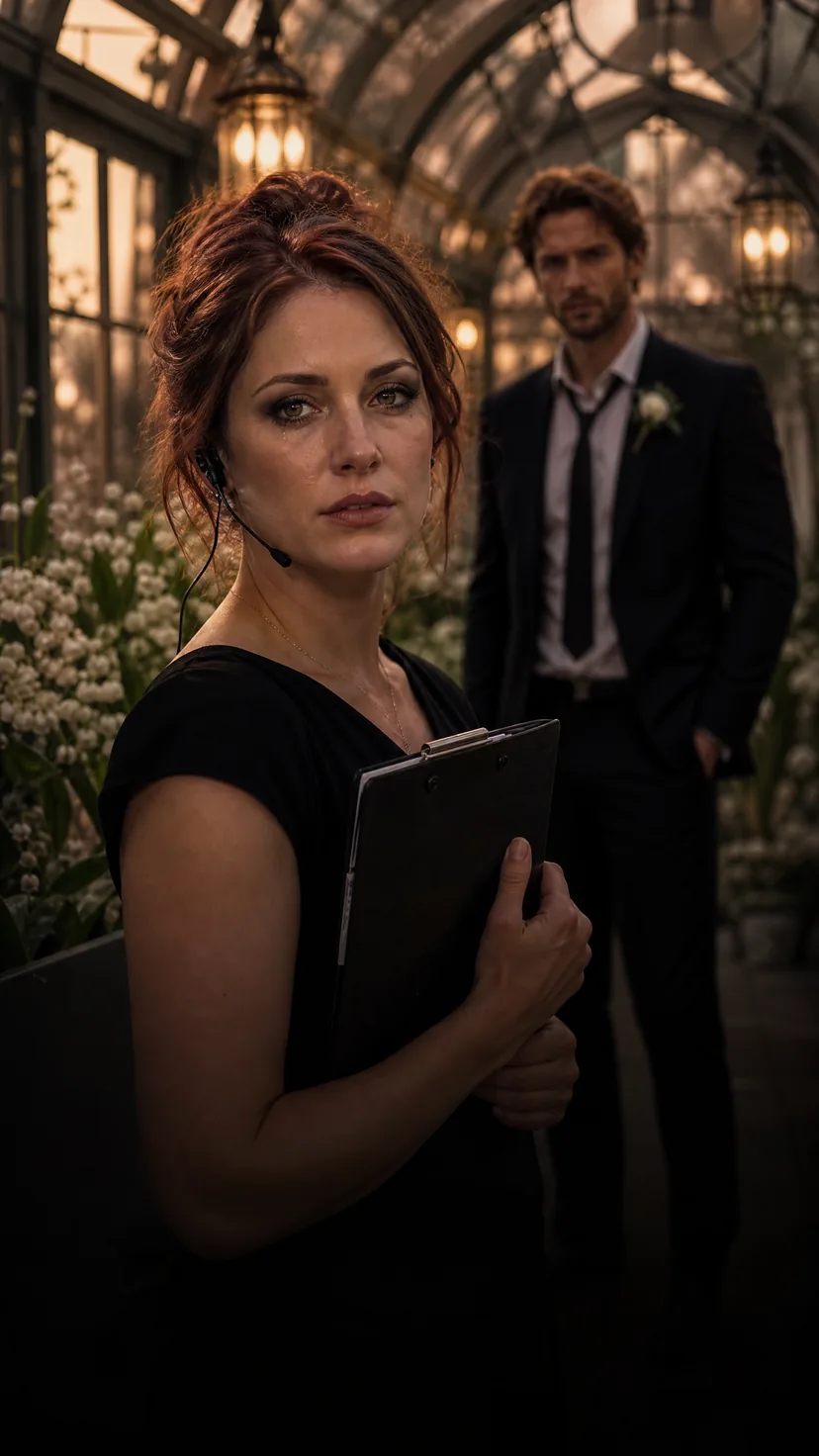
Sloane Whitlock lays a deposit check for thirty thousand dollars on my desk, face up, and asks whether I can give her a wedding in thirty-nine days. The bank wants twenty-four thousand nine hundred from me by five o'clock Friday, or it closes every account Kinsella Weddings has. So I don't look at the check. I look at her, and I ask the question I always ask first, the one she has somehow managed not to answer in twenty minutes.
"Who's the groom?"
"Running late." She smiles. It is a very good smile, expensive and brief. "His best man is driving. Men, you know. They think a wedding is something that happens to them."
I write *groom: TBC* on my pad and underline it twice.
The rest she has answered beautifully. Saturday, May sixteenth. Ceremony at four. Reception at Whitlock House, which her family owns, two hundred and twenty guests, black tie. Her last planner left in March. She wants the rush rate, sixty thousand, half on signing.
"Thursday," she says. "Two o'clock, at the hotel. My father's lawyer will bring the contract." She slides the check back into a slim leather folder and the folder into her bag. "You'll have it then."
Ravi leans into my doorway with two coffees and the face he uses for clients, which is the face of a very polite owl.
"Black with honey," he says, setting mine down. Then, to Sloane: "Yours is oat, no sugar, extra hot."
"Lovely," Sloane says, and doesn't touch it.
I check my grandmother's watch. 10:38. I can build a wedding for two hundred and twenty people in thirty-nine days; I've done it in thirty-one. What I can't do is lose this one.
"Let's get your groom's details down when he arrives," I say. "In the meantime, I'll need your vision."
"Oh, I brought it." She lifts a second folder onto the chair beside her, cream linen, thick as a dictionary. "I'm very decided."
Somebody takes the stairs two at a time. A man laughs on the landing, warm and easy, the kind of laugh that apologizes for being late before anyone has complained, and something low in my stomach recognizes it before the rest of me does.
The door opens.
"Sorry, sorry. Parking on Dockery is a crime scene." He is wiping rain off his sleeve, and then he looks up. "Hi, I'm..."
He stops.
Rhys Whitford has had a haircut since I last saw him. That is the first thing I notice, and I hate that I notice anything. He is wearing the navy coat I helped him choose, and looking at me the way you look at a step that isn't there.
"Mae," he says.
Nobody but Rhys ever cut my name down to one syllable.
On June tenth, almost three years ago, I stood at the front of the Glasshouse at Merriam Gardens in a dress with forty-one covered buttons. The ceremony was at half past eleven. I know exactly how long I stood there, because I am the kind of person who checks her watch even then. Fifty-two minutes. A hundred and forty guests. The quartet played the same four bars until the cellist's bow started to shake.
"You two know each other?" Sloane says.
She says it lightly. She already has her pen out.
Rhys's eyes come to mine and stay there. I know that look. I spent four years learning it. It means *please*, and it means *you'll handle it*, and it has always, always meant that I will.
Thirty thousand dollars in a leather folder. Twenty-four thousand nine hundred by Friday at five.
"We went to school together," I say.
"Same year," Rhys says, much too fast. "Small world."
"Tiny," says Sloane.
I stand and hold out my hand to him like a professional, and he takes it like a man taking hold of a wire. His palm is damp. Mine isn't. I'm proud of that, in a small, sick way.
"Congratulations," I say.
"Thanks. Yeah." He lets go. "This is Dec. My best man. He's the one who reads the small print."
He steps aside, and the man behind him in the doorway comes in out of the dark of the landing, shaking rain off a black umbrella, and I stop being proud of anything.
I know his hands before I let myself know his face. Long fingers. A plain steel watch. The last time I saw them they were taking a bouquet of lily of the valley out of mine, very gently, because my hands had started to shake and wouldn't stop. That was in the vestry of the Glasshouse at twelve twenty-two. He had closed the door behind him. He had said four words, low and level, like a doctor.
*He isn't coming, Maeve.*
Then he had held my flowers while I sat down on the floor in forty-one buttons.
"Ms. Kinsella," Declan Drury says now.
Just that. He doesn't play along with the school story. He doesn't contradict it either. He looks at me for exactly one second too long, then looks at Rhys, and I can't read what's in it.
"Mr. Drury."
"Wonderful," says Sloane, who is watching all three of us and smiling at none of us. "Then you'll work beautifully together."
She signs the letter of intent in green ink. I sign under her. Rhys signs as the groom, and his signature has not changed at all, the big looped O, the S that trails off as if he lost interest halfway. I watch him write it on a line I drew, and I keep my face completely still.
They leave at 10:57. Rhys doesn't look back. Dec does, once, from the landing, and then the door swings shut and Ravi lets out a long, low whistle.
"School," he says.
"Don't."
"What school? You went to a convent."
"Ravi."
"Okay. Okay." He picks up Sloane's untouched oat milk. "She forgot her vision."
The cream linen folder is still on the chair.
I should run down and catch her at the car. Instead I open it, because I want to see what kind of wedding the woman marrying Rhys Whitford has dreamed about.
Page one is the bouquet.
Lily of the valley, small and tight, the stems bound in pale blue silk ribbon. The ribbon has a date stitched along it in white thread, 6.10.23, and beside the date, two tiny letters, an M and an O, the M slightly crooked where the needle slipped.
I stitched that ribbon. At my kitchen table, three nights before my wedding, with a darning needle and my glasses on.
There is only one of it in the world. It's in a shoebox at the bottom of my wardrobe. Nobody has seen it since that morning.