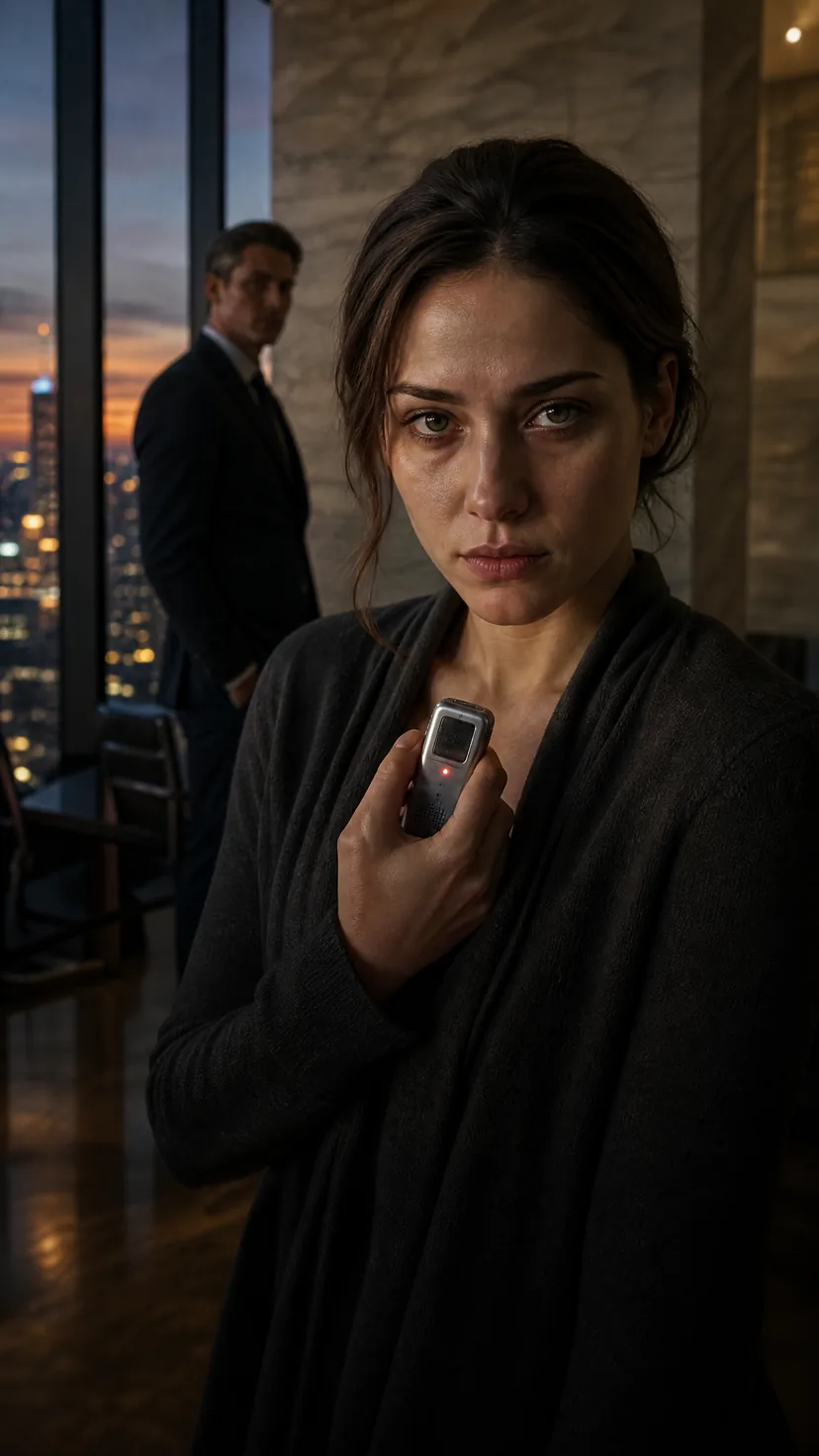
The banking app said $212. Rent was $1,640, two days late, and the man on my doorstep was holding two coffees and an offer.
"Send me the number," Gideon said. "It's paid by noon. No folder. No paragraph nine."
"No."
"Carrie."
"Tuesday at nine a.m. a board decides if I'm still a court reporter. You pay my rent today and Draycott calls it a bribe by lunch." I took the coffee anyway. I am not a saint. It was the good kind, with a lid that fit, and I drank half of it standing in my own doorway.
My word against a Thorne's was a coin toss with a loaded coin. But for two months in 2020 I had written everything down, every night, in steno nobody else could read. That included the afternoon of August 28th and Celia Thorne in the Pier Club back office.
The pads were in a box in my old closet at 9 Tern Lane, Penhallow Point, two hours north. I had not been back since July 2021.
"I'll drive," he said.
"You'll give me a ride. That's all."
Mrs. Okonkwo took Bea at the kitchen table, her walker parked beside the toast, tennis balls on its feet. "Go, girl. A woman with a walker and a pot of soup is an army." Bea said, "Fact, we're making pancakes," and did not look up. I kissed her hair anyway, over the white streak, and she let me. That cost me more than the rent.
Forty minutes out I called Penhallow Point Savings. Celia had said ask your bank, and I could not stop hearing it.
Saturday hours. A teller who sounded like she was filing her nails. I asked what accounts I held under my name, the one question they answer by phone.
"One closed account," she said. "Joint holder with a Jeanette Kerr, opened when you were sixteen. Closed in 2021."
"I never knew about it."
"Records are in person only. ID. Monday to Friday."
My mother had opened a hundred accounts and closed them all, chasing whichever bank gave away a toaster. I hung up and filed it where I file things I cannot use today.
At a diner off the highway the booth stuck to my sleeves and the coffee tasted of the pot. Gideon turned his cup a full circle.
"September nineteenth, 2020," he said. "I flew back from Singapore. Thirty-six hours on the ground. I went to 9 Tern Lane."
I stopped chewing.
"Your mother answered. She said you'd taken the money and gone to Ohio with a man."
"What money?"
"She shut the door."
On September nineteenth I was across town in a clinic gown, twenty-one and alone, staring at a gray screen.
"My mother records every phone call she makes and hates everyone," I said. "She'd have said anything to anyone."
"Probably." He looked at his hands. "I stood on that step for ten minutes anyway."
He had crossed an ocean and stood at my door, and I had spent five years believing he never looked back. Nobody told me. I put money on the table and went out to the car so he would not see my face.
The salon is open until four on Saturdays, and my mother was at it. The key was under the ceramic frog, cold as a stone in my palm.
The house smelled of perm solution and old carpet. Nothing had moved. The same calendar from the same salon hung by the phone, and the same mug sat in the drying rack. I went past the kitchen once, then came back.
On the fridge, held by a magnet shaped like a lemon, hung a crayon invitation in purple. BEA IS 5. PARTY. YOU CAN COME. Beside it was a photograph of Bea at four months, bald and furious in a yellow hat.
So that was the faraway one, and my mother had kept it where she could see it. It hurt, and it almost softened me, and I left both of them exactly where they were.
The box was in the closet under my winter coat. I took the August and September pads, locked the door, and put the key back under the frog.
In the parked car I slid the rubber band off August and found the twenty-eighth. Gideon turned off the engine.
"Read it," he said.
I translated as I went, the way I would for a judge. "Friday, August twenty-eighth. Pier Club office. C.T. offered fifty thousand dollars. Her words, exactly." My voice did not wobble, and I hated that it didn't. "'If there is ever a child, Miss Kerr, it will be raised by people who can afford it, and it will never know your name.'"
There was one more line. I read it too. "Tore it. She picked up both halves."
Gideon went very still. A car pulled out of the lot behind us.
"The check I showed you," he said. "Dated September first."
"A second one. She kept the halves of the first." I turned the page toward him. "Why does a woman keep the pieces of something she wanted me to cash?"
His hand lay on the gearshift, six inches from mine on the pad. Neither of us moved either one.
"Noted," he said, and it came out wrong, the one word he always uses to end a conversation, now asked to hold one up, scraped and small, like a man reading a verdict about himself.
Bea was asleep by seven-thirty, one hand curled around her notebook. I sat on the kitchen floor with the August pad open in my lap.
Celia's cream card was in my coat pocket, where it had been since Wednesday. Navy ink, ten digits, no name. I propped it against the silver mouse's drawer.
I photographed the page. I typed one line and read it three times, because I read everything three times.
Withdraw the complaint by Monday, or your board hears this word for word.
I pressed send before I could be sensible. The phone buzzed in my hand in under a minute.
*Tomorrow. Four o'clock. Harrow Hill. Bring the original.*