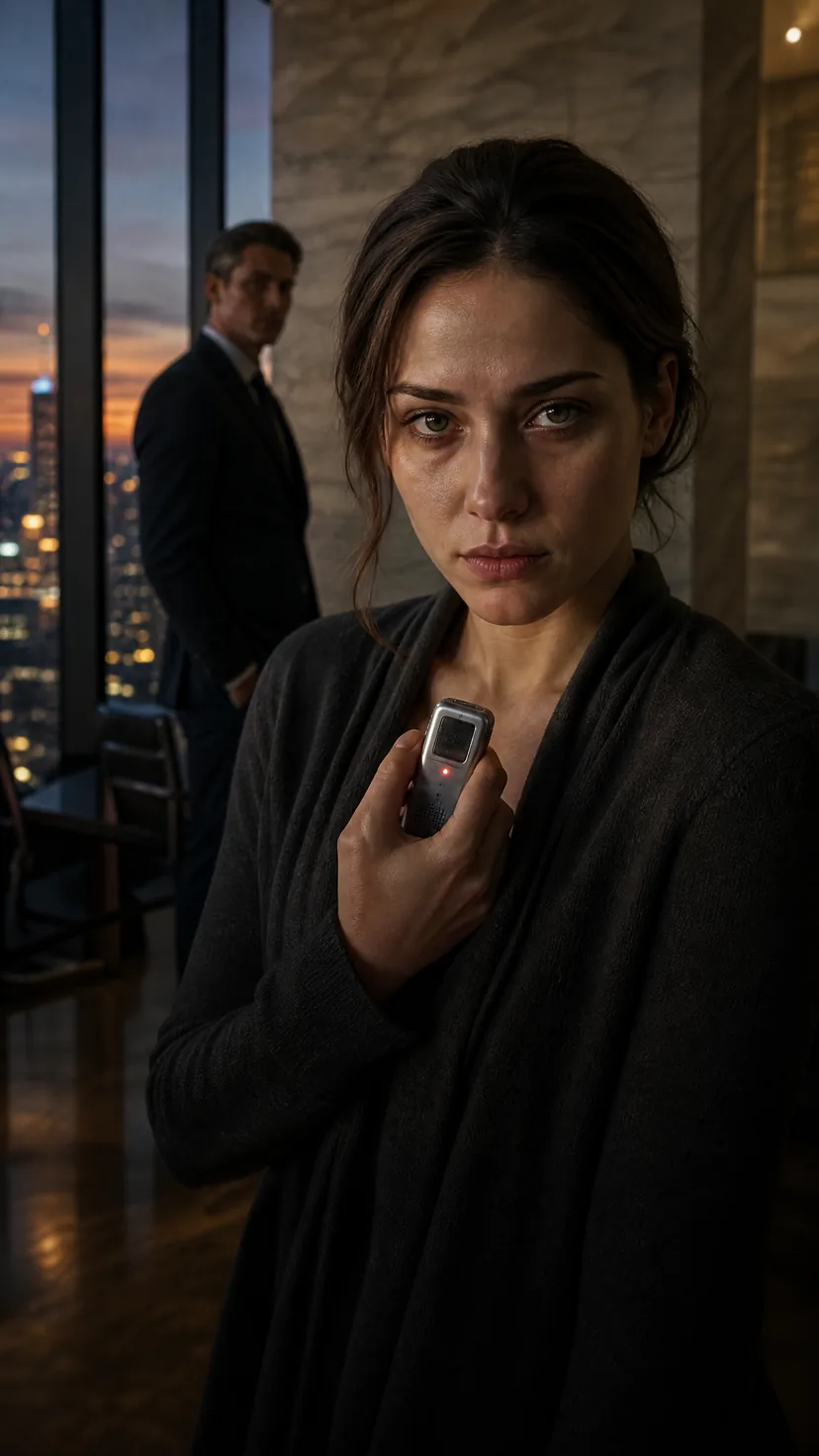
Dell called at 7:30 to say a client had asked for me by name, and he sounded so happy that I should have heard the trap.
"Nineteen-fifty a page, kid. Triple. A private session at ten, one hour." He was breathing like a man who had run to the phone. "That's your rent, Carrie."
Rent was $1,640, due today, and I was short. Dell knew it. I knew it. I asked who the client was and he said "confidential, downtown," in the voice he uses when he is frightened of someone.
I dropped Bea at Larkin Street at 8:15. She wore her white streak pinned back with a yellow clip and carried the notebook under her arm, closed. The aftercare director watched me sign her in for the full day and said nothing.
The text with the address came as I reached the bus stop. I read it twice, then a third time, as if the numbers might rearrange. Thorne Harbor Tower. Fortieth floor.
I rode the bus anyway. The receptionist walked me to the Harbor Room and shut the door behind me. The long table was bare. No lawyers, no water glasses, no plaintiffs. Just Gideon at the far end in his shirtsleeves, with a folder in front of him and the city flat and gray behind his head.
I turned around. My hand was on the knob.
"I pay you for the hour," he said. "Whether you stay or not. Please. Ten minutes of it."
I did not let go of the knob. "Say the thing you brought me here to say."
"I said I have no daughter. On camera, last night." He didn't look away. "A daughter on the news is a target, Carrie. Photographers, strangers, men with long lenses. By seven this morning I had Larkin Street lock her records. Nobody gets her file without a court order. And I called the owner of that site myself."
"Called him and said what?"
"A number." His mouth moved, not quite a smile. "The photo comes down by noon."
It did. I checked at 11:58, on my phone, and the page said NOT FOUND. But that was later. In the room I only stood there, with the knob cold in my palm.
I let go of it. I sat down two chairs away. "Then let's talk about what your lawyer offered me Tuesday."
"Draycott delivered the money. You sent it back."
"I tore it in half. And I read the NDA." I didn't need the paper. I have never needed the paper. "Paragraph nine. 'Recipient shall not, at any time or in any forum, state, imply, or permit to be inferred that Gideon Thorne is the parent of any child.'"
He had been looking at me. He stopped.
It was a very small stop. His eyes went to the folder and came back, and two fingers tapped the table once and quit. I have watched thousands of faces take bad news in a deposition. I know the difference between a man who is performing surprise and a man who is learning something.
"That isn't what I authorized," he said.
"It's what I was handed."
He took out his phone and put it on the table between us, on speaker. Draycott picked up on the second ring, cheerful, a keyboard clicking behind him.
"Gid. I'm in a thing, can it..."
"Paragraph nine."
The keyboard stopped. Then Draycott, easy as milk: "That was your mother's instruction. Gid, I assumed you knew."
Gideon didn't say a word. He ended the call with one thumb and set the phone face down, very gently, the way you lay down something that might go off.
He did not tell me what that was to him. I did not ask.
He slid the folder across. It was thick and heavy and very expensive.
"My lawyers drafted it overnight." He sounded tired and a little proud. "Schedules. A trust. Education, medical, a residence on Harrow Hill with her own..."
I turned pages. A trust. Custody exchanges. Section 4(c): The Parties acknowledge that the Child's public presentation shall be coordinated through the Office of the Chair.
I read it aloud, flatly, the way I read back testimony. Then I closed the folder.
"She isn't a merger."
"That isn't what..."
"It has a section for her haircut." I pushed it back. "She is four. She names her crayons after people who were nice to her."
He took the folder and set it down on top of his own hands, as though they'd been caught at something. "Then I ask for one thing. A test. Properly done, by a clinic, so that no one, not Montclair, not a board member, not me at three in the morning, can ever say otherwise."
I had been braced for that since the elevator. "Fine. Friday afternoon. A clinic I choose. And you do not call yourself her father to her. Not the word. Not until the results come back."
"Noted," he said, and this time he said it like a vow.
At the door the receptionist offered a check for $19.50 a page, an hour's worth. I gave it back. I took the standard appearance fee, $195, for sitting in a chair. Nothing for the transcript. I typed nothing, so he owned nothing.
Rent was still short, and the bus did not care.
Mrs. Okonkwo was home by evening, on a walker, scolding the whole stairwell from behind the door of 2B. "Girl, I can hear you thinking. Go feed that child."
Bea ate every pea in a line and went to bed at 7:30. I turned the lamp low.
"Mommy. Can I have two stamps?" She patted the notebook on her pillow. "For the faraway one. It's a secret invitation."
She opened the cover just enough to show me a corner of the old Christmas card, the one addressed For Beatrix, and the edge of a photograph tucked inside it. I was so tired the room had started to tilt. I assumed a classmate. I assumed a pretend friend.
I found two stamps in the kitchen drawer, beside the dead silver recorder, and gave them to her without looking closely at anything.
"Thank you." She pulled the blanket up to her chin. "Mommy? Fact. I already know he's my daddy."
My hand stopped on the lamp.
"The lady with silver hair told me," Bea said, mostly asleep. "She said I'll have a room in a tower."