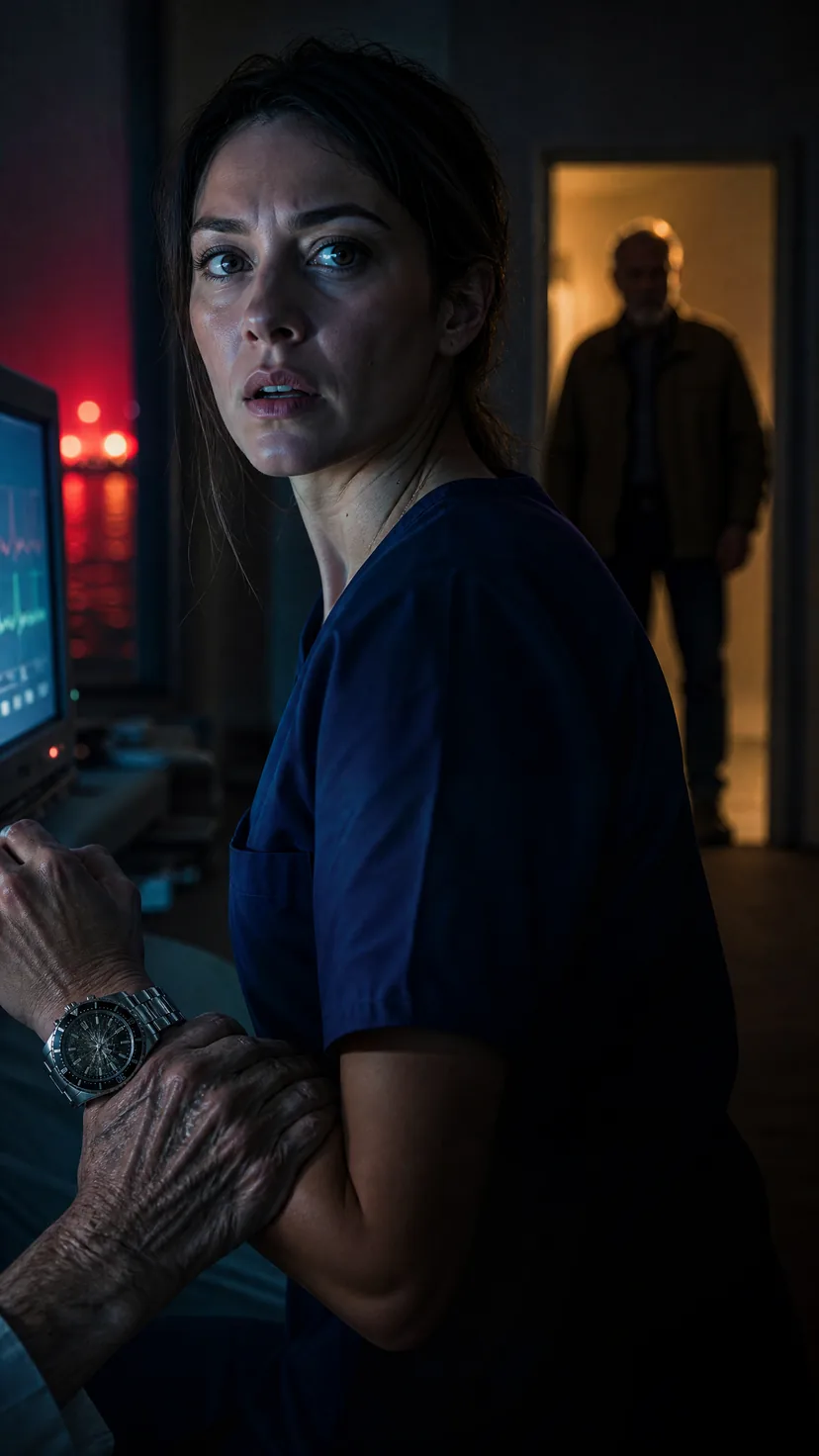
At ten to three, Javi Ortega got up out of the visitor's chair in bed twelve and said, "You have ten minutes, Vance. Then I call security."
He had been sitting in the dark, waiting for her. Her badge was dead, and the one nurse on 3 West who still said her name at normal volume was looking at her like a man watching someone lean on a railing.
"Four hours," he said. "At seven he's on a gurney to Riverbend. Whatever you think he's got, it's now or never."
"I know when the van comes."
If he meant it, why was the phone still in his pocket?
He shut the door and went to stand against the wall by the sink, where the hall camera couldn't find him. Arms still crossed. Watching.
Tess took out her phone. She thumbed the recorder on and held it flat against the blanket.
"Wednesday, October fourteenth. Two fifty-two a.m. Bed twelve, 3 West. Patient is Elias Kerrigan."
"That's a different kind of trouble," Javi said.
"I'm already in the kind I'm in."
"I know. I read your file." He rubbed his jaw. "Rhonda's on break till three-fifteen. That's the only reason you have ten minutes and not two."
Elias lay propped on two pillows with his mouth slightly open. The oximeter read ninety-one, and the whole room smelled of cherry swabs and warm plastic. His eyes were half there, the pale wet look of a man surfacing in a pool and not yet sure which way was up. She put her hand over his. His skin was dry and cold as paper, so she held on until it warmed.
"Mr. Kerrigan. It's Tess. Tess Vance."
"Tailwater's high."
"Yes, sir. Here." She tipped the cup to his lip and let him have three swallows, counted them, took it away. "Do you know where you are?"
"My gates."
"Close enough."
She wasn't going to lead him. Haverford's terms were plain: lucid, unprompted, on tape. So she slid the printout from her bag and held it under the lamp, young Curtis Lyle in a new badge, May of 1979, smiling at the camera like he owned the county.
"Do you know this man?"
Elias looked. He looked a long time. His lips worked the way they did when he was reading something off the inside of his own head.
"Curtis came after," he said. "Curtis brought the money."
Tess didn't move.
After. Not during. After.
The whole week had been built on that face, the phone call and the proxy and the doubled dose, and it came apart in her fingers like wet paper. She lowered the page. Her thumb found the edge of the watch on her wrist, the cracked crystal.
Then she thought of the arrest card in her glove box, the one Curtis Lyle had pressed into her hand at his door. July 3, 1979. Kerrigan, Elias R. Assault. Victim: L. Mahaffey.
"Mr. Kerrigan." Her voice came out very even. "July third. You had a fight with Lonnie Mahaffey. Tell me about it."
His breath caught and rattled.
"He shorted my fee." A pause. "I shoved him. I was drunk." His hand plucked the blanket. "He bought me a beer after. Sat on the wall. Said he was sorry first."
That was all. Something small and sad, and she could not tell if it was a confession.
"Is the flag up?" Elias said. "Somebody check the flag."
"Mr. Kerrigan, stay with me."
"Is the flag up?"
The oximeter chirped and dropped. Eighty-nine. Eighty-eight. She reached up and nudged the cannula back under his nose, and the number held there, thin and stubborn.
"Vance." Javi hadn't moved from the wall. "Ten minutes was ten minutes ago."
"Give me one more."
"One more what? Minute? Breath?" His voice cracked on it. "I have a license too, Vance. I like it."
"You're hurting him."
"I know."
She did know. She had a patient breathing at eighty-eight percent and a recording that proved nothing, and she was nearly out of room. So she did the only thing left. She took the photograph out of her scrub jacket and unwrapped it. It had nothing to do with the tape. He needed something to hold that wasn't a blanket.
"This is my grandfather," she said. "This is Lonnie."
Elias turned his head.
Lonnie squinted into the sun with the steel watch on his wrist, a paper cup in his hand, alive. Tess held the picture low and close. The old man put out one finger and touched the glass over Lonnie's face, very gently, the way you'd touch a sleeping baby.
His face folded.
"I held the lantern," Elias said. Tears ran into the creases beside his mouth. "I never went in. I swear to God, I never went in."
Nobody breathed. On the phone, the little red recording dot kept pulsing.
Then his finger moved.
It slid off Lonnie and across the picture, past Marian laughing, and stopped on the young man at the edge of the frame. Broad shoulders. Sun in his eyes. A six-year-old girl in a sparkler dress sitting on his shoulders with both fists tangled in his hair.
"That's Ray," Tess said, too fast. "That's Grandpa Ray. He was on the barge all night. Everybody saw him."
"He took the little boat," Elias said, "when the reds went up."
Javi had gone completely still against the wall.
Tess had the rest of it in her body before it reached her head. A paper bag at the nurses' station. The cellophane crackle. Sundays, always Sundays, and a man who never let a silence sit, saying kiddo, saying let me make some calls.
"Mr. Kerrigan," she whispered. "Who sits in the chair?"
His finger tapped the young man's face. Once. Twice.
"That's the one," Elias said. "He comes on Sundays. Brings me peppermints. He asks what I remember."
The oximeter chirped. His eyes stayed on the picture, on the little girl's bare ankles, held fast in the young man's two big hands.
"Same hands," Elias said. "That's how he held Lonnie down."